Aksa vs Duolingo: Streak Gamification vs Verified Proof for Your Goals
Duolingo perfected the streak for language learning. Aksa applies verified proof and social accountability to any goal. Here is how the two approaches compare.
Published October 24, 2026 · 7 min read
The direct answer
Choose Duolingo if your goal is learning a language, chess, math, or music through short daily lessons. Choose Aksa if your goal is anything else in your life, fitness, reading, building, waking early, and you want verified proof and other people holding the line with you.
The two apps are not really competitors; they are two different answers to the question of daily consistency. Duolingo gamifies a curriculum. Aksa, a social platform with an AI agent, verifies your actions and wraps them in social accountability. This comparison explains where each philosophy wins.
What Duolingo built, by its own numbers
Duolingo's streak counts consecutive days of completing a lesson, and the company has published unusually honest data about it. In a November 19, 2020 post on the Duolingo blog, engineer Anton Yu shared that learners who reach a 7-day streak are 2.4 times more likely to return the next day than learners without one, and that separating the streak from the daily goal, so one lesson extends it, raised day-14 retention by 3.3 percent.
In a January 31, 2022 post, Duolingo's Osman Mansur reported more than 6 million people on streaks of 7 days or longer, and that a new streak-celebration animation alone lifted the likelihood a new learner was still active a week later by 1.7 percent. Few companies in the world have tuned a single mechanic this carefully.
Duolingo also confronted the demotivation of a broken streak with the Streak Freeze, which pauses a streak for a day, with up to two equippable at once. Per the same 2022 post, expanding freezes increased the relative number of daily active learners by 0.38 percent, small-sounding numbers that translate to millions of people at Duolingo's scale.
Where the Duolingo model reaches its limits
The first limit is scope. A Duolingo streak proves you completed a Duolingo lesson. It says nothing about your workout, your writing, your sleep, or any other goal you hold. If your life has five goals, one of them can be on Duolingo; the other four need something else.
The second limit is evidence. Lesson completion is self-contained software state: the app trusts that you tapped through the lesson. That is appropriate for learning vocabulary, but it cannot verify that you ran three kilometers, cooked dinner, or finished a page of your thesis.
The third limit is the freeze trade-off. Streak Freezes keep people returning, by Duolingo's own data, but a pausable streak is a softer contract. For goals where the daily repetition itself is the point, some people want a number that only moves when they truly moved.
None of this makes Duolingo's design wrong. For vocabulary acquisition, trusted completion is friction-free and effective. The mismatch only appears when the goal leaves the app: no amount of streak tuning can verify a gym session, a finished chapter draft, or a sober evening, because those events happen in the world rather than on a screen.
How Aksa answers the same problem differently
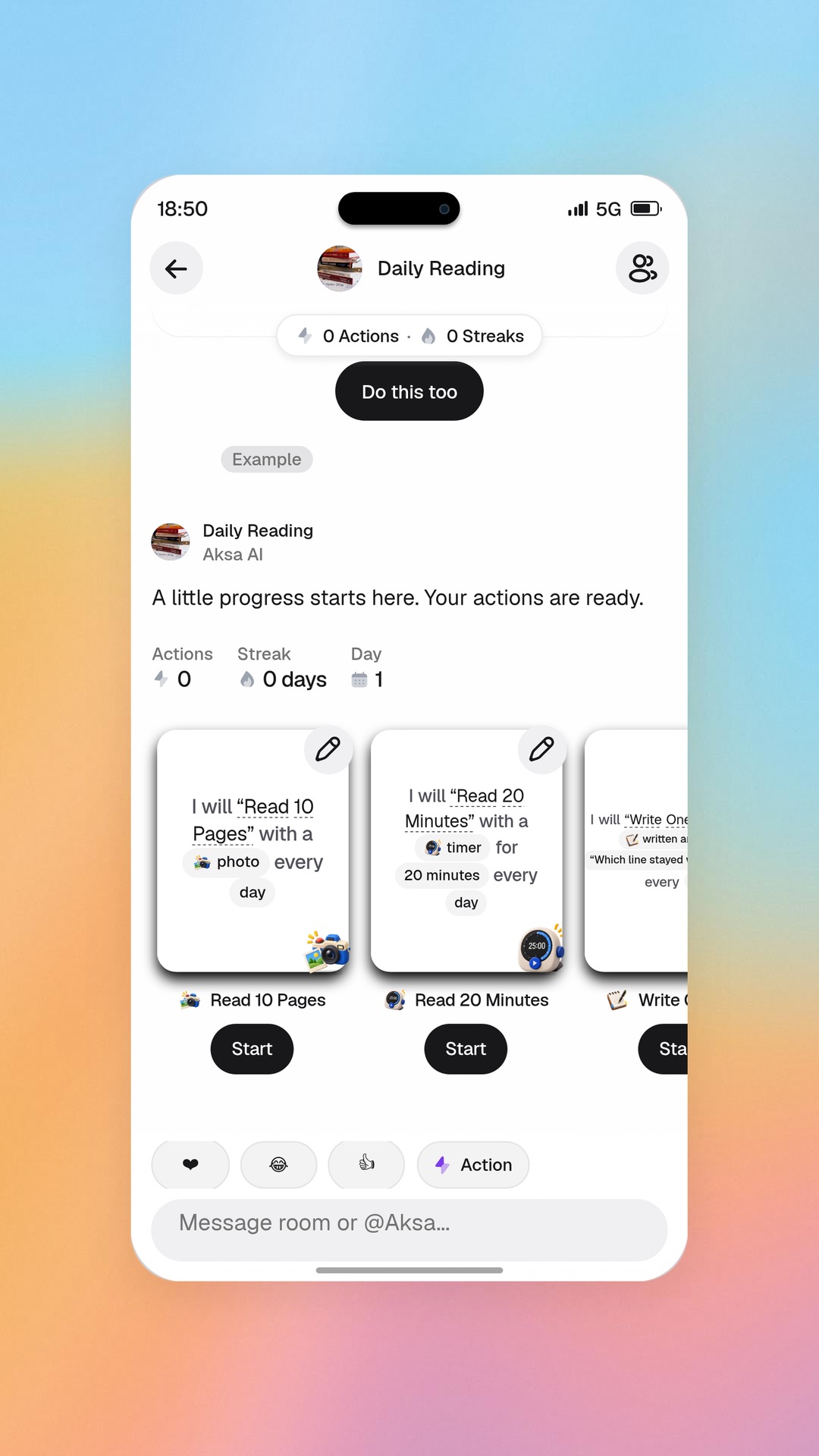
Aksa's streak moves only on verified proof. Every daily Action runs on one of six primitives: Submit for photo or video evidence, Answer for written reflections, Counter for repetitions, Timer for focus sessions, Check-in for presence, and Confirm for binary commitments. The core rule is explicit: progress counts only verified proof, never an unverified tap.
Because the primitives are generic, any goal fits. A run becomes a photo Submit. Deep work becomes a Timer session. A reading habit becomes a Counter for pages. Duolingo had to build a curriculum for every subject; Aksa only had to build evidence types, which is why it covers goals no curriculum ever will.
The social layer is the bigger difference. Duolingo's accountability is between you and the app. Aksa's Action Rooms put one to fifty people around your goal, posting daily proof in the same space, with an AI agent that plans the daily action list, answers goal questions, and posts updates so the room never goes quiet.
There is also an asymmetry in what a streak can stand for. A Duolingo streak certifies engagement with Duolingo's content, and Duolingo itself defines what a lesson is. An Aksa streak certifies your definition of done: you chose the action, you chose the primitive, and the evidence is yours, stored as a browsable record on your profile. One model trusts the curriculum; the other trusts the witness and the proof.
Head to head on the mechanics
Side by side, the design philosophies look like this:
Neither column is a criticism. They are optimized for different jobs, which is why the honest answer for many people is both apps at once.
- Goal scope - Duolingo: language, chess, math, and music courses. Aksa: any goal you can define as a daily action.
- Proof standard - Duolingo: lesson completion recorded by the app. Aksa: six verified proof primitives including photo evidence and focus timers.
- Streak flexibility - Duolingo: Streak Freezes can pause a streak, up to two equipped at once. Aksa: the streak moves only on verified proof, with no pause mechanic.
- Accountability - Duolingo: between you and the app, plus optional friend quests. Aksa: Action Rooms where members post daily proof and react to each other.
- Progress surfaces - Duolingo: streak count and course progress. Aksa: streak, consistency heatmap, momentum chart, and a 3-month Photo Calendar of proof.
- Competition - Duolingo: weekly leagues by XP. Aksa: Individual, School, and City leaderboards with a Weekly Arena resetting Monday 00:00 UTC.
What Aksa borrows from Duolingo's playbook
Credit where it is due: Duolingo proved, with published experiments, that shrinking the daily unit grows retention. Aksa applies the same lesson by letting you set the smallest meaningful daily action as your floor, so the chain survives bad days instead of demanding heroic sessions.
Duolingo also proved that celebration matters. Aksa's equivalent is the claim card: when your action verifies, a celebratory post renders in the room with your streak pill, and cheers from roommates arrive as push notifications. Recognition is the reward loop.
And like Duolingo's leagues, Aksa's Weekly Arena resets every Monday at 00:00 UTC across Individual, School, and City leaderboards, so each week is a fresh contest and last week's miss never permanently buries you.
Which one for which person
If you want to learn Spanish before a trip, open Duolingo. It is a genuinely excellent curriculum with two decades of tuning, free to start, and its streak will keep your lessons daily.
If you want to train for a 10K, finish a thesis, read 20 books this year, or build a morning routine, open Aksa. Its proof primitives verify real-world actions, its rooms supply the people who notice your silence, and in a company database pull from late September 2026, 36% of proofs received a social response.
If you want both, run both. A common pattern in Aksa rooms is a daily Action defined as "complete today's language lesson," verified with a quick Answer reflection or photo, so the Duolingo streak and the Aksa streak reinforce the same habit from two sides.
The bottom line
Duolingo gamified learning better than anyone, and its published streak research is a gift to the whole field of behavior design. If your goal lives inside its course catalog, you will not find better.
Aksa takes the next step for everything outside a curriculum: verified proof instead of trusted taps, rooms instead of solo streaks, and a record of evidence you can scroll back through.
The question is not which app is better. It is whether your goal needs a lesson plan or a witness.
FAQ
Is Aksa a language learning app like Duolingo?
No. Aksa is a social platform with an AI agent for staying consistent at any goal, not a curriculum. Many members use it alongside Duolingo: they define a daily Action like completing a language lesson, verify it with a photo or reflection, and let the room hold them accountable to showing up daily.
Does Duolingo verify that you actually studied?
Duolingo records lesson completion inside its own app, which is reasonable for coursework. It cannot verify anything outside its lessons. Aksa is built for the outside case: six proof primitives, including photo Submit, Timer, and Counter, create evidence for real-world actions like runs, focus sessions, and reading.
What is a Streak Freeze and does Aksa have one?
Duolingo's Streak Freeze pauses your streak for a day, with up to two equippable at once, and Duolingo's January 2022 blog post credits the feature with lifting daily active learners. Aksa takes a stricter line: streaks move only on verified proof, with no pause mechanic, so the number always means what it says.
Which app is better for fitness or non-learning goals?
Aksa, clearly, because Duolingo has no mechanism for goals outside its courses. A run, a workout, or a morning routine becomes a daily Action in Aksa with photo or timer proof, visible to an Action Room, and counted on Individual, School, or City leaderboards that reset weekly.
Can I use both apps together?
Yes, and it works well. Keep your Duolingo streak for the curriculum, and add an Aksa daily Action for the same language goal so the habit is witnessed by your room. Many people run Duolingo for the lessons and Aksa for the accountability across all their goals at once.
How big is Aksa compared to Duolingo?
There is no comparison in scale: Duolingo reported over 6 million users on 7+ day streaks back in January 2022. Aksa is an early-stage platform, past 900 registered members in its first month per a company database count in late September 2026, which means smaller rooms, tighter accountability, and a product where early members visibly shape the community.