Aksa vs Todoist: Task Manager or Proof of Action? (2026)
Aksa vs Todoist compared honestly: Todoist is the world's most popular to-do list for organizing work and life; Aksa is a social platform with an AI agent where daily actions produce proof friends can see.
Published October 23, 2026 · 7 min read
The short answer
Todoist is the world's most popular task manager - '50+ million professionals' and '347K+ five-star reviews' by its own count (todoist.com, read 23 October 2026) - built to capture and organize everything you intend to do. Aksa is a social platform with an AI agent built to prove what you actually did, with friends watching.
They are different tools answering different questions. Todoist answers 'what should I do next?' Aksa answers 'did I actually do it - and who saw?' Many people need both: Todoist for the project inbox, Aksa for the daily commitment that cannot be allowed to slip.
The failure mode that separates them: a Todoist task can be rescheduled forever, silently. An Aksa action ends each day as proof or gap, on a heatmap your room can see.
This comparison keeps both products honest: dated sources for every claim, genuine strengths named on both sides, and a clean routing rule at the end for using both without overlap.
Key facts, side by side
Sources: todoist.com and todoist.com/pricing read 23 October 2026; Aksa product spec v1.1.0 read the same day.
- Purpose - Todoist: capture and organize tasks for work and life. Aksa: turn goals into proof-backed daily actions.
- Unit - Todoist: the task row - rescheduleable, deferrable. Aksa: the action - persistent workflow ending in proof.
- Completion - Todoist: check the box. Aksa: submit evidence in one of six formats.
- Social - Todoist: shared projects for teams. Aksa: rooms, feed, reactions, weekly leaderboard.
- AI - Todoist: Task Assist features. Aksa: an Aksa AI that plans actions and nudges on stalls.
- Price - Todoist: free Beginner (5 projects), Pro and Business tiers. Aksa: free download, optional Premium.
How Todoist works (from todoist.com, 23 Oct 2026)
Todoist's homepage pitch is clarity: natural-language capture ('every Friday at 4pm' just works), views for Today and Upcoming, custom filters, and a calm interface refined 'over a decade.' It calls itself the world's #1 to-do list app, citing 50+ million professionals.
The free Beginner plan includes 5 personal projects, smart quick add, reminders, list and board layouts, 3 filter views and one week of activity history. Pro raises that to 300 projects, calendar layout, task duration, deadlines and full reporting history; a Business tier covers teams (todoist.com/pricing, read 23 October 2026).
Todoist's center of gravity is the inbox of intentions: everything you might do, captured fast, sorted sanely. For managing the chaos of a workday, it is the category's benchmark.
Where Todoist is genuinely strong
Capture speed and ubiquity. Todoist is on every platform with excellent natural-language parsing - it is genuinely the fastest way to get a task out of your head and into a system.
Scale and polish. Fifty million users bought a decade of refinement: filters, labels, boards, calendar layouts, integrations with everything. For pure task logistics, nothing in this comparison comes close.
Team coordination. Shared projects, assignments and comments make Todoist a real work tool - Aksa does not try to be a project manager, and if you need one, Todoist is the safe default.
Where Aksa is genuinely strong
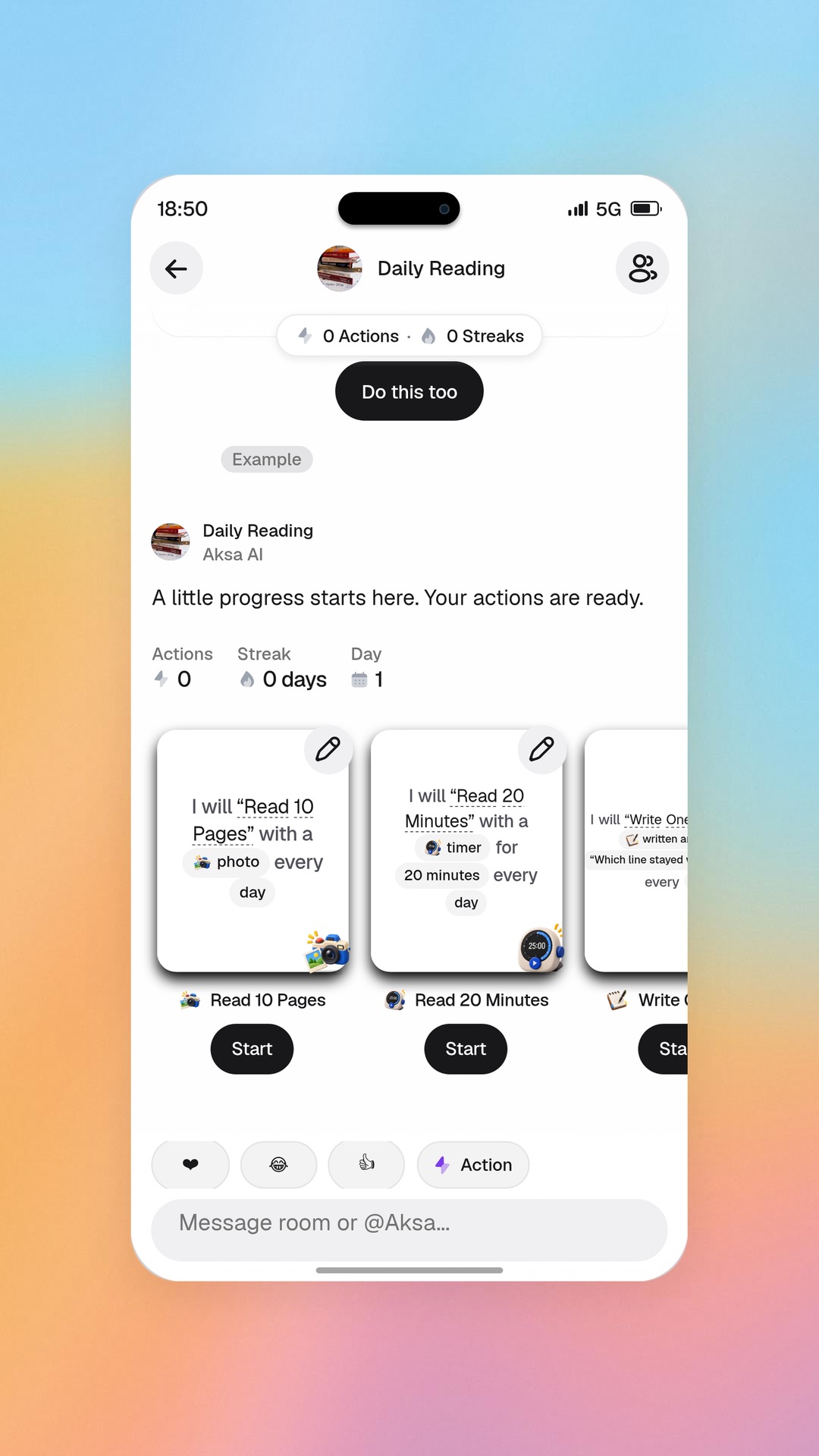
Completion means something. A Todoist checkbox records a tap; an Aksa action ends in proof - a photo, a written answer, a counter, a timer session, a check-in or a confirmation - with honest strength labels. 'Done' is a conclusion from evidence, not a gesture.
Witnesses. Todoist is private by default (shared projects aside); Aksa puts your daily proofs in a room where friends react. Accountability you cannot quietly reschedule is the product.
Goal structure and momentum. Aksa's agent decomposes a goal into daily actions and nudges with one concrete step when you stall; streaks count only proof-backed days; the weekly leaderboard resets Mondays 00:00 UTC. Todoist manages intentions; Aksa manages follow-through.
The philosophical difference
Todoist treats the core problem as organization: you have too many things to do, and clarity will save you. It is right - for work logistics, clarity is the bottleneck.
Aksa treats the core problem as follow-through: you already know what matters, and the gap between intention and execution is where goals die. Clarity does not fix that gap; evidence and witnesses do.
The practical test: open your task manager. If the problem is chaos - hundreds of unsorted tasks - you need Todoist. If the problem is the same three important tasks, carried forward day after day for a month, you need Aksa.
What the numbers say about each approach
Todoist's scale is vendor-reported but staggering: 50+ million professionals and 347K+ five-star reviews (todoist.com, 23 October 2026). That is proof the organization problem is real and that Todoist solves it for a huge crowd.
Aksa's numbers are smaller and pointed at a different problem: the platform passed 900 registered members in its first month, per a company database count in late September 2026, a company database count on October 1, 2026 recorded 375 proof posts from 40 contributors, and in a company database pull from late September 2026, 36% of proofs received a social response. The ratio that matters - proofs per poster - is what a follow-through platform exists to maximize.
Read both honestly: Todoist's numbers prove people need help organizing intentions. Aksa's numbers test whether proof plus witnesses changes execution. You probably have both problems; now you know which tool answers which.
A worked example: the carried-forward task
The task: 'work on thesis.' In Todoist it gets captured perfectly, tagged, scheduled for today. At 6 PM it is not done, so it moves to tomorrow - one tap, zero friction. It moves again the next day. And the next. Todoist faithfully organizes the avoidance.
In Aksa the same intention becomes an action: 'one 45-minute timer session, proof: timer plus two-sentence answer.' It cannot be carried forward - by tonight it is either a proof in the room feed or a visible gap on the heatmap your writing group checks.
A month later the Todoist task is still beautifully organized, still upcoming. The Aksa action has 22 proofs and a chapter. Both apps worked exactly as designed; the designs aim at different outcomes.
Can you use both? Yes - here is the clean split
Todoist for the many: errands, emails, project tasks, anything one-off or logistical. Its capture and sorting are unmatched, and most of life's tasks genuinely need no proof.
Aksa for the few: the one to three goals whose daily repetition decides your year - the training, the writing, the study. Those get proof, witnesses and a streak, because those are the ones that die quietly.
The mistake to avoid: tracking everything with proof (exhausting) or nothing with proof (thesis never happens). Route by stakes - logistics to the task manager, identity to the proof platform.
Choose Todoist if / choose Aksa if
- Choose Todoist if your problem is organizing many tasks across work and life.
- Choose Todoist if you need team project coordination.
- Choose Todoist if natural-language capture and filters are your daily drivers.
- Choose Aksa if your problem is doing the same important thing daily.
- Choose Aksa if you want proof and witnesses, not checkboxes.
- Choose Aksa if you want an AI agent planning your next step when you stall.
FAQ
What is the difference between Aksa and Todoist?
Todoist is a task manager: it captures and organizes everything you intend to do (50+ million users, vendor-reported). Aksa is a social platform with an AI agent: it turns one to three goals into daily actions that end in proof - photo, answer, counter, timer, check-in or confirm - visible to friends in rooms. Organization vs follow-through.
Can Todoist be used for habits?
You can create recurring tasks, but a recurring checkbox is still a checkbox - it records a tap, can be rescheduled silently, and nobody sees the miss. For habits that matter, that is exactly the failure mode. Aksa's actions end each day as proof or visible gap, with streaks that count only proof-backed days. If you want one Todoist-friendly rule: anything you would be embarrassed to reschedule ten times belongs on a proof platform instead.
Is Todoist free?
Todoist has a free Beginner plan (5 personal projects, 3 filter views, 1 week of activity history) plus Pro and Business paid tiers (todoist.com/pricing, read 23 October 2026). Aksa is free to download with an optional Premium tier.
Does Todoist have an AI?
Todoist lists Task Assist among its Pro features (todoist.com/pricing, 23 Oct 2026). Aksa AI is built for a different job: decomposing goals into provable daily actions, planning next steps, and nudging with one concrete step when you stall - measured by proofs submitted, not tasks organized.
Which is better for accountability, Aksa or Todoist?
Aksa - accountability is its core, with witnesses (rooms, feed, heatmap, weekly leaderboard) and proof as the completion standard. Todoist is private task logistics; its shared projects coordinate work but nobody is watching your daily follow-through. Different tools, honestly different purposes.
Should I replace Todoist with Aksa?
Probably not - replace the right layer. Keep Todoist for errands, projects and one-off tasks. Move your one to three identity-level goals - the ones whose daily repetition decides your year - into Aksa where they get proof and witnesses. Route by stakes.
Does Aksa have projects, labels and filters like Todoist?
No - Aksa deliberately is not a task manager. Its unit is the action: a persistent workflow with outcome, owner, state, blockers, history and proof, ending in Verified Done only when evidence meets the rule. If you need inbox logistics, Todoist is the right tool.