Cold Shower Challenge: 30 Days of Cold Water, Proof Every Morning
A 30-day cold shower challenge with a gradual protocol, honest health claims, daily proof, and a room doing it with you. Rules, benefits and limits, setup, and FAQs.
Published October 27, 2026 · 7 min read
The short answer
A 30-day cold shower challenge works with a gradual protocol: finish your normal warm shower with 15-30 seconds of cold in week one, build to 60-90 seconds by week four, and prove every single day with a dated submission. The cold does the adaptation; the proof and the room do the consistency.
Below: what the evidence actually supports (and what it does not), the week-by-week protocol, safety notes, and the exact setup in Aksa.
Why people stick with cold water - and what to actually expect
Cold exposure has a loud internet mythology, so start with what is solid. The most-cited controlled finding is a 2016 Dutch study published in PLOS ONE (Buijze and colleagues, roughly 3,000 participants): people who ended showers with 30-90 seconds of cold reported about 29 percent fewer sick days from work over the following months - notably, they did not get sick less often, they powered through or experienced illness less severely. Alertness and a reliable morning jolt are the effects everyone agrees on, because they are immediate and obvious.
What the evidence does not yet support are the grand claims: miracle immunity, fat loss transformations, cured depression. The honest reason to do this challenge is simpler and strong enough: it is a daily, voluntary, small discomfort - a controlled dose of hard - and doing one hard thing at 7 AM changes what the rest of the day feels allowed to ask of you.
That framing matters for consistency too. In a 2009 study by Lally and colleagues in the European Journal of Social Psychology, habits reached a median of 66 days to automate - and the 30-day frame gets you halfway there with the smallest daily hard thing that exists.
The week-by-week protocol
Week 1: end your normal warm shower with 15-30 seconds of cold. The goal is not toughness - it is showing up daily. Breathe slowly and deliberately; the gasp reflex settles within seconds if you let it.
Week 2: 30-45 seconds of cold, and start turning the dial cold a little earlier in the shower. The dread before the shower is now worse than the water - noticing that is part of the training.
Week 3: 60 seconds. Most people report the mental shift arriving here: the cold becomes a known quantity, and the morning starts to feel owned rather than survived.
Week 4: 60-90 seconds, or fully cold showers if you want the badge. The number matters less than the unbroken record - thirty mornings, thirty proofs, zero negotiations.
One safety note that is not optional: cold exposure is not for everyone. People with heart conditions, uncontrolled hypertension, or pregnancy should talk to a doctor first, and anyone who feels chest pain, dizziness, or numbness beyond brief tingling should stop. The challenge is a stressor, and stressors are dose-dependent medicine.
Proof that survives the excuse
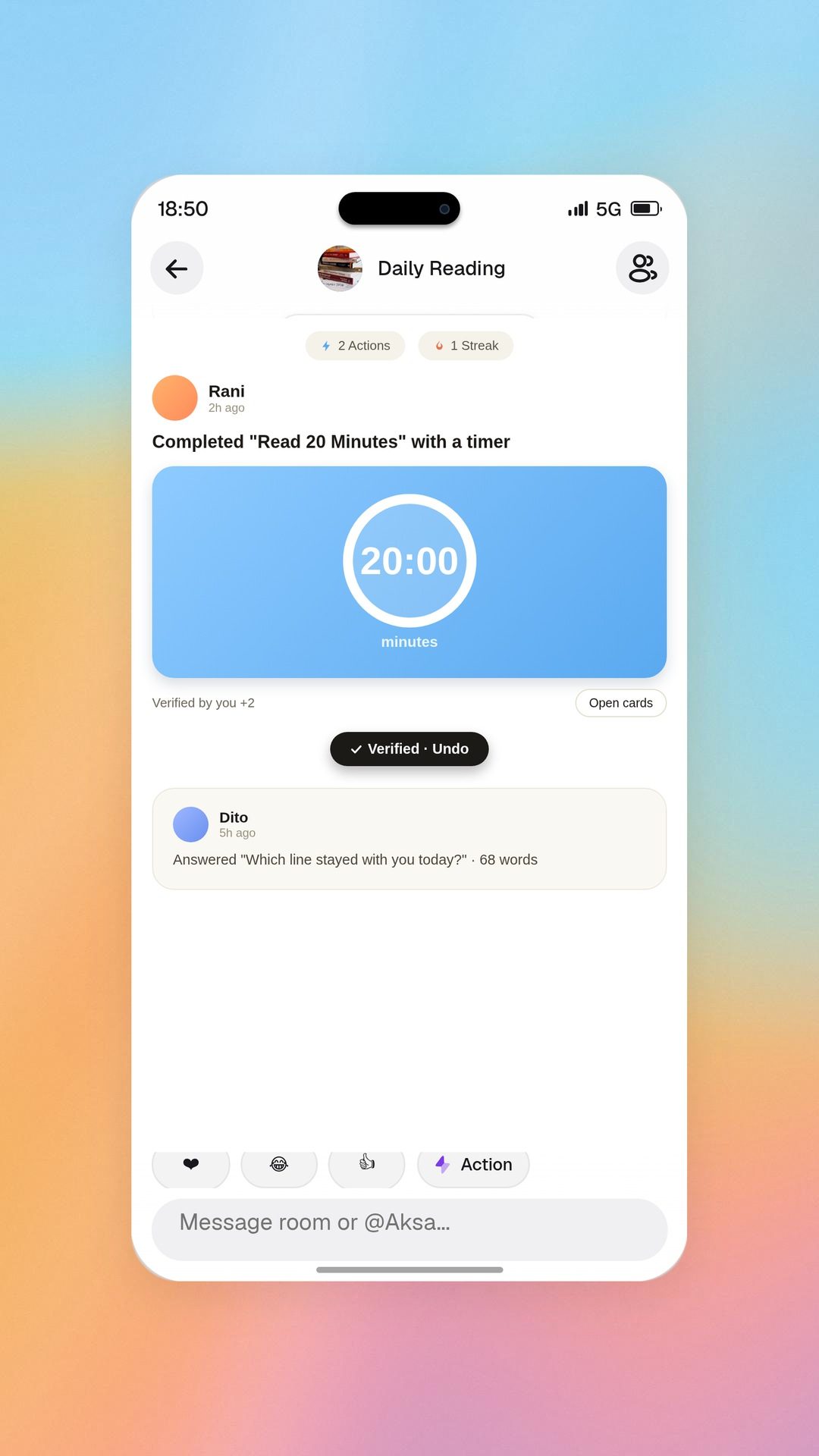
Cold showers have a unique accountability problem: the entire act happens alone in a bathroom at dawn, which makes it the easiest promise in the world to quietly break. Aksa is a social platform with an AI agent - the day's proof can be a Check-in submitted in the post-shower window, a Photo of the dripping shower handle, or a Timer record of the cold interval, and streak counts move only on verified proof days.
The reminder does the heavy lifting at the decision point: a Reminder repeats Every Day with an Alarm switch, so the commitment rings before the excuse wakes up. The Aksa AI Action agent helps decompose the challenge into provable daily actions at setup and answers questions when you stall - it never marks a day done, because Verified Done requires durable proof.
Thirty days of proofs build the actual prize: a visible record that you do hard things daily. That record lives on the profile - streak counts, a momentum chart, and a 3-month Photo Calendar - as evidence of who you are becoming, not just what you survived.
Set up the challenge in Aksa
Ten minutes tonight, and tomorrow morning is day one.
- 1. Create the Goal: '30 days of cold shower finishes' with the week-by-week protocol attached.
- 2. Add a daily Action with your proof - a check-in in the post-shower window, a timer for the cold interval, or a photo.
- 3. Set the Reminder for your shower time, Repeat Every Day, Alarm switch on - the alarm beats the excuse to the punch.
- 4. Write tonight's commitment where tomorrow's towel is: 15 seconds, that is the whole ask for day one.
- 5. Create an Action Room and invite the brave - each friend who joins through your invite and finishes onboarding earns one month of Premium for both of you, up to five friends.
- 6. Review the room heatmap every Sunday - the Weekly Arena resets every Monday, so a broken week ends and a new one begins.
The room makes the cold warmer
Everything about this challenge is easier in a group, and not for motivational-poster reasons. The pre-shower dread is universal, and a room where three other people post their proof each morning converts private dread into shared ritual - you are not enduring the cold alone at 6:47 AM, you are all doing it, separately, together.
Keep the room's tone playful. Each Action post lands as one compact row in room chat with reactions, so a morning of proofs reads as a quick drumbeat rather than a feed of essays. The first person to post usually drags the rest of the room through the water - be that person when you can.
After day 30
Most finishers keep the cold finish in some form - not from discipline heroics but because the morning jolt becomes something you miss. The common permanent form is the 30-second finish: all of the alertness, minimal drama, no challenge framing required.
The deeper residue is the calibrated relationship with discomfort. Thirty days of voluntary cold teaches a specific lesson that transfers: the anticipation is worse than the thing, and you can do hard things on schedule without feeling ready first. That lesson, once proven daily for a month, tends to walk into the rest of your life uninvited - which is the whole point.
The breathing is the technique
If one skill decides whether this challenge is miserable or manageable, it is breathing. The cold shock triggers an involuntary gasp and rapid shallow breaths; slow, deliberate exhales - longer out than in - tell the nervous system the situation is chosen, not an emergency. Most people find the water tolerable within ten seconds once the breath is led instead of chased.
Practice the breath on dry land first: thirty seconds of slow breathing before the shower, then carry the same rhythm into the water. The people who 'cannot handle cold' are almost always people whose breathing sprinted; the water was the same temperature for everyone.
FAQ
What are the real benefits of cold showers?
The solid ones: immediate alertness and a reliable morning jolt, and a 2016 PLOS ONE study by Buijze and colleagues (about 3,000 participants) found 30-90 seconds of cold at the end of showers was associated with 29 percent fewer reported sick days from work - though not fewer illnesses. Claims about immunity transformation or major fat loss are not established.
How cold does the water need to be?
Uncomfortably cold but tolerable - for most homes, the coldest tap setting works, and 15-30 seconds at that temperature is the day-one target. The adaptation is in the regular exposure, not the extreme: a daily 60 seconds of cold beats a monthly 3-minute heroic ice bath for building the habit.
Is a cold shower challenge safe?
For healthy adults ending a warm shower with short cold exposure, generally yes. People with heart conditions, uncontrolled hypertension, or pregnancy should check with a doctor first, and anyone feeling chest pain, dizziness, or persistent numbness should stop. The challenge is a stressor - dose it like one.
Should the whole shower be cold or just the finish?
The finish is enough, and it is the version people actually sustain: take your normal warm shower, then turn the dial cold for the final 15-90 seconds depending on your week. Fully cold showers are a week-four option for those who want the badge, not a requirement.
How do I stop dreading the cold part?
You mostly do not - you get faster at walking into it. Two things help: slow deliberate breathing from the first second (the gasp reflex settles quickly), and the streak - a visible count of consecutive days makes 'just today, skip it' expensive. The dread itself becomes familiar company by week three.
What is the best time of day for a cold shower?
Morning, for two reasons: the alertness effect is most useful at the start of the day, and a fixed morning slot makes the daily proof easy to anchor. Evening cold exposure can interfere with winding down for some people, so mornings are the default - but any fixed daily time beats the 'perfect' time you keep missing.
Do I need to build up to cold showers or start fully cold?
Build up: end a warm shower with 15-30 seconds of cold in week one and add time weekly. The gradual protocol is what makes the challenge survivable past day four - and the daily record, not the water temperature, is what the challenge is actually measuring.