Discipline vs Motivation: Why Systems Beat Feelings Every Time
Motivation starts goals and abandons them. Discipline is not a feeling but a structure: small verified actions, witnesses, and proof. Here is the honest comparison.
Published October 24, 2026 · 7 min read
The direct answer
Discipline beats motivation because motivation is a feeling that arrives and leaves on its own schedule, while discipline is a structure that works on days you feel nothing. Build the structure: a small daily action, verified proof, visible progress, and witnesses.
The popular framing of discipline as a personality trait is wrong and discouraging. Disciplined people are running systems. This guide breaks down the difference and builds the system inside Aksa, a social platform with an AI agent.
Motivation is weather
Motivation is real and useful, but it has two fatal properties: it spikes after inspiration and fades within days, and it is strongest precisely when the work is easiest, at the beginning. The moment the goal needs it most, week two, bad weather, busy season, motivation is gone.
This is not a personal failing. Research on habit formation, the 2009 Lally study at University College London published in the European Journal of Social Psychology, found behaviors take an average of 66 days to automate, with a range of 18 to 254 days. No motivational spike lasts 66 days. Something else must carry the middle.
Motivation also lies about the future. At peak motivation you design the plan: daily hour-long workouts, fifty pages, dawn starts. Then ordinary life inherits the plan. Motivation writes checks that discipline is expected to cash.
There is a subtler cost to motivation-dependence: it makes every goal emotional. When action requires feeling, every skipped day becomes evidence about your character rather than your calendar. Structures return the emotion to where it belongs: you feel proud about the record, not responsible for generating the will.
Discipline is a structure, not a mood
Watch a reliably consistent person for a week and you will find machinery, not heroism: the same trigger hour, a floor version of the action for bad days, a record they check, and people who would notice a skip. Their discipline is mostly architecture built once and maintained cheaply.
The architecture has four load-bearing parts. First, an action small enough to survive the worst day. Second, proof that separates done from claimed. Third, visibility, so progress and gaps are seen. Fourth, a recovery rule, so a miss triggers a return instead of a collapse.
None of these requires feeling like it. That is the whole point: the structure carries you across the days when feeling is absent, which is most days, for everyone, including the people you admire.
Notice what is missing from that machinery: intensity. Nothing in the four parts requires the action to be impressive. Duolingo's own data underlines the point, from a November 19, 2020 blog post by engineer Anton Yu: learners with the most intense daily goals were the least likely to hold a streak, while shrinking the daily requirement raised day-14 retention by 3.3 percent. Discipline scales down to survive; motivation scales up to impress.
How the system works inside Aksa
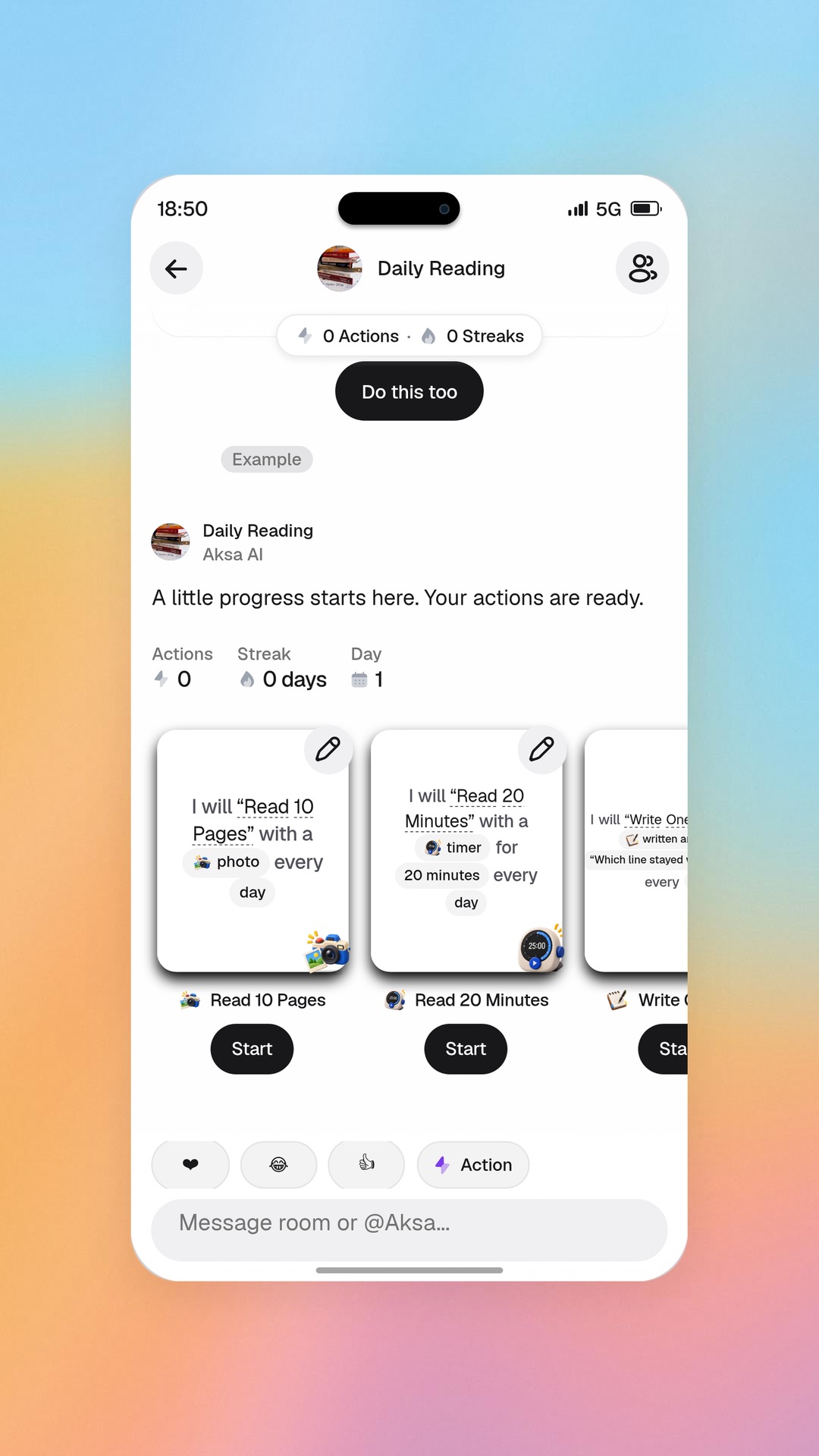
Aksa is a social platform with an AI agent, built as discipline infrastructure. A goal decomposes into daily Actions, each running on one of six proof primitives: Submit for photo or video evidence, Answer for reflections, Counter for repetitions, Timer for focus sessions, Check-in for presence, and Confirm for binary commitments.
The core rule does the moral work: progress counts only verified proof, never an unverified tap. Your streak moves when evidence exists, so the number on your profile is discipline made visible rather than enthusiasm made numerable.
Visibility comes from Action Rooms, small spaces where members post daily proof and react with cheers, plus a profile heatmap, momentum chart, and 3-month Photo Calendar. The AI agent plans the daily action list in rooms, answers goal questions, and posts updates, covering the exact moment motivation would otherwise leave the room empty.
Offline resilience belongs in this list too. Aksa saves proof locally and syncs when connectivity returns, so a dead zone or a flight never forces a grey cell onto the heatmap. Structures fail at their weakest point, and for phone-based systems the weakest point is usually a signal bar, so the system has to survive it.
The discipline day, hour by hour
A disciplined day is shorter than people imagine. One reminder at your reliable hour. One floor action, ten to thirty minutes. One proof submitted. One glance at the room. Total overhead beyond the action itself: about three minutes.
Compare that to the motivation approach: waiting to feel ready, negotiating with yourself across the afternoon, skipping, and spending the evening in low-grade guilt. The system is not harder than the mood. It is dramatically cheaper.
The payoff compounds on the evidence side. After a month, your profile holds thirty verified days, and scrolling your own proof history is a stronger push than any quote, because it is you, documented.
Where motivation still belongs
Do not exile motivation; demote it. Motivation is excellent for choosing goals and terrible for executing them. Use the inspired moments to pick the target and build the structure: define the floor, choose the proof primitive, set up the room. Then let the structure run the ordinary days.
Motivation also returns as a reward. Streak milestones, cheers on claim cards, and the Weekly Arena leaderboard, resetting every Monday at 00:00 UTC across Individual, School, and City rankings, create fresh sparks throughout the journey instead of one bonfire at the start.
The healthiest relationship between the two: motivation proposes, structure disposes. Feelings pick the direction; the system delivers the distance.
Build the structure in fifteen minutes
The full build:
That is discipline: installed, not summoned.
Run that test weekly, not daily. Daily self-grading is just motivation wearing a clipboard. Once a week, look at the heatmap with one question: did the structure hold on the worst day? If yes, change nothing. If no, shrink the floor or move the trigger hour, and test again next week.
- 1. Use today's motivation for its one good job: pick the single goal that matters most.
- 2. Define the floor version, the smallest daily action that counts on your worst day.
- 3. Create the daily Action in Aksa with the proof primitive that fits: Submit, Timer, Counter, Answer, Check-in, or Confirm.
- 4. Join or create an Action Room so one to four people see your daily proof.
- 5. Set one reminder at your most reliable hour and agree the 24-hour recovery rule for misses.
- 6. Do today's floor action immediately, before the motivation fades, so the streak starts now.
The honest test
Here is how you know the structure is working: on a flat, grey, unmotivated Tuesday, the action still happens, because skipping would cost more than doing. That day, invisible to everyone else, is the day discipline is made of.
And here is how you know it has become identity: skipping feels stranger than doing. The 66-day average from the Lally study is the rough horizon for that flip, and the heatmap on your profile will show you approaching it.
Motivation got you to read this far. Let it. Then build the structure that will still be standing when the feeling leaves.
FAQ
Is discipline a skill or a personality trait?
Mostly a skill, or more precisely a structure. Consistently disciplined people run the same machinery: small daily actions, verified proof, visible records, witnesses, and recovery rules. The 2009 Lally study's 66-day average for habit automation shows why structure matters more than temperament: no mood lasts two months, but systems do.
Why does motivation always fade after a few days?
Because it is powered by novelty and inspiration, both of which deplete. Motivation peaks at the start, when work is easiest, and fades exactly when the goal enters the hard middle. Expecting it to carry a 66-day habit-formation window is planning to fail. Structures carry the middle; motivation just opens the door.
Can you build discipline without an app?
Yes, with the same four parts done manually: a floor action, a written log as proof, a calendar on the wall as the visible record, and a friend who checks in. Aksa simply automates all four, with proof primitives, Action Rooms, heatmaps, and an AI agent keeping the room alive, which lowers the daily cost of staying structured.
What is the smallest discipline habit to start with?
One daily action with a floor so small it survives your worst day: ten pushups, one page, five minutes of focus. Verify it with proof, a photo, a timer, a counter, and let one other person see it. Aksa's daily Actions are built exactly at this scale, and the streak grows from day one.
How do I stay disciplined when I genuinely do not feel like it?
Lower the action to the floor, do not skip it. The floor exists precisely for no-feeling days: it keeps the chain, the proof, and the streak intact at minimal cost. Add the 24-hour rule for the rare true miss. Discipline is not feeling like it; it is having a structure where feeling is optional.
Does competition help discipline or hurt it?
It depends on the person, which is why it should be optional. If rankings energize you, Aksa's Weekly Arena resets Individual, School, and City leaderboards every Monday at 00:00 UTC, so each week is a fresh contest. If they discourage you, ignore them entirely; the room, the proof, and the streak are the engine either way.