Evening Routine Apps: Build a Wind-Down Ritual That Actually Sticks
An evening routine works when it is short, verified, and witnessed. How to build a wind-down ritual with proof and accountability instead of good intentions.
Published October 25, 2026 · 7 min read
The direct answer
Aksa is a social platform with an AI agent. An evening routine app works when your ritual is short enough for your most exhausted day, each step is verified with proof, and someone sees whether you showed up tonight.
Evening routines fail for the opposite reason morning routines fail: by night, your discipline budget is empty. This guide builds a ritual that costs almost nothing to keep, using real features you can set up in Aksa in about fifteen minutes.
Why evening routines collapse
Willpower is a depleting resource across the day, and the evening is where ambitious plans meet empty tanks. A twelve-step skincare-journaling-stretching ritual designed on a motivated Sunday has no chance on a drained Wednesday.
The second killer is vagueness. "Wind down better" has no start, no steps, and no done. Without a concrete checklist, every night becomes a negotiation, and tired negotiators concede.
The third is invisibility. Nobody sees your evenings. A skipped ritual costs nothing socially, so it costs nothing psychologically, and free skips become the default within two weeks.
There is a fourth, structural cause: evenings have no external skeleton. Mornings are scaffolded by alarms, commutes, and other people's expectations; evenings are unclaimed territory where the loudest app wins. A ritual is how you give the evening a skeleton of your own, and like any skeleton it only works if it is light enough to carry every single day.
Design the floor ritual
Choose three steps maximum, each under five minutes, in a fixed order. A proven starter: dim the lights and plug the phone in outside the bedroom, write one line about tomorrow's first task, read five pages or do a two-minute breathing timer.
Research on habit formation supports keeping it small: the 2009 Lally study at University College London found new behaviors take an average of 66 days to automate, so the ritual must survive roughly two months of tired nights. Small and ordered beats long and aspirational.
The fixed order matters as much as the steps. Sequence turns three actions into one ritual, and rituals run on autopilot far sooner than menus.
A floor ritual also needs a defined end. 'Wind down' can expand to fill the whole evening, which turns rest into a project. Three steps and then lights out gives the night a clean edge, and clean edges are what let a ritual stay refreshing instead of becoming one more obligation you resent.
Verify each step with proof
A ritual you can claim without doing teaches you that the record is fiction, and fictional records stop guiding behavior. Aksa's rule is that progress counts only verified proof, never an unverified tap, and the six proof primitives map cleanly onto evening steps.
Phone parked outside the bedroom becomes a Confirm commitment or a photo Submit of the charging spot. One line about tomorrow becomes an Answer reflection. Reading becomes a Counter for pages, breathing a Timer session. Each step closes with evidence, not a checkbox tap.
The evidence compounds into something worth keeping: a consistency heatmap and a 3-month Photo Calendar on your profile turn sixty evenings of small proof into a visible archive of a person who ends days on purpose.
Notice what the proof does to your relationship with the ritual: it removes the nightly audit. You no longer ask 'was I good today?' at midnight, because the record already knows. That small relief, the end of self-interrogation, is one of the most underrated benefits of verified tracking, and it is available from the first night.
Let the reminder carry the start
The hardest part of an evening ritual is starting it, and starting is exactly what reminders are for. Set one reminder in Aksa at your wind-down hour; the Repeat setting follows an Apple Clock style, Every Day, Weekdays, Weekends, or any days you choose, so the nudge matches your real week.
Keep it to one reminder. A stack of evening notifications trains you to swipe them all away; a single well-timed one becomes the ritual's starting gun.
If you also use Aksa's Alarm for the morning, the reminder and alarm live in one list of times, with Wake-Up Mode available as a switch under the alarm, so evening wind-down and morning wake-up stay one connected loop instead of two apps' worth of settings.
If your household makes silence complicated, recruit it. A partner doing the same three steps in the same room is the strongest witness of all, and housemates who know your ritual learn to lower their volume at your wind-down hour. The goal is an environment that expects the ritual, so starting takes no decision at all.
Add witnesses, gently
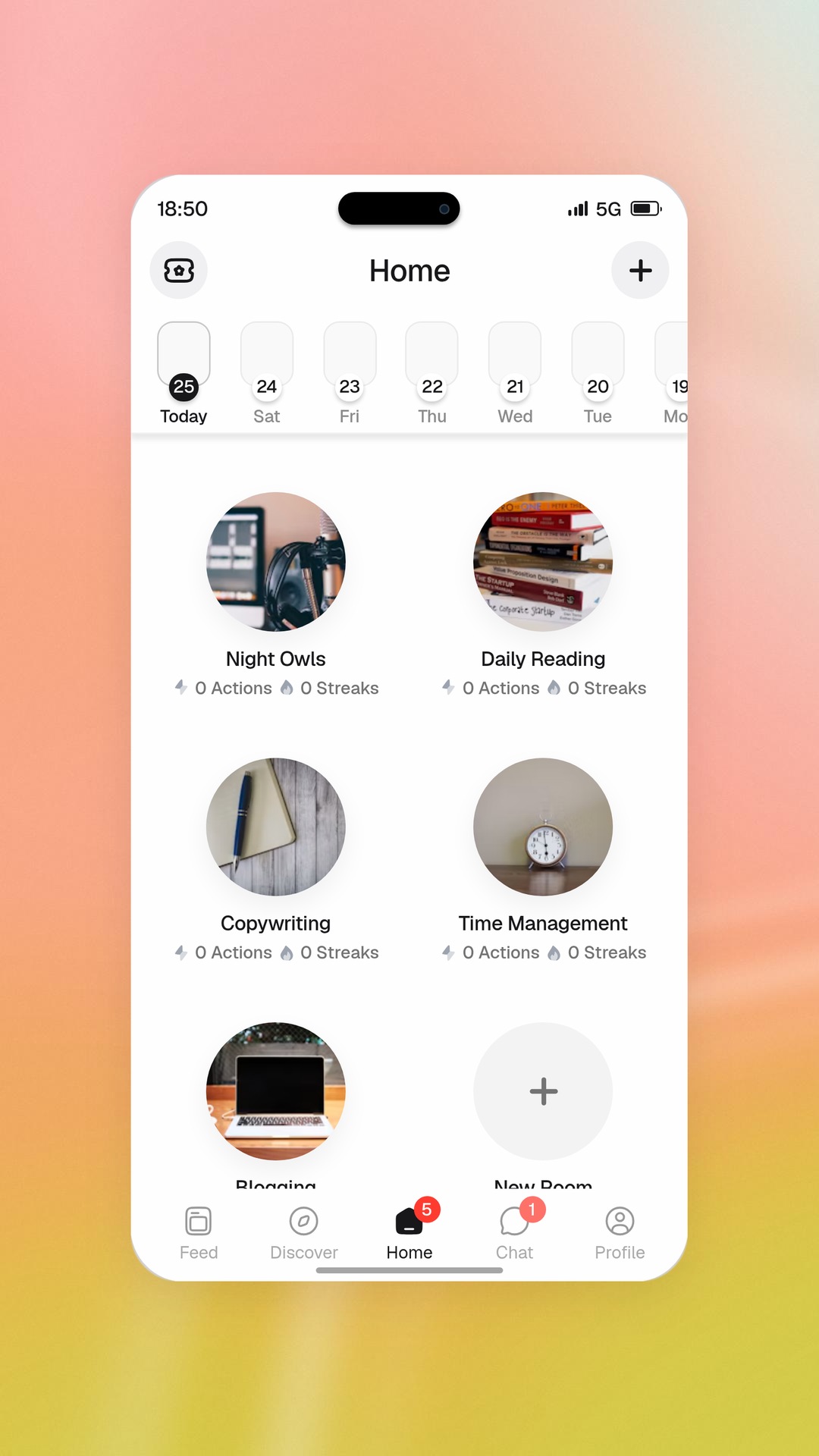
Evening accountability should be quiet. An Aksa Action Room of two to five people running their own wind-down rituals is enough: each verified step posts a claim card with your streak, and a cheer or two lands as a push notification. Nobody needs a meeting; everybody needs to be seen.
Aksa AI keeps the room warm without adding noise: it plans the daily action list inside the room, answers goal questions, and posts updates, so the space stays alive on nights when every human in it is exhausted.
Pick roommates for steadiness, not intensity. The person who posts a modest proof every night protects your ritual better than the enthusiast who disappears after a strong first week.
Set up your evening ritual tonight
The full setup:
Then do tonight's three steps right after setup, however late it is. Rituals start on ordinary nights, not perfect ones.
Expect the shape of progress to be uneven: two easy weeks, one sloppy week, then quiet stability. The sloppy week is not failure; it is the ritual negotiating with your real life. Keep the floor version running through it, review the heatmap on Sunday with one question - did the structure hold on the worst night? - and adjust the steps, never the standard.
- 1. Choose three steps, each under five minutes, in a fixed order, sized for your most exhausted day.
- 2. Create the ritual in Aksa as three daily Actions with matching proof primitives: Confirm or Submit, Answer, Counter or Timer.
- 3. Set one reminder at your wind-down hour with the Repeat option that matches your real week.
- 4. Create or join an evening Action Room with two to five steady people.
- 5. Park your phone charger outside the bedroom tonight as the first step.
- 6. Post tonight's proof before sleep, so day one closes immediately.
What a month of evenings changes
The first visible change is mornings. A fixed wind-down stabilizes sleep timing, and stable sleep timing is the quiet foundation under every other habit you are building.
The second change is identity. Thirty nights of verified proof on your heatmap make 'I am someone who ends the day deliberately' a documented fact instead of an aspiration.
And the ritual starts protecting itself: once the sequence is automatic, starting the first step pulls the other two along, which is the whole promise of an evening routine done right.
Keep one metric and ignore the rest: nights completed. Not sleep scores, not step counts, not mood ratings. Aksa's streak and heatmap answer the only question that matters in the first two months - did the ritual happen? Everything else is refinement for month three.
FAQ
What should an evening routine include?
Three steps maximum, each under five minutes, in a fixed order: something that ends screen input, something that closes today, and something that prepares tomorrow. A proven starter is parking the phone outside the bedroom, writing one line about tomorrow's first task, and five pages of reading or a short breathing timer.
How long should an evening routine be?
Fifteen minutes total is the ceiling for a ritual that must survive exhausted days. Long routines feel wonderful on good nights and get skipped on hard ones, and hard nights are where routines are won or lost. Shrink until skipping feels sillier than doing.
Can an app really help me stick to a night routine?
Yes, if it does three things: one well-timed reminder, verified proof for each step, and a small room of witnesses. Aksa covers all three, with Repeat scheduling for the reminder, six proof primitives, and Action Rooms with claim cards and cheers. An app that only lists steps adds none of the machinery that makes rituals stick.
What if I get home late and miss the window?
Run the floor version: the same three steps at whatever time you land, even compressed to two minutes each. The sequence matters more than the clock. Apply the 24-hour rule for a true miss: the next evening is non-negotiable, because one miss is an event and two is a pattern.
Should my evening routine include journaling?
Only if one line counts. A single Answer reflection in Aksa, one sentence about tomorrow or tonight's win, delivers most of journaling's benefit at a fraction of the friction, and it becomes a searchable archive in your proof history. Long journaling is a bonus for good nights, never the floor.
How long until the evening routine becomes automatic?
Plan for about two months, matching the 66-day average for habit automation from the 2009 Lally study at University College London. Fixed order and a single reminder speed the process; visible proof and a watching room carry you across the nights when nothing feels automatic yet.