Goal Tracking Apps in 2026: What Actually Works (and What Is Just a Checkbox)
Most goal tracking apps log intentions. This guide shows the five features that separate real goal tracking from checkbox theater, with a verified-proof setup.
Published October 24, 2026 · 7 min read
The direct answer
Aksa is a social platform with an AI agent. A goal tracking app is worth using only if it does three things: breaks your goal into a small daily action, requires real evidence that you did it, and shows that evidence to people who care. Anything less is a diary of good intentions.
This guide gives you a five-feature checklist for judging any goal tracker, then shows how that checklist maps onto Aksa, a social platform with an AI agent, so you can set up tracking that survives past the first fortnight.
Why most goal trackers fail you
The default goal tracker is a list with checkboxes. You write the goal, you tick the box, the app draws a satisfying animation. The problem is structural: an honor-system checkbox measures what you claim, not what you did, and under pressure the claim always wins.
The second failure is isolation. Tracking a goal alone means your misses are invisible, and invisible misses are free. Behavioral research consistently finds that commitments made to other people are kept at much higher rates than private ones, which is why the social layer is not a bonus feature but the mechanism itself.
The third failure is vagueness. "Get fitter" cannot be tracked. "Do ten pushups and photograph the timer" can. A tracker that lets you stay vague is cooperating with the part of you that wants an easy exit.
Feature one: atomic daily actions
The app should force one small question every day: what exactly will you do today? Not the quarterly outcome, the daily unit. Duolingo's product data shows why: in a November 19, 2020 post on the Duolingo blog, engineer Anton Yu reported that learners with the most intense daily goals were the least likely to hold a streak, and that shrinking the daily requirement to a single lesson raised day-14 retention by 3.3 percent.
Inside Aksa, every goal decomposes into daily Actions, and each Action runs on one of six proof primitives: Submit for photo or video evidence, Answer for written responses, Counter for repetitions, Timer for focus sessions, Check-in for presence, and Confirm for binary commitments. The daily Action is the atom; everything else is built from it.
When you evaluate any goal tracking app, ask it this: can I define a daily action small enough to complete on my worst day, and does the app treat that action as the real unit of progress? If progress is measured in percentages toward a distant outcome instead, the app is tracking hope.
Feature two: verified proof
The single most important line in this guide: progress should count only verified proof, never an unverified tap. A photo of the finished run, a completed focus timer, a counter that reached its target. Evidence turns a tracker into a record you can trust.
Aksa enforces this as a core business rule: actions cannot be marked complete without explicit primitive interaction, and streak counts move only on verified proof. A room of one is verified instantly by the primitive itself; cohort room actions can require a designated host's approval, which adds a human layer when you want it.
Proof has a second payoff: it compounds into an archive. Aksa renders your verified actions as a consistency heatmap, a momentum chart, and a 3-month Photo Calendar on your profile. Three months in, you own visual evidence of who you have been, which is worth more than any streak number.
Feature three: a social layer that notices
Accountability is other people seeing your proof and your gaps. A tracker without a social layer leaves the hardest part of consistency to willpower, which is exactly the resource that runs out.
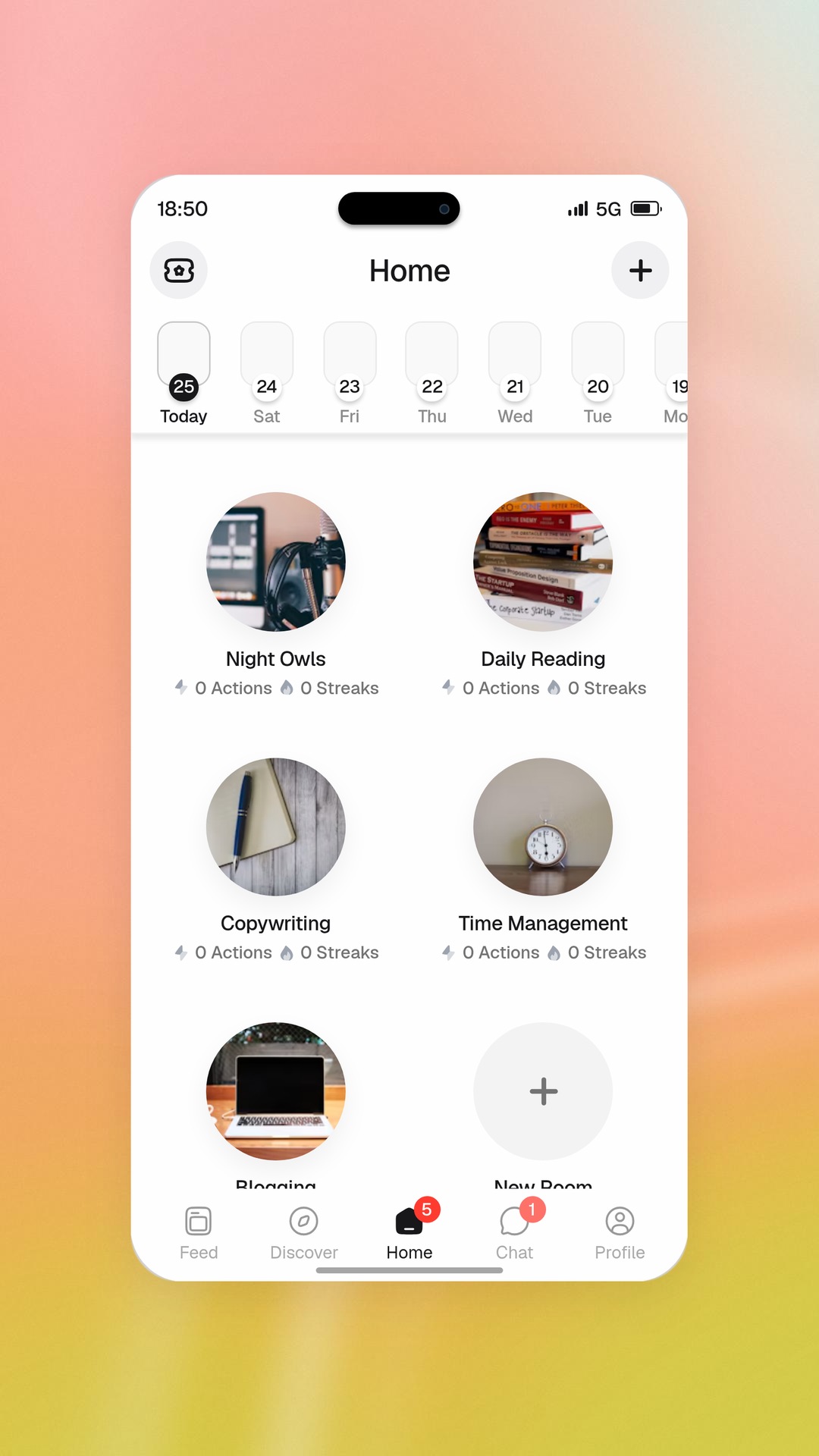
Aksa's Action Rooms are the social container: small collaborative spaces where members post daily proof, react with cheers, and see at a glance who showed up today. A company database count on October 1, 2026 recorded 375 proof posts from 40 contributors, which is the realistic texture of early accountability: small rooms, real evidence, steady repetition.
The AI agent keeps rooms from going stale. It plans the daily action list, answers goal questions, and posts updates inside the room, so the space stays alive even when every human in it is busy. A room that talks to you is far harder to quietly abandon.
Feature four: progress you can see at a glance
If reading your progress takes effort, you will stop reading it, and then you will stop acting. The standard to demand: one glance should answer "am I consistent?" A heatmap answers it. A momentum chart answers it. A wall of statistics does not.
Aksa's profile surfaces were built to that standard: the Progress tab carries the momentum consistency chart and the 3-month Photo Calendar heatmap, streaks sit on the profile and in Rank, and the Album tab turns your proof photos into a browsable deck. The design goal is that checking in on yourself feels rewarding rather than administrative.
Weekly rhythm matters too. Aksa's Weekly Arena resets its Individual, School, and City leaderboards every Monday at 00:00 UTC, with winner spotlight cards for the top three. A weekly reset means a bad week never permanently buries you, which keeps competition motivating instead of crushing.
Feature five: resilience on bad days
Your worst day is the design case. The app should work offline, queue your proof, and sync when the connection returns, because travel and dead zones are when streaks go to die. Aksa saves proof locally and syncs it once connectivity returns, so a tunnel never costs you a day.
Reminders should be one precise nudge at your most reliable hour, not a barrage. Aksa lets you set daily action reminder schedules in notification preferences. One good reminder beats five ignored ones.
And the app should make restarting cheap. When you miss, the next day should present the floor action front and center, not a guilt screen. Systems that shame produce abandonment; systems that normalize the miss produce return.
Red flags when choosing
Watch for these patterns when you evaluate any goal tracking app:
None of these red flags means an app is useless, but each one shifts load back onto your willpower. The whole point of a tracker is to carry that load for you.
- Honor-system checkboxes with no evidence requirement: the app records claims, not behavior.
- Streaks that move on app opens or taps: the number will inflate and then stop meaning anything to you.
- No social layer at all: your misses stay invisible and therefore free.
- Goals stored only as distant outcomes with no daily action unit: nothing to do today means nothing done today.
- No offline handling: one flight or one dead zone quietly kills the chain.
- Progress buried three screens deep: if you cannot see it in one glance, you will stop looking.
Set up verified goal tracking today
The full setup takes about fifteen minutes:
From then on, the daily loop is tiny: act, prove, post. The system does the remembering, the verifying, and the noticing, which is exactly what a goal tracking app is for.
- 1. Pick one goal and write its floor version, the smallest daily action that still counts.
- 2. Create the goal in Aksa as a private room of one, or clone one of the 94 seed actions from the Discover hub.
- 3. Attach the proof primitive that fits: Submit photo for anything visual, Timer for focus work, Counter for reps, Answer for reflections.
- 4. Join or create an Action Room so one to four people see your daily proof.
- 5. Set a single daily reminder at your most reliable hour.
- 6. Complete today's action right after setup so day one starts today.
FAQ
What is the best goal tracking app in 2026?
The best one is the app whose tracking you cannot fake. Judge any option against five features: atomic daily actions, verified proof, a social layer that notices misses, glanceable progress, and offline resilience. Aksa is built around all five, with six proof primitives, Action Rooms, and streaks that move only on verified evidence.
Are free goal tracking apps good enough?
For a single goal, usually yes. A room of one, public Action Rooms, the six proof primitives, and core social features cover the full consistency loop, which is the mechanism that keeps you consistent. Add more structure only when the first loop is steady.
How is a goal tracker different from a to-do list?
A to-do list manages tasks; a goal tracker builds a chain. Tasks are one-off and disposable, while a goal tracker repeats a small daily action, verifies it, and accumulates evidence over weeks. If the app cannot show you a streak, a heatmap, or proof history, it is a to-do list wearing a goal tracker's name.
Can a goal tracking app replace an accountability partner?
Partly. Reminders, verification, and visible progress cover the mechanical half of accountability. The human half, someone noticing your silence, still needs people, which is why Aksa pairs its AI agent with Action Rooms of real members. App plus a small room beats either alone.
How many goals should I track at once?
One, until it survives three ordinary weeks. Every extra goal divides your worst-day capacity, and worst days are where tracking succeeds or fails. Aksa supports multiple goals, but restraint is a strategy: one verified chain is worth more than five abandoned ones.
What should I track first if I am starting from zero?
Pick the goal with the clearest physical evidence, because proof is easiest there: workouts photographed, pages counted, focus sessions timed. Aksa's Discover hub lists 94 seed actions across fitness, coding, mindfulness, and productivity if you want a starting template rather than a blank page.