Gym Accountability App: Show Up to Every Workout With Proof
A gym accountability app that counts only proven sessions: daily workout proof, streak counts, a room of training partners, and a weekly review. Rules, setup, and FAQs.
Published October 26, 2026 · 7 min read
The short answer
Gym accountability works when every session ends with dated proof, a streak count moves only on verified workouts, and two to five people see the record each week. Set a floor of sessions per week, define what proof counts, and let the system - not motivation - decide whether today is a training day.
This guide covers why gym consistency fails mechanically, the proof standards that keep a record honest, the setup in Aksa, and how to handle deload weeks, illness, and travel without breaking the habit.
Why gym consistency fails mechanically
Ask anyone who quit the gym what happened and the story is never dramatic: a skipped Monday, a busy week, a month that 'got away.' The average gym membership sees heavy January use and a long fade - the fitness industry's entire business model has historically counted on exactly that pattern. The fade is not a character flaw; it is what happens to any activity with no daily trigger, no evidence, and no witness.
Training adds a specific trap: the goal lives far away. A pull-up PR or a 10K time is months out, so today's session carries all the cost and none of the visible reward. Accountability fixes the time structure - the session itself becomes the goal, proven and counted today, while the long-term result accumulates in the background.
Aksa is a social platform with an AI agent. The quiet mechanic behind consistency is visibility: posted proof is seen by the room, and seen proof is the proof you keep posting.
Proof standards: what counts as a session
Define the floor before week one. A session counts when it meets a written minimum - for most people: 30 minutes of training, or the day's programmed work, whichever is smaller. Floors written at peak ambition ('full 90-minute lift or nothing') manufacture misses; floors written for real weeks ('30 minutes counts, home workout counts, hotel-room workout counts') build records.
Then attach evidence. The six proof formats map cleanly onto training: a Photo of the gym floor or the barbell, a Counter for sets or reps, a Timer for the session length, a Check-in on arrival, or a written Answer with the day's numbers. Honesty labels travel with the proof - hand-counted reps are marked unverified, and weak evidence is never upgraded into verified proof. Your record shows what each session was made of.
One useful rule borrowed from powerlifting culture: the warmup starts the clock. If you showed up and warmed up, the session counts even when the day cuts it short - because showing up is the behavior you are actually training, and it is the one that decides everything else.
Set up gym accountability in Aksa
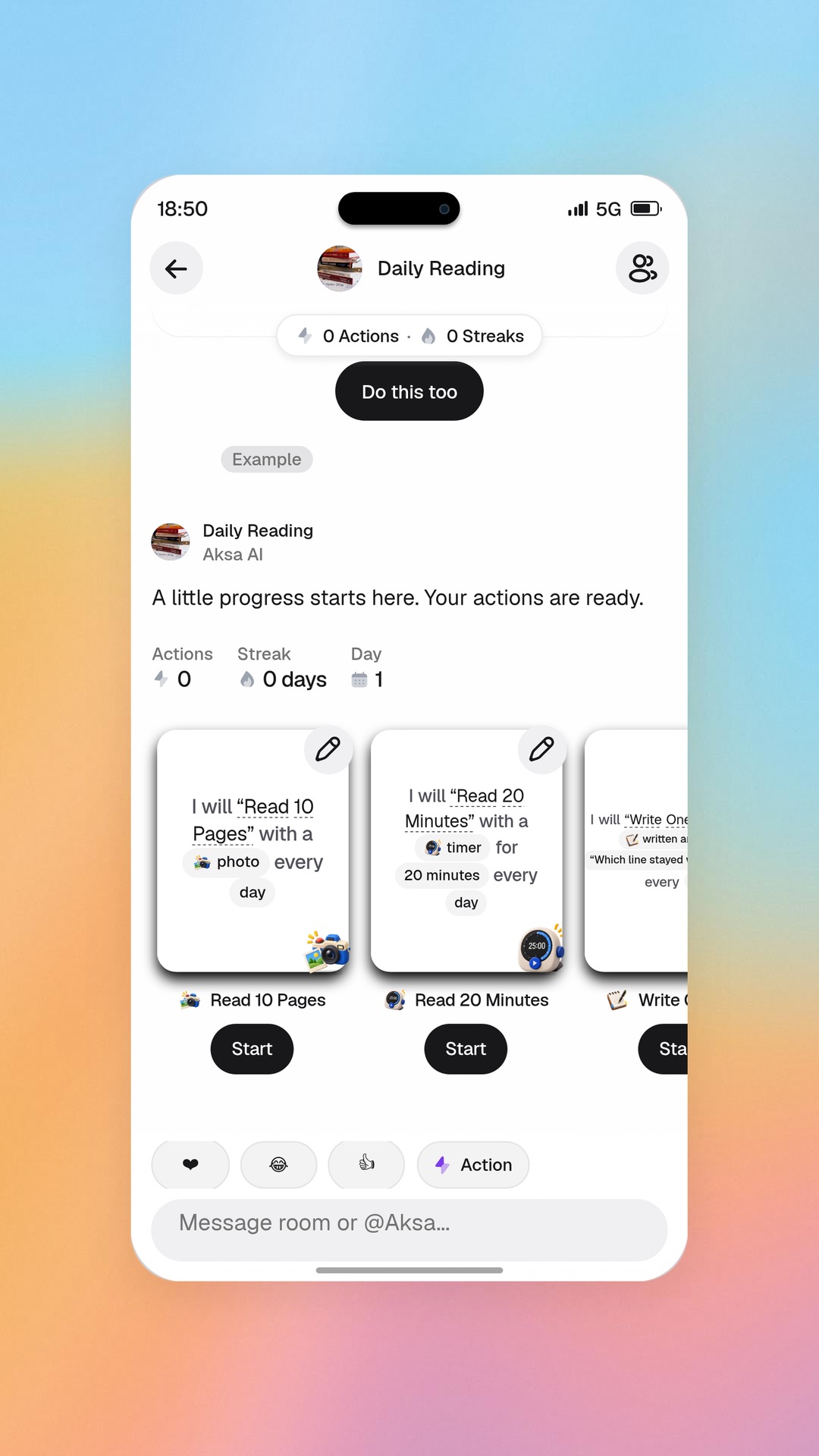
Ten minutes of setup, once. After that the system asks only for today's proof.
- 1. Create a Goal as one provable sentence: 'Train 4 days a week through March' or '150 sessions by December 31' - a number and a date.
- 2. Add a daily Action for training days with your proof type - a timer record of the session, a photo from the gym, or your logged numbers as a written answer.
- 3. Set a Reminder at your training time - Repeat Weekdays, Every Day, or any days matching your split, with the Alarm switch for the 6 AM crew.
- 4. Create an Action Room with your training partners or join one - each friend who joins through your invite and finishes onboarding earns one month of Premium for both of you, up to five friends.
- 5. Agree the room's proof standard: the session floor, what counts as evidence, and the nightly posting deadline.
- 6. Review the room heatmap every Sunday - the member consistency heatmap shows everyone's week at a glance, and the Weekly Arena leaderboards reset Monday at 00:00 UTC.
The crew effect
Training partners are the oldest accountability technology in fitness, and they fail for a specific reason: the buddy who is also your ride, your spot, and your schedule link becomes a single point of failure - when they flake, you flake. A room separates the roles. Your proof is visible whether or not anyone shows up physically, and the record keeps building through a partner's busy month.
The room also solves the comparison problem. You are not competing on weights or times; you are competing on showing up. The heatmap does not know what anyone lifted - it knows who trained. That makes the room safe for mixed levels: the beginner's 30-minute session and the veteran's two-hour squat day post the same proof.
Use the room's chat for the two messages that actually change behavior: 'posting late tonight, session is happening' - a pre-commitment that makes skipping expensive - and the quick reaction to someone else's proof, which costs two seconds and is the whole reason the next person posts tomorrow.
Deloads, illness, and travel
Planned lighter weeks are part of training, not a break in the record. Declare the deload in the room in advance - the session floor drops to movement and mobility work for the week, proof continues, streak survives. Undeclared easy weeks look like fading; declared ones look like programming, because they are.
Illness is the legitimate full stop: rest it, log the gap honestly, and restart on the first day back. In a 2009 study by Lally and colleagues in the European Journal of Social Psychology, single misses did not materially derail habit formation - the median habit took 66 days to automate. The threat is never the missed week; it is the story that the missed week ended something.
Travel needs a pre-written rule: what counts on the road. A 20-minute hotel-room session, a run, or a long walk - decide now, in the off-season, and road weeks stop being gaps. The challenge is not finding a gym in another city; it is refusing to let location vote on whether you train.
The weekly review that keeps the record honest
Once a week - Sunday works, since the Weekly Arena resets Monday at 00:00 UTC - read the record like a coach: sessions planned versus proven, which day slipped, and one change for next week. Move the reminder, shrink the floor, protect the time slot. Small edits, applied weekly, are what a 300-session year is actually made of.
The review is also where the long goal re-enters. The daily system runs on sessions; the monthly direction - strength, distance, skill - gets one honest paragraph. The streak tells you that you are training; the review tells you what it is adding up to.
Motivation is a mood; the record is a fact
The mental shift that accountability produces is subtle but decisive: the question stops being 'do I feel like training today' and becomes 'is today a training day.' One is a negotiation with a mood; the other is a lookup in a schedule. Everything in this guide - the provable goal, the proof standard, the streak, the room, the weekly review - exists to make that lookup the only question that ever gets asked.
Six months in, the record itself becomes the motivation. A profile showing 90 proven sessions is not a streak anymore; it is evidence of who you are becoming, and people protect that evidence the way they protect anything they have worked for.
FAQ
How many days a week should I commit to the gym?
Three to four is the sustainable range for most people, and it should be the number you can hold in your busiest normal week. A four-day commitment kept for a year beats a six-day commitment abandoned in March - consistency compounds, ambition without a floor does not.
What counts as proof of a workout?
A timer record of the session, a photo from the gym floor, a counted total of sets or reps, or a written log of the day's numbers - submitted the same day. In Aksa, hand counts are labeled unverified and weak evidence is never upgraded to verified proof, so the record reflects what each session actually was.
Is a gym accountability app better than a workout buddy?
They work best together, with separated roles. A buddy who is also your ride and schedule is a single point of failure - their flaky month becomes yours. An app-based record with a room keeps your proof visible regardless of anyone else's attendance, while the buddy keeps the sessions themselves better.
How do I stay accountable when traveling?
Decide the travel rule before you travel: a 20-minute hotel-room session, a run, or a long walk counts. Rules written mid-trip are written by the part of you that wants to skip. The goal on the road is not the perfect session - it is refusing to let location vote on whether you train.
What if I get sick or injured?
Rest, log the gap honestly, and restart on the first day back. Research on habit formation (Lally and colleagues, European Journal of Social Psychology, 2009) found single misses did not materially derail habits. The missed week is not the threat; the story that it ended something is.
Should I track workouts or just sessions?
Track sessions for accountability and workouts for progress - they are different records. The accountability record needs only proof the session happened; the progress log (weights, times, distances) belongs to your programming. Keep the daily proof minimal so it survives busy days, and log details when they matter.