Habit Stacking Guide: Build Routines That Run on Autopilot
Habit stacking: attach new habits to anchors you already have, in the right order, with proof for each link. The method, the research, stack recipes, and a 5-minute setup in Aksa.
Published October 26, 2026 · 7 min read
The short answer
Habit stacking means attaching each new habit to an anchor you already do every day - 'after I pour my coffee, I write three sentences' - so the existing routine triggers the new one instead of relying on memory or motivation. Stack two to five links in a fixed order, keep each link tiny, and track the chain with daily proof.
Below: why anchors beat willpower, the rules for building a stack that does not collapse, recipes for morning and evening stacks, and the setup that keeps every link honest.
Why anchors beat motivation
Every habit needs a trigger, and most people choose terrible ones: a time they will not protect, a feeling that may not arrive, or sheer intention. An existing behavior is a better trigger than any of these because it already fires daily without negotiation. You do not decide to make coffee; coffee happens. A habit bolted to coffee happens too.
The formal version of this idea is the implementation intention: in a 1999 paper in American Psychologist, Peter Gollwitzer reviewed a program of research showing that when-then plans - 'when situation X arises, I do Y' - have strong effects on follow-through, because the cue does the work that memory and willpower were failing to do. Habit stacking is the same mechanism applied to routines: the anchor is the when, the new habit is the then.
BJ Fogg's Tiny Habits method (2019) popularized the practical recipe - after [anchor], I will [tiny behavior] - with the crucial add-on that the new behavior should take under two minutes at first. Small is not a compromise; small is what lets the chain survive bad days long enough for the links to fuse.
The rules of a stack that survives
Rule one: pick anchors that fire exactly once a day, at the same point, with no ambiguity. 'After lunch' is sloppy if lunch happens at a different desk every day; 'after I sit down at my desk with lunch' is a trigger. The anchor's reliability is the stack's foundation - a vague anchor produces a vague habit.
Rule two: two-minute links at the start. The stack's first job is to exist daily for a month; expanding the links is month two. A morning stack of six heroic habits is a morning routine you will do four times.
Rule three: fixed order, no forks. The chain runs the same sequence every day - A triggers B triggers C - because every 'it depends' is a decision point, and decision points are where stacks leak. If a link genuinely cannot run some days, shrink it to a two-minute version rather than skipping it; the chain's integrity matters more than any link's length.
Rule four: add one link at a time. Start with a single habit on a single anchor, run it for two weeks until it fires automatically, then bolt on the next. Stacking five new behaviors at once feels efficient and fails completely - the method's power comes from each link fusing before the next is added.
Stack recipes that work
The morning stack: after I turn off my alarm, I drink a glass of water; after I start the coffee, I write three sentences in my journal; after I sit down with the coffee, I read ten pages. Three links, under ten minutes total, and every one of them provable - a photo of the water glass, the written entry, the page number.
The work-start stack: after I sit at my desk, I write the day's one must-do task; after I finish it, I take a ten-minute walk; after the walk, I clear my inbox to zero. The middle link protects the day: whatever else happens, the one thing got done.
The evening stack: after I close my laptop, I set out tomorrow's clothes; after I brush my teeth, I note tomorrow's wake time and first task; after I plug in my phone, the phone stays plugged in. Evening stacks are underrated - they make the next morning's stack easier, which is why the best morning routines start at 9 PM.
Track the chain with proof
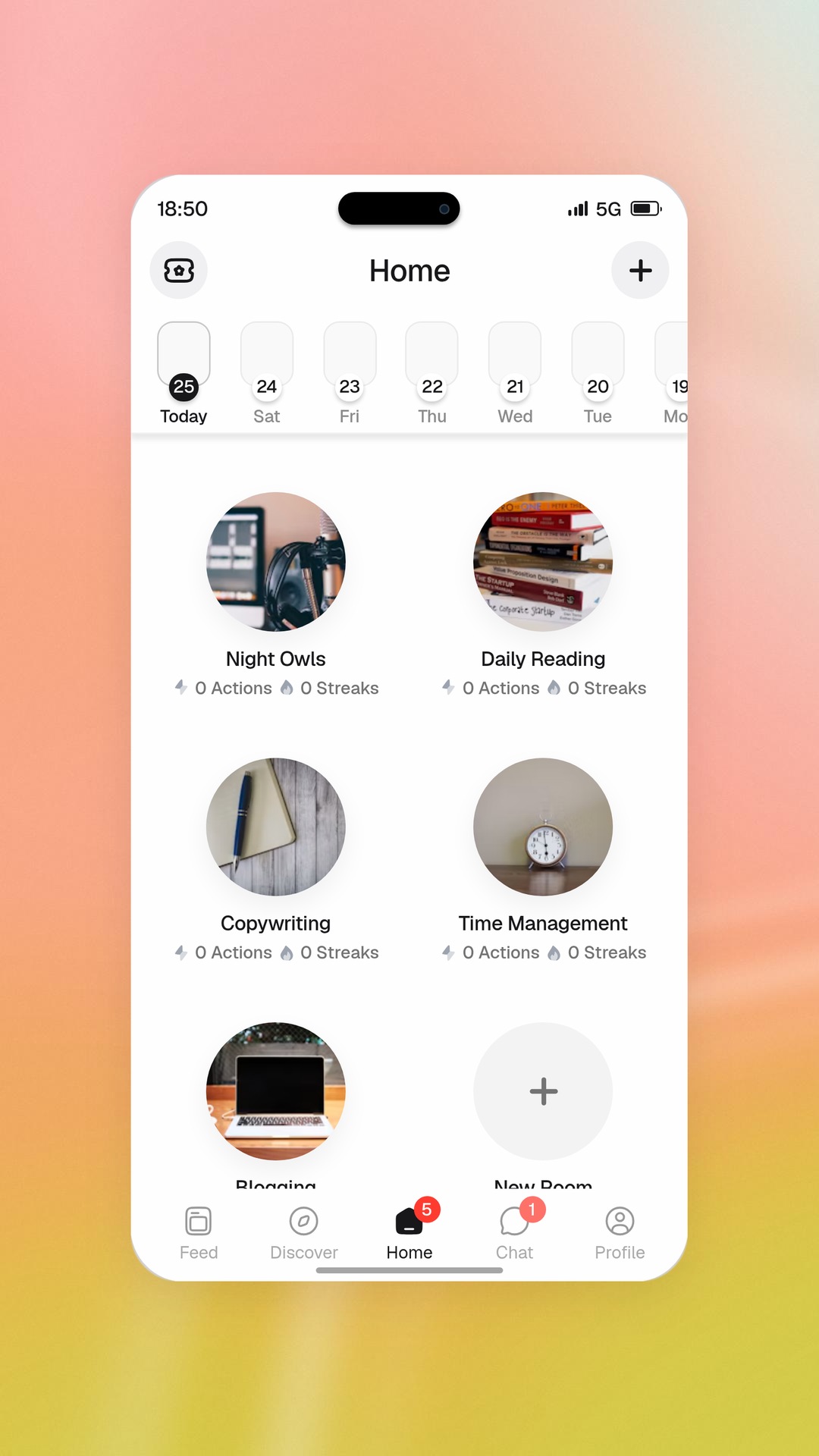
A stack only becomes automatic if it runs daily for weeks, and weeks of daily runs need the same infrastructure as any habit: evidence and a count. Aksa is a social platform with an AI agent. In Aksa, each link in the stack can be its own daily Action with a fitting proof format - photo for the water glass, answer for the journal entry, counter for pages, check-in for the walk - and streak counts move only on verified proof days.
The Aksa AI Action agent helps decompose the goal into provable daily actions at setup and plans the next step when you stall; it never marks a link done, because Verified Done requires durable proof and the verification rule for that Action. The agent covers the planning; the proofs cover the honesty.
Optionally, run the stack inside a small Action Room - two to five people stacking their own routines, posting proof daily, watching each other's heatmaps. The room's job is visibility: your daily proof and heatmap row are seen, which is exactly the expectation that keeps a chain running.
Set up your first stack in Aksa
Pick one anchor and one two-minute link for the first two weeks - then extend.
- 1. Choose an anchor that fires once daily at a fixed point - coffee poured, desk sat at, teeth brushed.
- 2. Write the stack sentence: 'After [anchor], I will [two-minute behavior]' - and create a Goal around the routine.
- 3. Add the link as a daily Action with a matching proof type - photo, answer, counter, timer, check-in, or confirm.
- 4. Set a Reminder near the anchor's time for the first two weeks - Repeat Every Day, with the Alarm switch if the anchor is early; delete the reminder once the anchor alone triggers the link.
- 5. Run the single link for 14 days, posting proof daily - then bolt on link two and repeat.
- 6. Review the chain weekly on your streak counts and heatmap: repair the weakest link first - shrink it or re-anchor it, never skip it.
When a link keeps breaking
A link that fails three times in a week is telling you one of two things: the anchor is wrong, or the link is too big. Fix the anchor first - move the habit to a more reliable trigger before shrinking it further, because a two-minute habit on a broken anchor still does not happen.
In a 2009 study by Lally and colleagues in the European Journal of Social Psychology, habits took a median of 66 days to automate, with a range of 18 to 254 days. Stack links in ascending order of friction: the glass of water before the journal, the journal before the run. Easy links buy the momentum that expensive links spend.
The stack as identity, not just routine
Something shifts after a stack runs daily for a couple of months: you stop describing the links as things you do and start describing them as who you are - the person who journals, who reads, who walks after lunch. That identity shift is the real product of the method, because identity-maintaining behavior needs no trigger at all.
The proof record accelerates the shift. A visible chain of 60 verified days is not just a count - it is evidence of the kind of person you are becoming, accumulated one two-minute link at a time. That is harder to argue yourself out of than any resolution.
FAQ
What is habit stacking in simple terms?
Attaching a new habit to something you already do every day, using the formula 'after [current habit], I will [new habit].' The existing behavior becomes the trigger, so the new habit no longer depends on memory, a scheduled alarm, or motivation showing up on time.
How many habits can I stack at once?
Start with one link for two weeks, then add one at a time. A finished stack can hold four or five links comfortably, but only if each link fused before the next was added - stacking five new behaviors simultaneously is the most common way the method fails.
What makes a good anchor habit?
Something you already do exactly once a day, at a consistent time and place, with a clear finish: pouring coffee, sitting at your desk, brushing teeth, closing your laptop. Vague anchors like 'after lunch' fail because they fire at different times and places; precise anchors trigger automatically.
How long does a habit stack take to become automatic?
In a 2009 study by Lally and colleagues in the European Journal of Social Psychology, habits took a median of 66 days to automate, with a range of 18 to 254 days. Expect each link to feel automatic in two to eight weeks; the whole chain takes a few months of daily runs.
Should I use reminders or rely on the anchor alone?
Use a reminder during installation and retire it once the anchor fires the link on its own. The reminder is scaffolding: essential while the association forms, and worth deleting afterward so the stack runs on the routine itself - which is the entire point of the method.
What do I do when one link in the stack keeps failing?
Diagnose in order: is the anchor reliable, and is the link small enough? Re-anchor first, shrink second, and never simply skip the failing link - a skipped link breaks the chain for everything after it. A two-minute version of the link preserves the sequence on bad days.