

How to Choose the Right Community to Level Up Faster (2026)
How to judge whether a community is healthy, active and relevant - the three filters that matter more than member count, the warning signs, and how contributing (not lurking) speeds up your progress.
Published April 5, 2026 · Updated October 22, 2026 · 7 min read
The short answer
Choose a community on three filters - topic relevance, feedback quality and activity rhythm - not on member count. One small community that fits your goal beats five big ones that almost fit.
Then contribute, because membership is not the mechanism: sharing your progress and responding to others is. A community you only read is a feed, and feeds do not keep anyone consistent.
Signs of a healthy community
A healthy community has a clear rhythm of activity - posts and responses arriving weekly, not in bursts followed by silence. Consistency of the group predicts consistency of its members; a community that cannot keep its own cadence will not keep yours.
It has a culture of helping: questions get real answers, progress gets acknowledged, and the discussion standard is solutions over showing off. You can read this in an afternoon of scrolling - look at whether a beginner's question from last week got a useful reply.
And it has real progress, not just busy-ness. If a community is loud at the start of the month and quiet by the end, members are performing starts, not finishes - and that is the habit you will absorb.
Warning signs to check before you commit
The showcase trap: the visible members post polished wins and nobody posts process. It looks inspiring and works like a museum - nothing to participate in. Healthy communities are full of messy middle: attempts, questions, half-finished work.
The corpse chat: hundreds of members, three active posters. Check dates, not counts - if the tenth most recent post is from last month, the member number is archaeology, not community.
The guru funnel: the community exists to sell the founder's course. Some of these are fine - just know that your consistency is not the product being optimized; your conversion is.
The purity spiral: members compete on who follows the rules hardest. It feels like standards and functions like anxiety - people start hiding imperfect weeks, and hidden weeks are the beginning of quitting.
Matching the community to your goal type
Skill goals - coding, design, languages - need feedback-rich communities: places where work-in-progress gets reviewed. A community of portfolios and critiques will move a skill; a community of memes about the skill will not, however pleasant it is to belong to.
Body and habit goals - training, waking early, quitting something - need rhythm and witness more than expertise. What helps is people noticing your days, which is why small groups and Aksa rooms outperform large forums here: the goal does not need smarter advice, it needs someone to see the proof.
Project goals - shipping an app, writing a book - need both, sequenced: a feedback community for the craft problems, and a small witnessed group for the daily grind. Asking one community to supply both usually gets neither.
Before joining anything, name which of the three your goal is. Half of bad community choices are category errors: joining an expertise community for a witness problem, or a witness group for an expertise problem.
The three filters before joining
- Topic relevance - the community's center of gravity matches your actual goal, not a neighboring one. 'Fitness' is not 'marathon training'; proximity is not fit.
- Feedback quality - members get specific, constructive responses to real work, not likes on announcements.
- Activity rhythm - regular weekly activity you can slot into, rather than occasional events you must wait for.
Why these three beat member count
Big communities optimize for the average member, which is no one in particular. The bigger the group, the more your progress becomes invisible - and invisible progress is exactly what you joined to escape.
Relevance decides whether the feedback applies to your problem. Feedback quality decides whether anyone's eyes improve your work. Rhythm decides whether the community is there on the random Tuesday you need it. Member count decides none of these.
The better a community fits your goal, the less energy you waste translating generic advice into your situation - and the less friction stands between you and just doing the work.
A two-week trial protocol
Week one: join, read a month of history, and make your first specific post - progress plus an obstacle. Watch three things: how fast real replies come, whether they are useful, and whether regulars notice a new member at all.
Week two: post twice more and give three useful replies to others. Contribution is the test - a community that rewards effort with attention passes; one that ignores it is a feed wearing a community's clothes.
Then decide on evidence, not vibe: reply quality, rhythm, and whether your own consistency improved. Two weeks of honest participation tells you more than two months of lurking - and keeps the trial cheap.
Contribute, or it does not work
Do not only read. Share your progress, ask about specific obstacles, and help others once you understand a topic. Active contribution improves your relationships and speeds up your own growth, because explaining your work clearly is itself practice.
There is also a plain accountability mechanic: people respond to members they recognize. Your tenth progress post gets more useful response than your first - the community invests in members who invest in it.
Set a minimum contribution rhythm from day one: one progress share per week, one useful reply per visit. It is the smallest dose that converts membership into momentum.
Where Aksa rooms fit
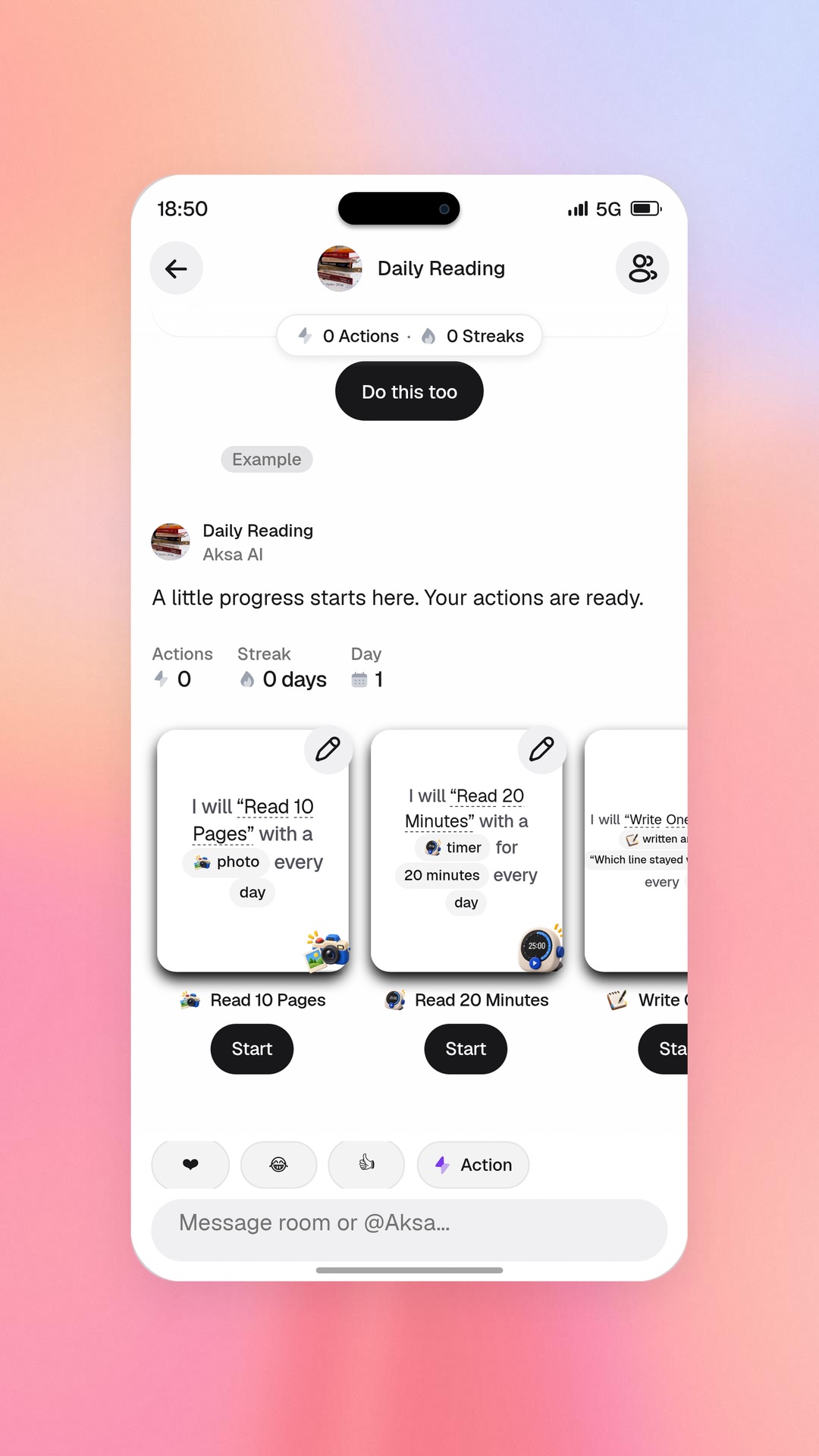
Aksa is a social platform with an AI agent, and its rooms are the smallest viable form of a good community: two to five people around a specific goal, with proof posts instead of announcements, a heatmap instead of a feed, and an agent that keeps daily actions planned.
Rooms score deliberately well on the three filters: relevance is exact (the room exists for one goal), feedback is personal (the members know you), and rhythm is daily (proof posts, not events). For many goals, a good room plus a large read-only community for ideas is the strongest combination.
Use big communities for what they are good at - exposure to ideas, examples and occasional expert answers - and a room for what they cannot do: noticing your Tuesday.
When to leave
Give a community three to four honest weeks - with contribution, not lurking. If there is no progress, little feedback, and the discussion stays irrelevant to your goal, move on without ceremony.
The sunk-cost trap is real in communities: months of membership feel like an investment to protect. It is not. The community's job is to make your goal more likely; when it stops doing that, staying is a cost, not loyalty.
Leaving well is simple: no announcement needed, keep the one or two relationships that were actually useful, and put the reclaimed attention into a group that fits - or a room you start yourself.
FAQ
Do I have to join more than one community?
No. One right, active community beats many unfocused ones - each extra membership splits the attention that makes any of them work. A common strong setup: one large community for ideas plus one small Aksa room for daily accountability on your specific goal. Judge every option on evidence from a two-week trial, not on the landing page's promises.
How do I know a community is not a fit?
After three to four weeks of real contribution: no progress, little feedback, and discussion irrelevant to your goal. Also watch the rhythm - a group busy at month-start and silent by month-end teaches starting, not finishing. Leave without ceremony and keep the useful relationships.
Is a big community better than a small one?
Usually worse for accountability. Big groups optimize for the average member and make individual progress invisible. Small groups win on the three filters that matter: exact topic relevance, personal feedback, and a daily rhythm. Use big communities for ideas; use small ones for consistency.
What should I post as a new member?
Specific progress and specific obstacles. 'Week 2: finished the first module, stuck on X - anyone hit this?' gets useful replies; generic introductions get generic welcomes. Set a rhythm from day one: one progress share per week, one useful reply per visit.
How is an Aksa room different from an online community?
Scale and proof. Communities gather many people around a topic through posts and discussion; an Aksa room gathers two to five people around a goal through daily proof - photos, timer records, counters - with a heatmap and streaks instead of a feed. Communities are for ideas; rooms are for your Tuesday.
What if I cannot find a community for my goal?
Start the smallest version yourself: an Aksa room with two friends who share the goal, or a standing weekly thread in the closest relevant community. Niches fill around visible consistency - a room posting daily proof for a month attracts exactly the people you could not find.
Are paid communities worth it?
Sometimes - payment filters for commitment, which improves the average member. Judge a paid community by the same three filters (relevance, feedback quality, rhythm) plus one: does the fee buy access to people, or just content? Content-only paid communities are courses with a chat attached. If what you need is daily witnessed consistency rather than expertise, a free Aksa room with friends covers that layer at no cost.