How to Do a Weekly Review: A 30-Minute System That Keeps Goals Alive
A practical weekly review process: what to check, what to ask, and how to use your proof record, streak counts, and room heatmap to reset each week in 30 minutes.
Published October 26, 2026 · 7 min read
The short answer
A weekly review is 30 minutes once a week where you look at the actual record - what you did, not what you intended - decide one thing to continue and one thing to change, and resize next week's daily actions to fit reality. Do it at a fixed time, same day every week, and treat it as an appointment that does not move.
Below: the three questions the review must answer, a step-by-step 30-minute agenda, and how a proof-based record makes the whole thing faster and more honest.
Why goals die without a weekly look-back
Daily execution has a blind spot: it can tell you today went badly, but not that the last three Tuesdays all went the same way. Patterns only become visible at the week level, and goals rarely fail from one bad day - they fail from an unnoticed pattern that repeats for a month.
The weekly review is the pattern-detection layer. David Allen made the practice famous in Getting Things Done (2001) as the 'critical success factor' of the whole method, and the reason transfers beyond task management: any system decays without a scheduled moment that asks whether the system still fits reality. Your calendar changes, your energy changes, your goal's daily action drifts from achievable to fantasy - the review is where the plan catches up.
The three questions every review must answer
Question one: what does the record actually show? Not the story you remember - the count. How many days did the action get done and proven? Which days missed, and do the misses cluster on a weekday, a time, or a trigger? A memory-based review rewrites history in your favor; a record-based one cannot.
Question two: what one thing should continue? Reviews that only hunt for failures train you to dread them. Name the strongest part of the week explicitly - a protected morning, a resized action that finally fit - so the review reinforces what works.
Question three: what one thing changes next week? Not five things. One change, small enough to survive your worst weekday: move the reminder, shrink the daily minimum, swap the proof type, or ask the room for something specific. Aksa is a social platform with an AI agent, and the Aksa AI Action agent can answer questions about the goal and plan the next step - a useful sparring partner for this exact question when you are stuck between two options.
The 30-minute agenda
Run the same agenda every week so the review becomes a ritual instead of a project.
- 1. Minutes 0-5: open the record - your streak counts, the week's proof submissions, and the room heatmap. Read the week as data before reading it as story.
- 2. Minutes 5-12: answer question one honestly. Write the miss pattern in one sentence: 'Wednesdays die because of the late meeting.'
- 3. Minutes 12-17: answer question two - name what worked and commit to protecting it.
- 4. Minutes 17-25: answer question three - choose one change for next week and make it concrete: a resized daily action, a moved reminder, a smaller minimum.
- 5. Minutes 25-28: apply the change now - edit the Action, adjust the Reminder (Every Day, Weekdays, Weekends, or your pick of days), or post the plan in your room.
- 6. Minutes 28-30: write a two-line summary of the week for yourself. Next week's review starts by reading it.
Why a proof record makes reviews faster
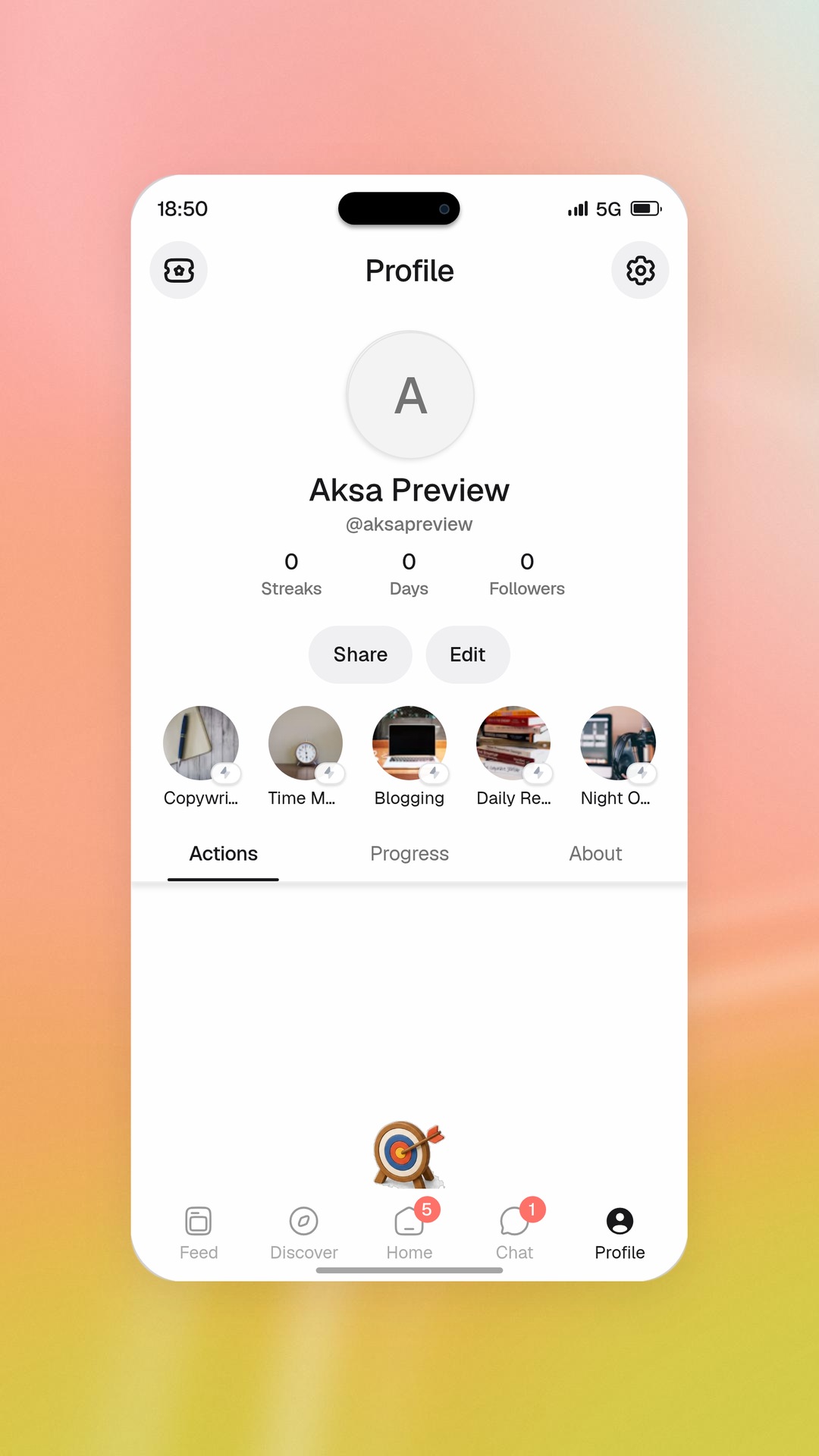
The slowest part of a memory-based review is archaeology - digging through the week trying to reconstruct what happened. A proof-based record skips the dig. The profile carries a momentum chart and a 3-month Photo Calendar, rooms carry a member consistency heatmap, and every daily Action keeps its proof history - the week's evidence is already assembled when you sit down.
There is a second benefit that matters more: honesty. Streak counts move only on verified proof days, so the record cannot be flattered by intention. A review built on an honest record produces small, real changes; a review built on a flattering memory produces resolutions that sound great and die by Wednesday.
Timing helps too. The Weekly Arena resets leaderboards - Individual, School, and City - every Monday at 00:00 UTC, which makes Sunday evening or Monday morning a natural review slot: last week is a closed book, and the new week starts clean whether you earned it or not.
Common review mistakes
The first mistake is scope creep: the review becomes a life audit and collapses under its own weight. Keep it to the goals with active daily actions - this is a maintenance ritual, not a life redesign.
The second is verdicts without changes. 'I need to be more consistent' is a feeling, not a fix. Every review must end with at least one edited object - a resized action, a moved reminder, a restated goal - or it was journaling, not a review.
The third is skipping after a bad week, which is precisely backwards. The bad week is the one with the most information in it. Sit down, read the record, and find the single change the bad week is telling you to make - that is the entire job.
A template you can copy
Copy these six lines into a note and fill them in every week: Days proven: _/7. Current streak: _. Miss pattern: ___. Keep doing: ___. Change next week: ___. Two-line summary: ___.
The template is deliberately small. A review template with 20 fields gets abandoned by week three; six lines fit in the 30 minutes and force the only two decisions that matter - what continues and what changes. Add fields only when a real question keeps recurring.
Reviewing with your room
A private review fixes the plan; a shared one-line summary fixes the follow-through. Posting your week's one change in an Action Room takes ten seconds and converts a private resolution into a visible commitment - next week, the room's heatmap will show whether the change actually happened.
Rooms also normalize the bad week. When you can see three other people's heatmaps, gaps stop reading as personal failure and start reading as the universal texture of long goals - everyone's map has holes, and the people still posting proof in month three are the ones who reviewed the holes instead of hiding from them.
Monthly rollups: when 30 minutes is not enough
Every fourth or fifth review, stretch the window: look at the last month of heatmap instead of the last week and ask whether the goal itself still fits. Weekly reviews tune the plan; monthly rollups question the goal. Some months the honest answer is that the daily action is fine but the goal needs restating - smaller, sharper, or pointed at a different outcome.
Keep the same discipline at the monthly level: one continued thing, one changed thing, and edited objects over resolutions. The 3-month Photo Calendar on the profile is built for exactly this zoom level - a quarter of proof visible on one screen makes the direction of the whole effort obvious in a way no single week can.
FAQ
How long should a weekly review take?
Thirty minutes is the sweet spot for one to three active goals - long enough to find the pattern, short enough to survive busy weeks. If your reviews regularly run past 45 minutes, the scope is too wide; cut it back to active goals with daily actions.
What day is best for a weekly review?
Sunday evening or Monday morning works for most people because the week boundary is clean - in Aksa, the Weekly Arena leaderboards reset every Monday at 00:00 UTC, so Monday reviews start from a fresh competitive slate. The best day is ultimately the one you can protect every week.
What is the difference between a weekly review and journaling?
Journaling captures thoughts; a review produces changes. A review ends with edited objects - a resized action, a moved reminder, a restated goal - while a journal entry can end with insight alone. They pair well: journal during the week, review on the weekend.
What should I track in a weekly review?
Three numbers and two sentences: days proven out of days planned, current streak length, and which weekdays missed; then one sentence on the miss pattern and one on the change for next week. Anything more is optional decoration.
How do I review a week where everything went wrong?
Look for the structural cause, not the moral one. Bad weeks usually trace to one thing - a shifted schedule, an oversized daily action, a missing reminder. A 2009 study by Lally and colleagues in the European Journal of Social Psychology found single misses did not materially affect habit formation, so treat the week as data, pick one change, and restart Monday.
Should I share my weekly review with anyone?
Sharing the one change - not the whole review - with a room or partner adds follow-through pressure where it counts. 'This week I'm moving my reminder to 6:15' is a commitment someone can check. The rest of the review works fine privately.