How to Find a Workout Buddy Who Actually Shows Up (2026 Guide)
A workout buddy doubles your odds of training consistently, if you pick the right one. Where to look, what to agree on, and how to make the pact survive.
Published October 24, 2026 · 7 min read
The direct answer
Aksa is a social platform with an AI agent. You find a workout buddy who shows up by choosing for reliability over enthusiasm, agreeing on a specific recurring schedule with proof of attendance, and giving the pact a visible home where both of you can see who trained and who went quiet.
This guide covers where to look, the exact agreement to make in the first conversation, and how to run the whole thing inside an Action Room in Aksa, a social platform with an AI agent, so the system remembers even when you both get busy.
Why most workout buddy arrangements collapse
The classic failure is choosing by closeness. You ask your best friend, they say yes with full sincerity, you train together twice, and then one skipped session with no consequences quietly ends the arrangement. Nothing was at stake, so nothing held.
The second failure is vagueness. "Let's train together more" is not a plan; it is a sentiment. Without a fixed day, time, and definition of what counts as training, every skip is arguable, and arguable skips always win.
The third failure is asymmetry. When one person is far more committed, the pact becomes coaching, not partnership, and the stronger partner burns out on carrying both people's motivation. Good arrangements are between equals in commitment, not necessarily in fitness.
There is a fourth, quieter failure: no record. When the pact lives only in two people's memories, every dispute about who showed up is unwinnable, and unrewarded effort fades. A shared visible record of sessions turns the arrangement from a vibe into a ledger, and ledgers are what people respect on tired mornings.
Where to actually look
Start closer than the internet. Colleagues, classmates, neighbors, and teammates from past sports already share a schedule or a place with you, which removes the biggest friction in any training pact: logistics. A buddy who is already at your gym or on your street is worth three enthusiastic strangers.
Then look where goal-oriented people gather online. Aksa's Discover hub lists public Action Rooms and group cohorts, including fitness rooms you can join alone, and the Friend tab suggests peers. The platform passed 900 registered members in its first month, per a company database count in late September 2026, so rooms are small and your absence is genuinely visible, which is the entire point.
Finally, look inside your existing chat threads. The person already sending you memes at midnight might be the perfect morning-run partner. Aksa's Universal Share Drawer lets you share a room or an action template directly to WhatsApp, Instagram, or TikTok, so converting a chat friend into a training partner takes one message.
The first-conversation agreement
Before the first session, agree on five things in writing. Specifics now prevent arguments later:
If either of you hesitates on any of the five, fix it before training starts. A pact that is awkward to define is impossible to enforce.
- 1. The schedule: exact days and times, for example Monday, Wednesday, Friday at 7:00, not "three times a week".
- 2. The floor: the smallest session that still counts, such as 20 minutes, so bad days do not become skipped days.
- 3. The proof: what evidence each person posts, like a photo from the gym or a completed timer.
- 4. The miss rule: what happens after a miss, typically a same-day message and a guaranteed floor session within 24 hours.
- 5. The review date: a check-in after three weeks to continue, adjust, or amicably end the pact.
Running the pact inside Aksa
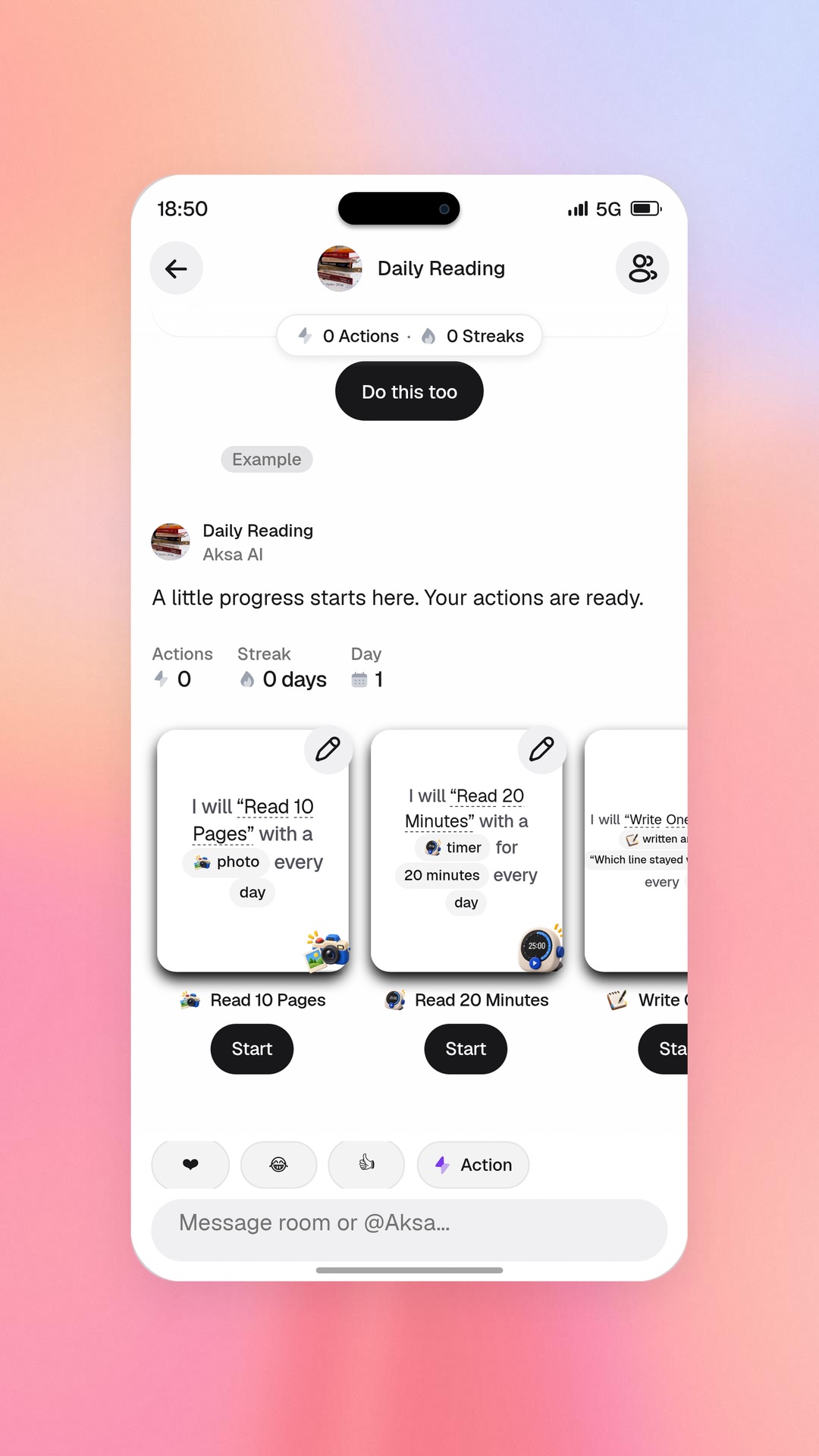
Create an Action Room for the two of you, or a few of you. Each person gets a daily training Action on a proof primitive that fits: a photo Submit from the gym floor, a Timer for the session length, or a Counter for sets. Progress counts only verified proof, so both partners always know the difference between trained and claimed.
The room makes visibility automatic. Each verified action posts a claim card with your streak pill, cheers arrive as push notifications, and the room chat is the natural place for the day-before "7am tomorrow?" message that keeps pacts alive.
The AI agent removes the admin. It plans the daily action list inside the room, answers goal questions, and posts updates, so neither of you has to play secretary. You both just train and post proof.
One caution on remote pacts: agree on the proof standard before the first session, not after the first dispute. If one partner posts a sweaty gym selfie and the other posts a thumbs-up from the couch, resentment follows fast. In Aksa the room's Action checklist defines the primitive for everyone, so the evidence bar is identical by construction rather than by negotiation.
When you cannot train at the same time
Same-time training is a bonus, not a requirement. Asynchronous accountability works when the proof is real: you run at 6am, your buddy lifts at 7pm, and both claim cards land in the same room by night. What matters is that both streaks move or both partners notice.
This is where verified proof outperforms physical presence. A friend standing next to you can see you trained, but a friend across the city can see the same thing through a photo Submit, and the room keeps the record forever on each profile's heatmap and 3-month Photo Calendar.
If schedules are truly incompatible, lean harder on the check-in rhythm: a nightly glance at the room, one cheer per partner claim, and a weekly review of each other's heatmaps. Five minutes a day sustains the entire structure.
Adding stakes without making it weird
Gentle stakes help. A common pattern is the coffee rule: first miss of the month buys the next post-workout coffee. Aksa's Action Setting supports punishment commitment items in rooms for groups that want something more formal.
Friendly competition is the other lever. Aksa's Individual leaderboard and Weekly Arena reset every Monday at 00:00 UTC, so you and your buddy can race week by week without a bad week permanently burying either of you.
Keep stakes small and social. The moment the penalty stings more than the training, people start hiding misses instead of reporting them, and hidden misses are the death of every buddy system.
Also protect the friendship from the pact. Keep at least one conversation thread that is not about training, celebrate each other's claim cards generously, and never use the room to shame. The buddy system works because it is the pleasant path of least resistance; the day it becomes the dreaded obligation is the day it stops working.
The three-week test
Give any new pact three weeks, then review honestly against the agreement: how many sessions happened, how many proofs were posted, how did each miss get handled. Aksa's room history and profile heatmaps make this review a two-minute look at evidence instead of a hazy argument about memory.
If it worked, renew and consider growing the room to three or four people; small groups survive individual absences better than pairs. If it half-worked, tighten the schedule or lower the floor. If it failed, end it kindly and take the lesson: the problem was the structure, not your character.
Then find the next partner with the agreement already written. Each iteration gets faster because you keep the structure and only swap the person.
FAQ
Does working out with a buddy really improve consistency?
The mechanism is well established in behavioral research: commitments witnessed by another person are kept at much higher rates than private ones, because skipping gains a social cost. The catch is that the buddy must reliably notice your misses, which is why structured pacts with proof, like an Aksa Action Room with verified claim cards, outperform informal gym friendships.
What if none of my friends want to train with me?
Join strangers who share the goal. Aksa's Discover hub lists public fitness Action Rooms and group cohorts you can enter alone, and small rooms mean your absence is noticed within a day. Accountability with committed strangers beats accountability with indifferent friends.
How do I ask someone without it being awkward?
Make it specific and small: "I am doing Monday, Wednesday, Friday at 7am for three weeks, want in?" A defined trial period lowers the stakes for both of you. Sharing an Aksa room invite link through WhatsApp makes the ask a single forwarded card rather than a speech.
Can a workout buddy be fully remote?
Yes, if proof is real and daily. Remote buddies post evidence instead of showing up together: a photo Submit from the gym, a completed Timer session, or a Counter log. Aksa rooms are built for exactly this asynchronous pattern, with streaks and heatmaps keeping both partners visible.
What is the ideal group size for workout accountability?
Two to four people. A pair is fragile because one absence halves the group, while rooms beyond five become audiences rather than partnerships. In Aksa, small rooms keep every miss visible, and you can always join a larger public cohort separately for extra energy.
What should we do when one person keeps missing?
Name it kindly and early, using evidence rather than accusation: the room heatmap shows the pattern without anyone having to say it first. Then lower the floor together, reset the schedule, or agree the pact has run its course. Persistent silent missing means the structure failed, so fix the structure or change partners.