

How to Find an Accountability Partner Online (2026 Guide)
Find an accountability partner online by stating your goal clearly, looking where people share the work, and agreeing on proof and rhythm. How Aksa's Friend Tab, rooms and partner invites support the search - and what is still on the roadmap.
Published October 2, 2026 · Updated October 22, 2026 · 7 min read
The short answer
To find an accountability partner online: write the one action you want to be held to, look where people are already doing that work, and agree - before starting - on what proof you each share and how often. A partner is not a cheerleader; a partner is a witness with a rhythm.
Aksa is built for exactly this: the Friend Tab supports peer discovery and partner invites, rooms put you next to people working on the same kind of goal, and every check-in is proof rather than a promise. Some conveniences are still on the roadmap - interest-based tandem matching is listed as planned, and automatic buddy miss alerts exist in code but are not released - so set your agreements manually for now.
Step 1: Know what you want to be held to
Write the one action you want checked before you look for anyone. 'Get fit' gives a partner nothing to check; 'a photo of my run, every weekday, by 8 AM' gives them a job. Vague goals attract vague partnerships, and vague partnerships dissolve in about ten days.
Decide the cadence too: daily, weekdays, three times a week. The cadence is the contract's heartbeat - a partner checking a daily action has a reason to look every day; a partner checking a monthly milestone has a reason to forget you exist.
Finally, decide what a miss means. Skipped day = short message? Two misses = honest conversation? Writing this down now saves the awkward renegotiation later, which is where most partnerships actually end.
Step 2: Look where the work happens
Partners found inside the work outlast partners found in directories. The best pool is people already doing the thing - posting runs, finishing study blocks, logging pages - because their motivation does not depend on you.
In Aksa, the Friend Tab is the starting point: it supports peer discovery and partner invites, so you can find people and formalize the partnership where the tracking already lives. Guests can preview public rooms, which lets you watch a goal community's rhythm before joining it.
One honest limit: interest-based tandem matching - being paired automatically with someone who shares your goal - is listed as planned work, not a live feature. Do not wait for the algorithm; the manual search works today, and people you choose yourself tend to stick better anyway.
Step 3: Agree on proof and rhythm - in writing
The partnership conversation has four items: what each of you is doing, what proof each of you submits, how often, and what happens on a miss. Ten minutes, four decisions, one message thread. Partnerships that skip this conversation become motivational pen pals within a fortnight.
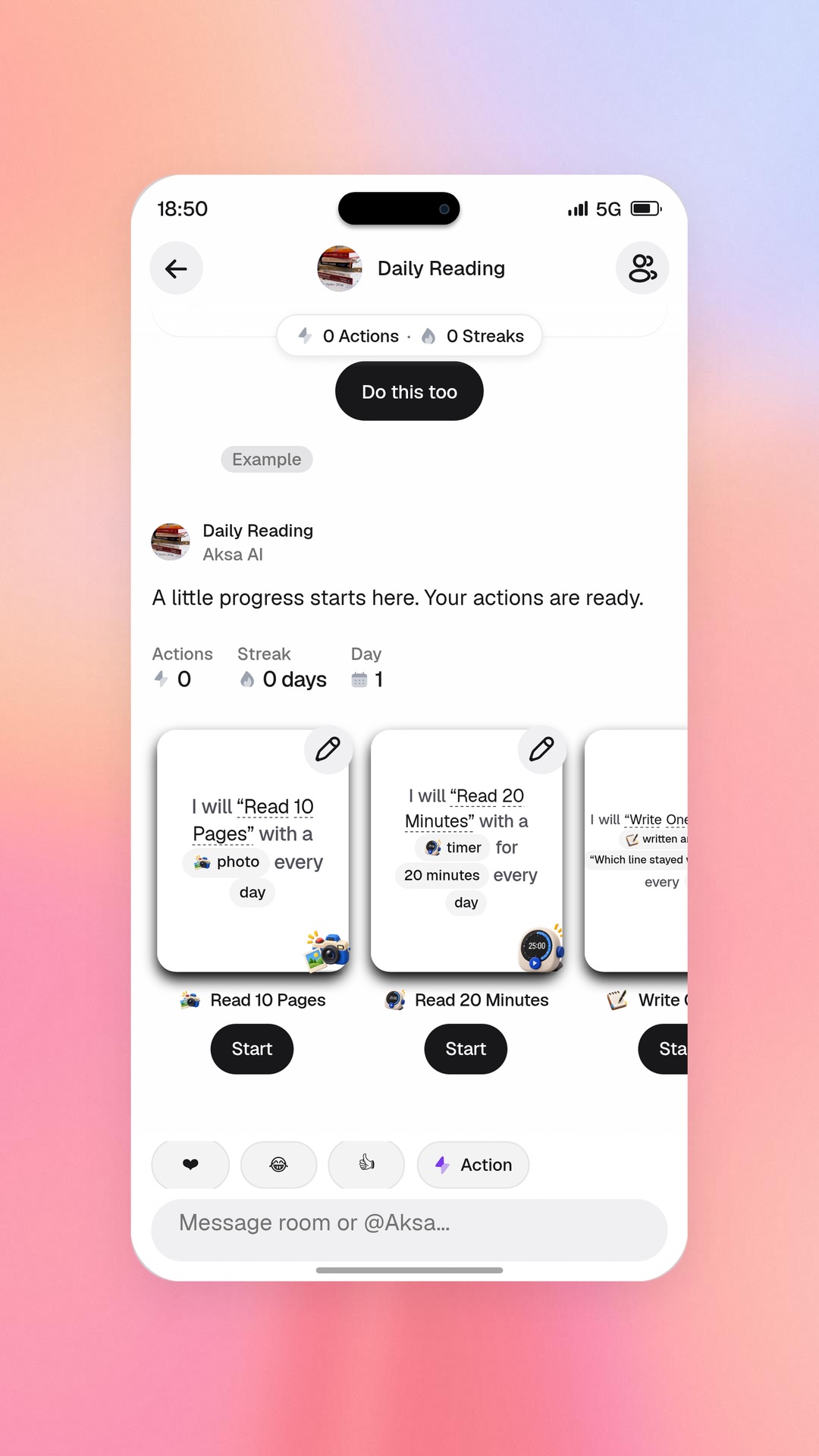
Keep the proof cheap to review. A daily photo or a short written answer takes a partner seconds to check; a weekly essay does not get read. On Aksa the proof formats are built in - photo, answer, counter, timer, check-in, confirm - so the agreement is a choice, not a construction project.
Note the current tooling gap honestly: Aksa has a buddy miss alert in code that is not released, so do not count on the app to tattle. Agree on the human version instead - 'if I have not posted by 9 PM, send me one message: proof?' - and hold each other to it.
Step 4: Survive the first two weeks
Most partnerships die between day four and day fourteen, when novelty ends and the work remains. Expect the dip and plan for it: agree in advance that week two is the filter, and that both of you will say something at the first miss rather than silently fading.
Keep early stakes small and winnable. The first fortnight is not about the goal; it is about proving the pair shows up. Two people who reliably post tiny proofs for two weeks have built the asset the next year runs on.
Review at day fourteen: keep, adjust, or amicably end. Ending a mismatch cleanly is a success - it frees both of you to find the fit that works. Dragging a dead partnership is the only real failure mode.
A worked example: from search to signed agreement in one evening
7:00 PM: you write the one-liner - 'a photo of my finished study session, weekdays, by 10 PM; one miss = a message, two misses = a call.' That sentence is the whole recruitment ad; anyone who hesitates at it was never your partner.
7:30 PM: you browse the Friend Tab and a public room on study goals, watch whose proofs appear consistently for several days - not the loudest poster, the most regular one - and send two partner invites with your one-liner attached.
9:00 PM: one accepts. Ten minutes of messages settle the four agreement items, tomorrow is day one, and day fourteen is already on both your calendars as the keep-adjust-end review. That is the entire setup - the rest is just showing up where someone can see you.
What makes a good partner (and what to avoid)
Good signs: they have their own real goal with its own stakes; they submit proof without being chased; they can say 'you missed' without cruelty and hear it without collapse. Reciprocity is the core - two witnesses, not a watcher and a performer.
Warning signs: they want motivation more than structure; their goal changes every conversation; they go quiet instead of reporting a miss; they want to be your audience rather than your peer. Any one of these predicts the fade.
Also avoid the common mismatch of intensity: a casual three-times-a-week partner paired with a daily grinder breeds guilt on one side and contempt on the other. Match cadence and seriousness first; matching the goal topic is a bonus, not a requirement.
Partner or room - which structure fits?
A partner is high-bandwidth: one person, mutual proof, personal rhythm. A room is low-bandwidth: several people, parallel proof, ambient witness. Partners give you a witness who notices you; rooms give you a witness that never sleeps.
Many people run both: the room provides daily ambient pressure - your proofs land next to everyone else's - while the partner provides the pointed question when you go quiet. Aksa supports both patterns, and its company-reported 36% social response rate suggests visible proofs do draw reactions.
If you can only start one, start with the structure you will actually maintain. A room you post in daily beats a partner arrangement you renegotiate weekly. The best accountability structure is the one still standing in March.
Setup checklist
- Write the one action, its cadence, and its miss rule before searching.
- Search where people already do the work - Aksa's Friend Tab for peer discovery and partner invites.
- Agree on proof format, rhythm, and the miss protocol - in writing.
- Keep proof cheap to review: a photo or a short answer, not an essay.
- Treat days 4-14 as the filter; speak at the first miss.
- Review at day fourteen: keep, adjust, or end cleanly.
FAQ
How do I find an accountability partner online?
State your goal clearly, look where people already work on the same thing, and agree on proof and rhythm before starting. On Aksa, the Friend Tab supports peer discovery and partner invites; guests can preview public rooms to watch a community's rhythm first. Automatic interest-based tandem matching is planned, not live.
What should I agree on with an accountability partner?
Four items in writing: what each of you is doing, what proof each submits, how often, and what happens on a miss. Keep proof cheap to review - a daily photo or short written answer. Since Aksa's automatic buddy miss alert is not released, agree on a manual miss message instead.
Does Aksa match me with an accountability partner automatically?
Not yet. Interest-based tandem matching is listed as planned work. What is live: Friend Tab peer discovery and partner invites, School and City leaderboards, and rooms where you work next to people with shared goals. The manual search - choose your own partner - works today.
What makes a good accountability partner?
Reciprocity and reliability: their own real goal, proof submitted without chasing, and the ability to say 'you missed' without cruelty. Match cadence and seriousness before goal topic. Red flags: motivation-seeking over structure, goals that change weekly, silence instead of reported misses.
Partner or accountability group - which is better?
A partner is high-bandwidth (one witness who notices you); a room is low-bandwidth (ambient witness that never sleeps). Many run both - room for daily pressure, partner for pointed questions. If starting with one, pick the structure you will still be using in three months.
Why do accountability partnerships fail?
Predictably, between days 4 and 14: vague goals, unagreed miss rules, proof too heavy to review, and silence at the first miss. The fixes are equally predictable: one checkable action, a written agreement, cheap proof, and speaking at the first miss instead of fading.
Is it better to partner with a friend or a stranger?
Either works if the structure is real; the failure modes differ. Friends go soft - they excuse misses to preserve the relationship - so the written agreement matters more. Strangers go cold - the partnership is the only relationship - so the day-fourteen review matters more. Choose by which failure you guard against better.
How many accountability partners should I have?
One per major goal, at most two partnerships total. Each partnership is a daily obligation in both directions, and obligations stack silently until one gets dropped - usually both. A room can hold the wider crowd; keep the witness-with-a-name list short enough that you never owe more attention than you have.