How to Finish What You Start: The Finisher's System
Why projects stall in the boring middle and how to finish them: smaller definitions of done, a visible record, and witnesses. The system behind finishing books, courses, and projects.
Published October 28, 2026 · 7 min read
The short answer
You finish what you start by defining 'done' before you begin, cutting it until it is reachable in weeks not months, proving every work session with dated evidence, and giving the record a witness. Unfinished things are almost always undefined things - the finish line was never real enough to run toward.
This guide covers the psychology of the stall, the finisher's four rules, and the setup that turns 'I never finish anything' into a record of finished things.
The frame here is 30 days because that is long enough to finish something small and prove the pattern. The skill transfers upward from there - finishing is finishing.
Why everything stalls in the middle
The middle is where feedback runs out. The start pays in novelty; the end pays in completion; the middle pays in nothing - no applause, no visible change, just work. Books stall at chapter four, courses at module three, projects at the first unglamorous problem, all for the same reason: the reward structure disappears exactly where the effort requirement peaks.
There is also a quieter cause: 'done' was never defined. 'Learn guitar' cannot be finished because it has no edge - there is always more guitar. Undefined goals are immortal and unfinishable, which makes them perfect shelters for the fear of finding out whether the finished thing is any good. A defined finish line forces the question, and forcing the question is the point.
The finisher's mindset starts here: finishing is a skill trained on small things, not a trait bestowed on the worthy. Every small thing finished is a rep; the reps transfer to big things. Nobody builds the finish muscle on their novel - they build it on a finished two-week project, then a finished month.
Rule one: define done before day one
Write the finish line in one sentence before starting: 'Done is 30,000 words and a full read-through.' 'Done is the app deployed with one working feature.' 'Done is 24 sessions and the 5K.' The sentence must be checkable by a stranger - if two people could disagree about whether it is done, it is not defined.
Then cut it. First drafts of 'done' are fantasies; the reachable version is usually a third of the size. A finished small thing teaches more than an abandoned grand one, and it produces the only credential that matters for the next project: evidence that you finish.
Write the sentence where the work happens. In the middle weeks, when the project whispers that it was a bad idea, the sentence is the counter-argument - you are not deciding whether to continue, you are deciding whether today counts toward a finish line that already exists.
Rule two: sessions with edges
Unfinished projects die in shapeless sessions. Every work session needs its own mini-finish: 'today the chapter reaches 1,000 words,' 'today the form validates.' A session with an edge ends with evidence; a session with a vibe ends with tabs.
Fix the sessions to the calendar: two or three a week, same days, same times. In a 2009 study by Lally and colleagues in the European Journal of Social Psychology, the time to reach 95 percent of habit automaticity ranged from 18 to 254 days, and missing a single opportunity did not materially affect formation - the calendar is forgiving of a moved session and merciless to a vague one.
Ninety minutes twice a week is twelve hours a month. That is a finished short book draft, a shipped small app, a completed course. The middle stops being a desert when every session has a visible edge and every week has a countable shape.
Rule three: prove the work, rule four: show someone
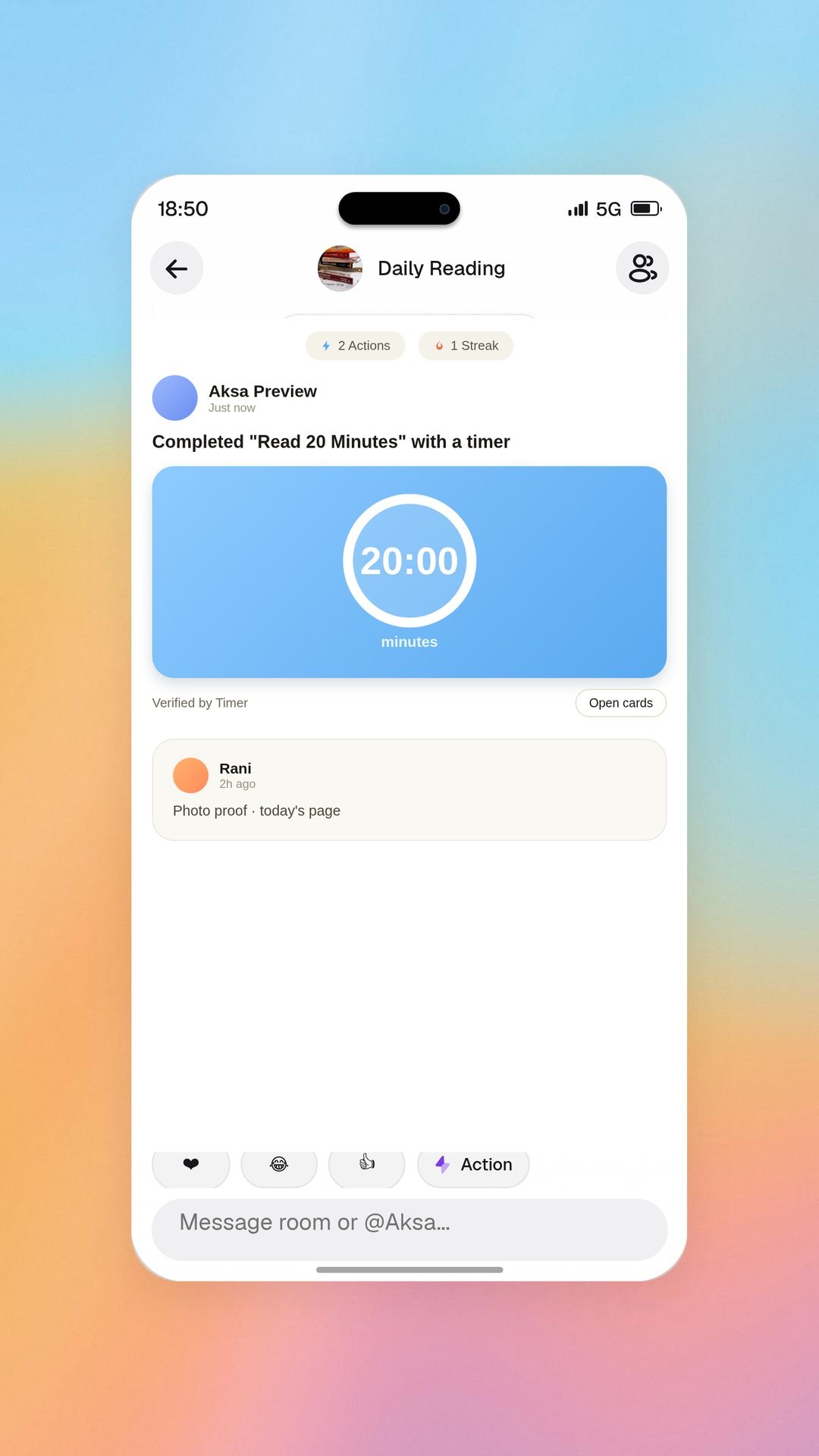
Aksa is a social platform with an AI agent. Every session's mini-finish becomes dated proof - a screenshot as a Photo, the day's word count as a Counter, a written Answer naming what got done - and streak counts move only on verified proof days. The record converts invisible middle-weeks effort into a visible asset you protect.
The Aksa AI Action agent covers the plan side: it helps decompose the goal into provable daily actions at setup and answers questions when you stall - including the 'what is the next finishable slice' question that stalls most middles. It never marks work done: Verified Done requires durable proof and the verification rule for the Action.
Rule four is the witness: one person, or a small Action Room of fellow finishers, who sees the record. In a November 19, 2020 post on the Duolingo blog, the company reported that users reaching a 7-day streak were 2.4 times more likely to still be active the next day than users without one - a witnessed streak protects itself, and the boring middle is exactly where that protection earns its keep.
Set up the finisher's system in Aksa
Twenty minutes tonight, and the finish line exists.
- 1. Pick ONE unfinished thing - the one that stings most - not the whole backlog.
- 2. Write its 'done' sentence and cut it until a stranger could check it: reachable in two to six weeks.
- 3. Create the Goal with the sentence and the finish date.
- 4. Add session Actions on your fixed days with proof - counter, photo, timer, or written answer.
- 5. Set Reminders for the sessions - Repeat on those days, Alarm switch on.
- 6. Create an Action Room or name one witness - each friend who joins through your invite and finishes onboarding earns one month of Premium for both of you, up to five friends.
The last 10 percent is a different country
Finishing has its own final boss: the last stretch, where the end is visible and suddenly the standards inflate. 'It is not ready' is the middle's cousin - the same fear, dressed as quality. The counter is the definition you wrote on day one: done is the sentence, not perfection. Ship at the sentence.
Then do the part people skip: mark it finished. Submit the final proof, tell the room, take the evening. Finishing is a skill, and skills consolidate when they are acknowledged - the next start is easier precisely in proportion to how deliberately you closed the last finish.
Over time the identity follows the record: a profile of finished things - courses completed, projects shipped, challenges closed - is evidence that contradicts the old story every time it tries to tell itself. You stop being someone who never finishes because, verifiably, you finish.
The graveyard audit
One exercise before starting fresh: list everything you have started and abandoned - books, courses, projects, instruments - and for each, write one line on where it died. Not why, where: chapter four, week three, the first refactor, module two.
The pattern in the where is the diagnosis. If everything dies in the middle, the fix is feedback and witnesses. If everything dies at the start, the fix is scope - the first step was too big. If things die at the end, the fix is the day-one definition of done. One audit, one line per corpse, and the next project starts with the specific repair instead of generic resolve.
FAQ
Why do I lose interest in everything I start?
Usually two causes stacked: the middle's feedback desert - starts pay in novelty, middles pay in nothing - and an undefined finish line that makes the thing unfinishable by design. Define 'done' small and checkable, and manufacture middle feedback with session-level proof and a witness. Interest follows progress; it rarely leads it.
Is it OK to quit a project that is not working?
Yes - deliberate quitting is a decision, drifting is not. Write down why you are stopping and what you learned, close it, and move on cleanly. The graveyard only claims projects that were never decided about. Finish small things often, and quit the big wrong things deliberately - both build the same skill of choosing.
How do I finish a project I have already abandoned once?
Restart it as a new project with a smaller 'done.' The old scope died once already - believe it. Cut the finish line to what is reachable from today in two to six weeks, schedule two sessions a week, and prove every session. The second start with an honest sentence beats the fifth revival of the original fantasy.
How many projects should I work on at once?
One, until it is finished - two at most if one is in a waiting state. Every parallel project multiplies the number of middles you must survive simultaneously, and middles are where projects die. Sequential finishing looks slower and ships more.
What if I finish things at work but never personal projects?
That is the feedback difference, not a character difference: work provides deadlines, pay, and witnesses; personal projects provide none unless you build them. Give the personal project the same three - a defined finish date, dated proof, and a witness - and the finisher you already are at work shows up at home.
How long should a finishable project be?
Two to six weeks of part-time work for training purposes. Long enough to have a real middle - that is the muscle being trained - short enough that the finish line stays visible. Once the finish muscle is proven on month-scale projects, longer ones become possible.