How to Fix Your Sleep Schedule in 30 Days (Without Going Crazy)
Fix a broken sleep schedule with one fixed wake time, morning light, an evening cutoff, and daily proof. The science, the 30-day plan, setup steps, and FAQs.
Published October 27, 2026 · 7 min read
The short answer
Fix a broken sleep schedule by locking your wake time to one hour, seven days a week, and holding it for 30 days - with morning light, a caffeine cutoff, and a screen curfew as supporting habits. Wake time is the only end of sleep you can directly control; control it and bedtime follows.
This guide covers why the wake time is the lever, the week-by-week plan, and the accountability setup that keeps you honest through the brutal first ten days.
Why you cannot fix bedtime directly
Every failed sleep-schedule fix starts the same way: deciding to 'get to bed earlier.' It fails because sleep onset is not voluntary - you cannot make yourself sleepy at 10 PM by decree, you can only lie there negotiating with the ceiling. The attempt collapses within days, and the schedule stays broken.
Wake time, by contrast, is fully voluntary: an alarm plus feet on the floor is a decision, not a negotiation. And wake time is the input the body clock actually reads. Sleep researchers describe the circadian rhythm as anchoring to morning light and morning activity - Roenneberg and colleagues' 2012 study in Current Biology on social jetlag found that social jetlag - the gap between the body clock and the social clock - results in chronic sleep loss and is associated with increased BMI.
The mechanism is simple pressure: wake at 6:30 every day and sleep pressure builds evenly every day, so sleepiness arrives at roughly the same hour every night. Wake at 6:30 on Tuesday and 9:45 on Saturday and the pressure never knows when to build - which is exactly the 'tired all day, wired at midnight' pattern most people call a broken schedule.
The four rules of the 30-day reset
Rule one: one wake time, seven days a week, chosen for your worst morning. Not your aspirational Monday - your realistic Saturday. If 7:00 is unsustainable on weekends, the honest time is 7:30, and 7:30 held seven days beats 6:00 held four.
Rule two: morning light within an hour of waking. Ten minutes outside or beside a bright window is the strongest legal circadian signal there is - light is the input that tells the clock 'this is morning,' and it is free.
Rule three: a caffeine cutoff eight hours before your target bedtime. Caffeine's half-life runs around five to six hours in most adults, so the 3 PM coffee is still on duty at midnight. Move the last cup to mid-afternoon or earlier and let chemistry do the rest.
Rule four: a screen curfew in the last hour. Not because blue light is the villain of the decade - the evidence on light itself is more modest than the headlines - but because the scroll is engineered to be more interesting than sleep, and it wins every open contest. Give sleep a fair fight.
Week by week: what the reset feels like
Days 1-5 are the hard part: you are waking earlier than your body wants on a sleep debt, and afternoons are rough. Do not nap longer than 20 minutes and do not 'catch up' by sleeping in - the debt is what makes the first early bedtime possible.
Days 6-10, sleepiness starts arriving earlier at night - the first sign the lever is working. This is the week most people blow it with one late weekend; protect Saturday and Sunday hardest precisely here.
Days 11-20, mornings stop feeling like theft. Waking near the alarm - or just before it - becomes normal, and bedtime starts regulating itself without any effort aimed at it.
Days 21-30, the schedule is installed but young. In a 2009 study by Lally and colleagues in the European Journal of Social Psychology, habits reached a median of 66 days to automate - so treat day 30 as the end of the repair, not the end of the protection. The wake time stays fixed; the vigilance can relax.
Prove every morning
A sleep reset lives or dies on morning honesty, and morning honesty needs a record. Aksa is a social platform with an AI agent. A morning Check-in or a photo proof - the sunrise, the made bed, the coffee - produces dated evidence for every wake-up, and streak counts move only on verified proof days. Two weeks in, the streak is a thing you own and protect.
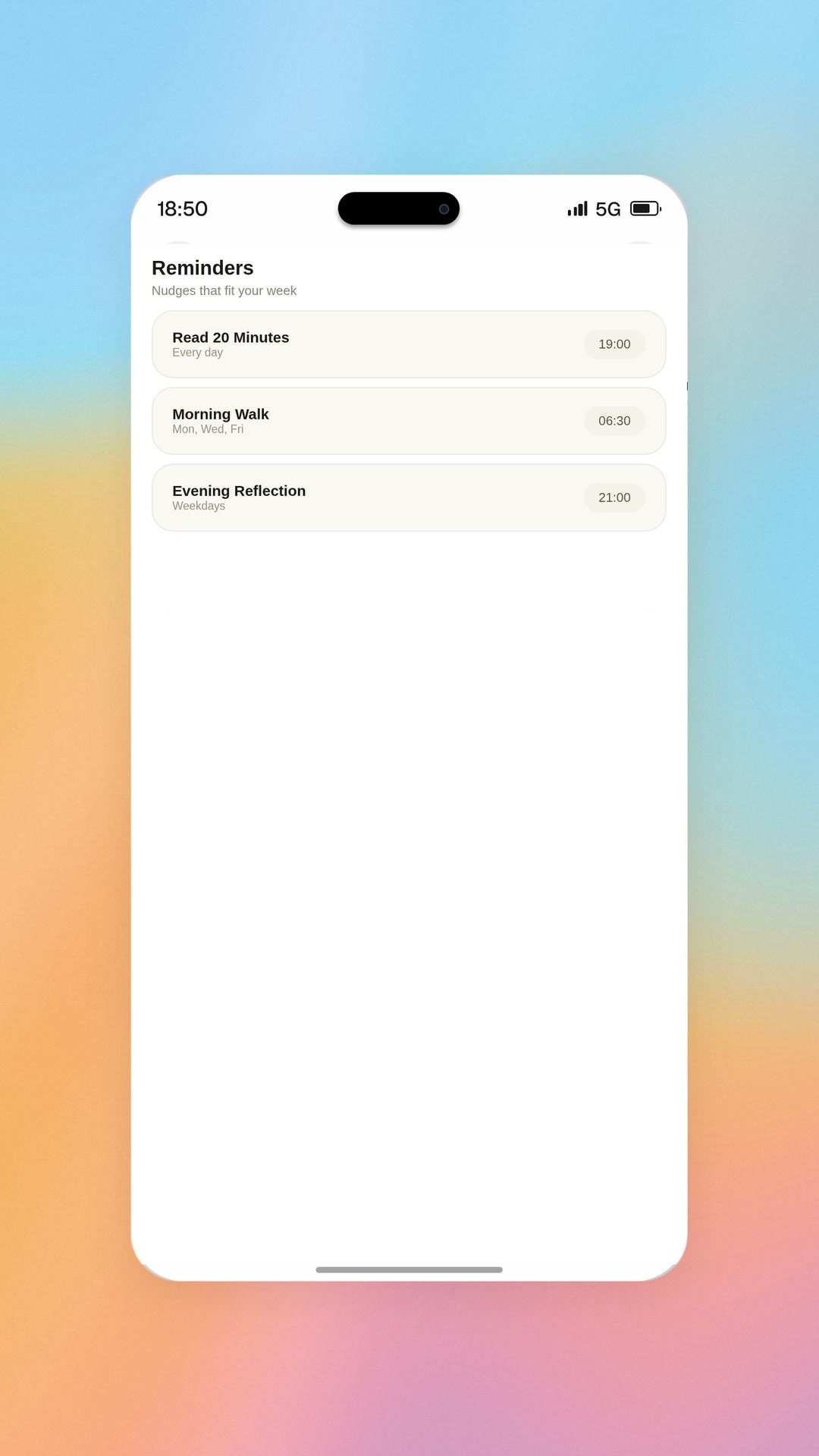
The reminder layer is built for exactly this: a Reminder can repeat Every Day, Weekdays, Weekends, or any days you pick, and its Alarm switch makes it ring as an alarm rather than a notification. For a schedule reset, Every Day is the setting that matches rule one - the body clock does not know what a weekend is.
Aksa is a community built on the same loop this reset uses: a daily action, dated proof, and a count that only moves on the real thing.
Set up the reset in Aksa
Ten minutes tonight, and tomorrow morning is day one.
- 1. Choose your single wake time - the one that survives your worst Saturday - and write the Goal: 'Wake at [time] every day for 30 days.'
- 2. Add a daily Action with a morning proof: a check-in at the wake time or a photo within 30 minutes of it.
- 3. Set the Reminder a few minutes before the wake time, Repeat Every Day, Alarm switch on - an alarm, not a notification.
- 4. Add the three supporting rules as evening Actions if you want them tracked: caffeine cutoff, screen curfew, and tomorrow's wake time confirmed.
- 5. Move the phone's charger out of the bedroom tonight - the alarm rings, the feet hit the floor, the scroll cannot intervene.
- 6. Review the streak and your sleep notes every Sunday - one adjustment per week, and the Weekly Arena resets every Monday.
Special cases: shifts, jet lag, and night owls
Shift workers should anchor to wake-time-relative rules instead of clock times: fixed wake time after each main sleep block, light on waking, dark before bed - whatever 'morning' and 'night' mean on your roster. The lever is the same; only the clock face changes.
For jet lag, the fix is aggressive morning anchoring at the destination: wake at the local target time from day one, get outside light early, and refuse the long afternoon nap. Most people adapt at roughly a day per time zone crossed.
And if you are a genuine night owl: the goal is a stable schedule, not a 5 AM one. A fixed 8:30 wake time held seven days a week is a repaired schedule. Consistency is the medicine; earliness is just a preference with good marketing.
The 30-day sleep log that keeps you honest
Keep one line per day alongside the proof: wake time, approximate sleep time, and a 1-5 rating of how the day felt. Thirty lines is enough to see the pattern the whole reset is chasing - sleepiness creeping earlier, mornings getting easier, the rating climbing - and it gives the Sunday review something real to read.
The log also catches the false negative: the week that feels like failure but shows wake times within 15 minutes of target every day. Feelings about sleep are unreliable narrators; the record is not. Trust the thirty lines over the three bad mornings you remember vividly.
FAQ
What is the fastest way to fix a sleep schedule?
Lock one wake time seven days a week and hold it - that single lever moves the whole schedule within two to three weeks. All-nighters and 'reset weekends' do not work; the body clock reads consistent morning light and wake time, not heroic one-off efforts.
Should I sleep in on weekends to catch up on rest?
No - weekend lie-ins are the main way schedules stay broken. Sleep researchers call the weekday-weekend gap social jetlag, and a 2012 Current Biology study by Roenneberg and colleagues found the gap results in chronic sleep loss and is associated with increased BMI. If you are short on sleep, go to bed earlier rather than waking later.
How long does it take to reset a body clock?
Expect the shift to build gradually across consistent days of a fixed wake time; consistency, not intensity, is what moves the clock. Habit research (Lally and colleagues, European Journal of Social Psychology, 2009) puts full automaticity at a median of 66 days, so protect the wake time for at least two months.
Does the caffeine cutoff really matter?
Yes - caffeine's half-life is around five to six hours in most adults, so a 4 PM coffee can still be active at midnight. An eight-hour cutoff before your target bedtime is the standard sleep-hygiene recommendation, and for many people it is the single change that unlocks earlier sleepiness.
What if I naturally function better at night?
Then fix a later schedule, not an earlier one: a stable 9 AM wake time held daily beats a chaotic 6 AM ambition. Chronotypes are real, and the repair target is consistency, not earliness - the body clock cares that mornings are predictable, not that they are early.
Can I nap while fixing my sleep schedule?
Keep naps to 20 minutes and before 3 PM, or skip them during the first two weeks. Long or late naps discharge the sleep pressure the reset depends on - the mild afternoon fatigue of week one is the engine of your first natural early bedtime.