How to Focus Better: 8 Ways to Protect Your Attention in a Distracted World
Eight evidence-based ways to focus better - from timed deep-work blocks to environment design and app blocking - plus a daily proof setup that makes focus measurable.
Published October 27, 2026 · 7 min read
The short answer
Focus improves when you stop asking attention to fight an unwinnable battle: remove the engineered distractions from reach, work in timed single-task blocks, and keep a dated count of real focus sessions. Environment first, timer second, record third - willpower is not on the list.
Here are eight methods that work mechanically, the evidence behind the key ones, and the setup that turns 'I should focus more' into a countable daily practice.
Why attention feels broken
Your attention is not broken; it is outnumbered. The average person now spends hours a day inside apps engineered by thousands of specialists to be more compelling than whatever you were doing - DataReportal's Digital 2024 report estimated average daily internet use around 6 hours 40 minutes. Asking raw willpower to win that contest, hundreds of times a day, is a design failure, not a personal one.
The second problem is the switching cost. Workplace task-switching research has found that regaining full focus after an interruption takes minutes, not seconds, and it documented the fragmented, self-interrupting rhythm of real knowledge work. Every 'quick check' is paid for in re-entry time.
So the methods below share one philosophy: change the number of battles, not your performance in them. Focus that must be re-won every four minutes is not focus; it is a siege.
Methods 1-3: the environment layer
Method 1: the phone leaves the room. Not silenced - gone. The mere presence of a phone measurably taxes attention; a 2017 study by Adrian Ward and colleagues in the Journal of the Association for Consumer Research found that even a face-down, silenced phone reduced available cognitive capacity. Distance is the setting that works.
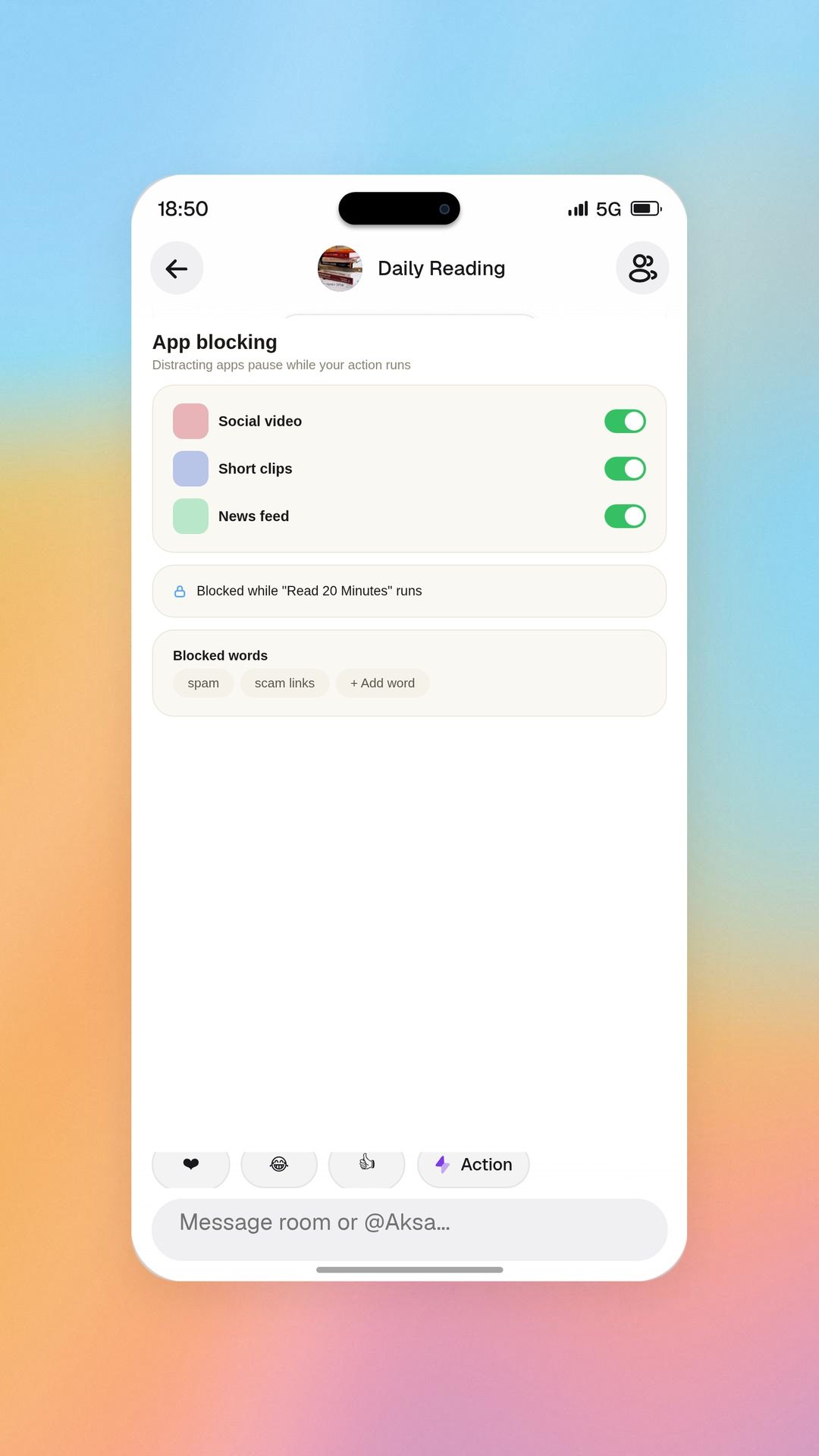
Method 2: block the loops at the source. The willpower-free version of app limits is a block list: Aksa includes app blocking. The block removes the negotiation entirely, which is the entire point.
Method 3: one workspace, one signal. Work in a consistent spot and the place becomes a cue for the mode - the same mechanism that makes kitchens trigger snacking makes a desk trigger focus. If the desk must serve double duty, a small ritual - headphones on, specific playlist, phone in the drawer - can carry the signal instead.
Methods 4-6: the time layer
Method 4: timed blocks. Single-task in bounded sessions - 25 minutes is the classic pomodoro default, 50 suits deeper work - with a real break between. The deadline focuses attention the way a visible finish line changes a runner's pace, and the break keeps block four as honest as block one.
Method 5: one named task per block. 'Work on the project' invites drift; 'draft the methods section' has a finish line. Cal Newport's Deep Work (2016) made the broader case: sustained single-tasked attention is the scarce skill of knowledge work, and it is trained in bounded sessions, not summoned.
Method 6: protect the first hour. The morning's first focus block is the highest-leverage session of the day, before the inbox and the feeds start bidding. In a 1999 American Psychologist paper, Peter Gollwitzer showed when-then plans substantially raised follow-through - 'when I sit down with coffee, the timer starts on the day's one task' is a pre-made decision the morning cannot talk you out of.
Methods 7-8: the body and the record
Method 7: sleep, movement, and glucose are attention infrastructure. A short night's sleep taxes the exact prefrontal functions focus runs on; a ten-minute walk measurably lifts alertness. Before concluding your attention is defective, audit the inputs - many 'focus problems' are sleep problems in costume.
Method 8: keep a dated count. Focus that is not measured drifts back to default within weeks. Aksa is a social platform with an AI agent - the Timer proof format records a bounded session as dated evidence, and streak counts move only on verified proof days. 'Four honest blocks every weekday' becomes a provable sentence with a visible record, not a New Year's intention.
The Aksa AI Action agent helps decompose the goal into provable daily actions and plans the next step when you stall - but never marks a block done: Verified Done requires durable proof and the verification rule for the Action. You bring the attention; the system keeps the score.
Set up the focus system in Aksa
Ten minutes of setup, and today's first block counts.
- 1. Create the Goal as a provable sentence: 'Complete 4 timed focus blocks every weekday.'
- 2. Add a daily Action with the Timer proof format - countdown or stopwatch - for the sessions.
- 3. Set the environment: phone out of the room, and block your most magnetic apps.
- 4. Set a Reminder for the first block of the day, Repeat Weekdays - a started morning block changes the day's whole trajectory.
- 5. Keep a capture list during blocks: intruding thoughts get written down and handled at the bell, never served live.
- 6. Review the week's count every Friday: total blocks, best day, and the interruption that keeps recurring - that recurring one is next week's single fix.
What improvement actually looks like
Focus gains arrive quietly: week two, the 25-minute block stops feeling long; week four, you notice you finished something before lunch; week six, the phone-in-another-room rule stops requiring a rule. In a 2009 study by Lally and colleagues in the European Journal of Social Psychology, habits reached a median of 66 days to automate - attention is trained the same way, one bounded session at a time.
The count is how you know it is working. Not the feeling of a focused week - the dated record of blocks, visible on a profile, building a streak you do not want to break. Attention retrained this way does not announce itself; it just shows up in finished work.
Focus for people with chaotic schedules
The standard objection is that blocks require a predictable day, and many people do not have one. The answer is to anchor the block to events instead of clock times: after the morning coffee, after the commute, after the kids' bedtime. Event anchors survive schedule chaos because the events happen even when the hours slide.
Shrink the unit on the worst days rather than skipping it: one 15-minute block with a named task and a timer is a proven session, and it keeps the streak and the identity intact. Chaotic weeks are exactly when the record matters most - it proves the practice survived the chaos, which is what makes it a practice instead of a fair-weather hobby.
FAQ
Why can't I focus even when I try hard?
Because trying hard fights the wrong battle. Focus fails from environment and switching costs - a phone in reach, dozens of daily micro-interruptions - not from insufficient effort. Remove the phone from the room, block the two most magnetic apps, and work in timed blocks; attention returns when the siege ends.
Does phone presence really affect concentration?
Yes - a 2017 study by Adrian Ward and colleagues in the Journal of the Association for Consumer Research found that even a silenced, face-down phone reduced available cognitive capacity, an effect dubbed 'brain drain.' The phone does not need to ring to tax attention; proximity alone does it. Another room is the fix.
How long does it take to rebuild an attention span?
Expect noticeable change in two to four weeks of daily timed blocks, with the habit stabilizing around the two-month mark - habit research (Lally and colleagues, European Journal of Social Psychology, 2009) runs a median of 66 days to automaticity. The gains arrive quietly: blocks feel shorter, finishes come earlier.
Are focus apps and website blockers worth using?
Blockers are among the few focus tools with a clean mechanism: they remove the decision entirely. Aksa's app blocking keeps chosen apps blocked until midnight. A block beats a limit you can override in a weak moment, because it never asks the weak moment.
Is multitasking ever efficient?
Not for cognitively demanding work - what feels like multitasking is rapid switching, and switching costs re-entry time on every jump. Real knowledge work has become fragmented and self-interrupting. Single-tasked blocks out-produce switches even when they feel slower.
What is the single fastest focus fix I can do today?
One 25-minute timed block on one named task with the phone in another room. It takes 30 minutes including the break, works the first time you try it, and teaches the whole system in one loop: the task gets a finish line, the timer bounds the effort, and the break resets you for the next one.
Can music or background noise help focus?
For routine work, familiar instrumental music or steady ambient noise can help by masking unpredictable sound - the true attention killer. For demanding reading or writing, most people do better in quiet or with very familiar audio that requires no listening. Test it across a few timed blocks and let your own count decide.