How to Hold Yourself Accountable: 7 Methods That Actually Work
Seven accountability methods ranked by what the evidence supports: implementation intentions, commitment devices, proof of work, social witnesses, and more - plus a 5-minute setup in Aksa.
Published October 26, 2026 · 7 min read
The short answer
You hold yourself accountable by making commitments specific, visible, and witnessed: define the exact daily action, require dated proof that it happened, and give at least one other person a view of the record. Willpower-based promises to yourself fail; structure-based ones survive bad days.
Below are seven methods ordered from weakest to strongest, the research behind the ones that work, and a five-minute setup that combines the strongest three.
Why 'trying harder' is not an accountability method
Most people's accountability system is a mood: feel guilty, resolve to do better, repeat. The problem is structural - a promise that lives only in your head has no specification, no evidence, and no witness, so it can be quietly renegotiated at any moment. Nobody is present to object when 'go to the gym' becomes 'I earned a rest day' at 7 PM.
Every method that works replaces one of those three gaps. Specificity removes the negotiation about what counts. Evidence removes the negotiation about whether it happened. A witness removes the privacy that makes silent failure free. Keep that triad in mind as you read the seven methods - the strong ones score three out of three.
Method 1-2: intentions done right
Method 1: implementation intentions. Instead of 'I will exercise more,' write 'When it is 6:30 AM on a weekday, I put on running shoes and leave the house.' In a 1999 paper in American Psychologist, Peter Gollwitzer reviewed a program of research showing this when-then format has strong effects on follow-through, because the decision is pre-made and the cue does the triggering.
Method 2: write the goal as a provable sentence. 'Get fit' is unverifiable; 'complete 30 gym sessions by March 1' has a number and a date. This sounds like wordplay but it is the difference between a goal that can be checked and a goal that can only be felt. In Aksa, goals are written exactly this way - one provable sentence - because the whole proof system downstream depends on the sentence being checkable.
Method 3-4: evidence and streaks
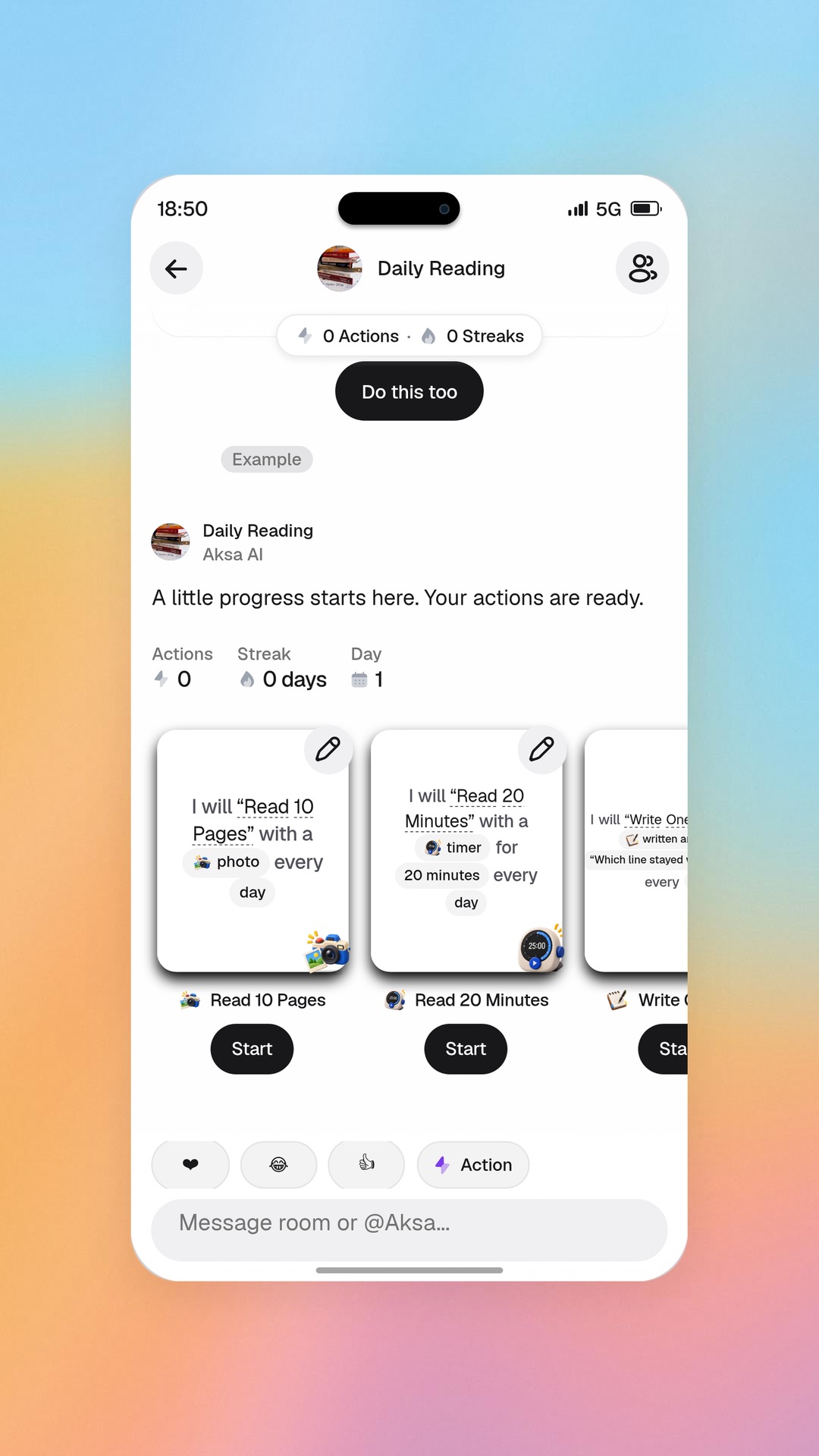
Method 3: proof of work. Require each day to produce a dated artifact - a photo, a written answer, a counted total, a timed session. The artifact kills the most common self-deception, which is rounding the day up: 'I basically worked out' cannot survive a request for the photo. Aksa is a social platform with an AI agent, and every daily Action maps to one of six proof formats - photo, answer, counter, timer, check-in, or confirm - with honesty labels that keep weak evidence from being upgraded into verified proof.
Method 4: a visible streak. A count that only moves on verified days turns consistency into an asset you own, and people protect assets. In a November 19, 2020 post on the Duolingo blog, data scientist Anton Yu reported that users who hit a 7-day streak were 2.4 times more likely to still be practicing the next day. The important design detail is the 'only moves on verified days' part - a streak you can fake is just a number you stop respecting.
Method 5-7: people, and what they change
Method 5: one witness. Tell one person exactly what you will do daily and show them the record weekly. This is the minimum viable audience and it changes the economics of skipping: a miss is no longer free, because it will be seen.
Method 6: a group working the same goal shape. A small room beats a big audience - two to five people with the same daily action creates mutual expectation without performance anxiety. The quiet mechanism here: proof that gets seen and answered is proof you keep submitting.
Method 7: a standing commitment with a cost. Commitment devices - stakes, deposits, public declarations - raise the price of failure. They work, but they are also the easiest to overdo; start with methods 1 through 6, which cost nothing, and add stakes only if the record shows you need them.
Set up the full system in Aksa
The setup combines the strongest three methods - provable goal, daily proof, and a witness - in about five minutes.
- 1. Write the goal as one provable sentence with a number and a date, like '40 gym sessions by March 1.'
- 2. Break it into a daily Action with a proof type attached - photo, answer, counter, timer, check-in, or confirm.
- 3. Set a Reminder at the action's real time - Repeat can be Every Day, Weekdays, Weekends, or any days, with an Alarm switch if notifications are too easy to ignore.
- 4. Let Aksa AI decompose the goal into provable daily steps at setup - the agent plans the next step and nudges when you stall, but never marks anything done without proof.
- 5. Create or join an Action Room with two to five people on the same goal shape and post your proof where the room can see it.
- 6. Review your streak count and the room heatmap every week - both count only verified proof days, so the record stays trustworthy.
What to do after a failure
The system's real test is the first broken day. Handle it the way the research suggests: in a 2009 study by Lally and colleagues in the European Journal of Social Psychology, missing one day did not materially affect habit formation - the median habit took 66 days to automate, with a range of 18 to 254 days, and single misses were noise. The danger is the narrative that one miss becomes ('I blew it') rather than the miss itself.
Log the failure honestly in the record - a gap on the heatmap is information, not shame - write one line about the cause, and submit proof the next day on time. Accountability that survives failure is the only kind worth having, because failure is guaranteed.
The 30-day accountability challenge
If you want to test the full stack, run it as a 30-day challenge: one provable goal, one daily action with proof, one room, one witness, 30 days. The timebox matters - 'forever' is too big to start, and '30 days' is short enough that the end is always in sight but long enough for the record to start meaning something.
By day 30 you will know which of the seven methods carries you. Most people discover the witness was doing more work than the willpower ever did - which is not a character flaw, it is the finding. Build the system around the witness and let motivation be a bonus, not the foundation.
Accountability for people who hate accountability
A fair objection: some people hear 'accountability' and picture surveillance, guilt, and a room full of scorekeepers. If that is you, reframe the record as a mirror rather than a judge. The heatmap does not care about your excuses or your intentions; it simply shows what happened, which is exactly what makes it useful.
Start with the private version - provable goal, daily proof, streak - and add the witness only when the streak alone stops moving you. Structure scales up as needed; the mistake is starting with none because the strongest version felt uncomfortable.
FAQ
What is the fastest way to start holding yourself accountable?
Write tomorrow's action in when-then form and decide what proof it will produce. 'At 6:30 AM I put on running shoes and leave, proof is a photo of my watch at the door.' That takes two minutes and combines the two strongest low-cost methods: an implementation intention plus defined evidence.
Is an accountability partner better than an app?
They solve different problems. A partner provides a witness; an app provides the specification, the evidence, and the record. The strongest setup combines both - a small group around a shared proof system - because a partner without a record is guessing, and a record without a witness is easy to quietly abandon.
Why do I keep breaking promises to myself?
Usually because the promise was vague, unverified, or private - or all three. 'Eat better' has no checkable meaning, produces no evidence, and no one sees it fail. Tighten the sentence, require dated proof, and add one witness. The promise was not weak; the structure around it was missing.
Do punishment-based systems work for accountability?
Stakes and penalties raise follow-through in the short term, but they are easy to overdo and can make the goal aversive. Start with free structure - provable goals, daily proof, streaks, and a witness - and add costs only if the record shows you still skip. Positive visibility usually outlasts fear.
How many habits should I track at once?
One, until it is stable - then add a second. Every additional daily action multiplies the chance of a total-collapse day where everything gets skipped together. A 30-day head start on habit one makes habit two dramatically easier to install.
What if I have no one to be my witness?
Join a room of strangers working the same goal shape - shared context matters more than prior friendship. Posting proof where two to five people see it creates the same expectation as telling a friend, and the record does most of the work either way.