How to Keep a Streak Alive: 9 Rules From People Who Never Break the Chain
Long streaks survive on floors, triggers, proof, and recovery rules, not willpower. Nine practical rules for protecting your streak through travel, illness, and bad weeks.
Published October 24, 2026 · 7 min read
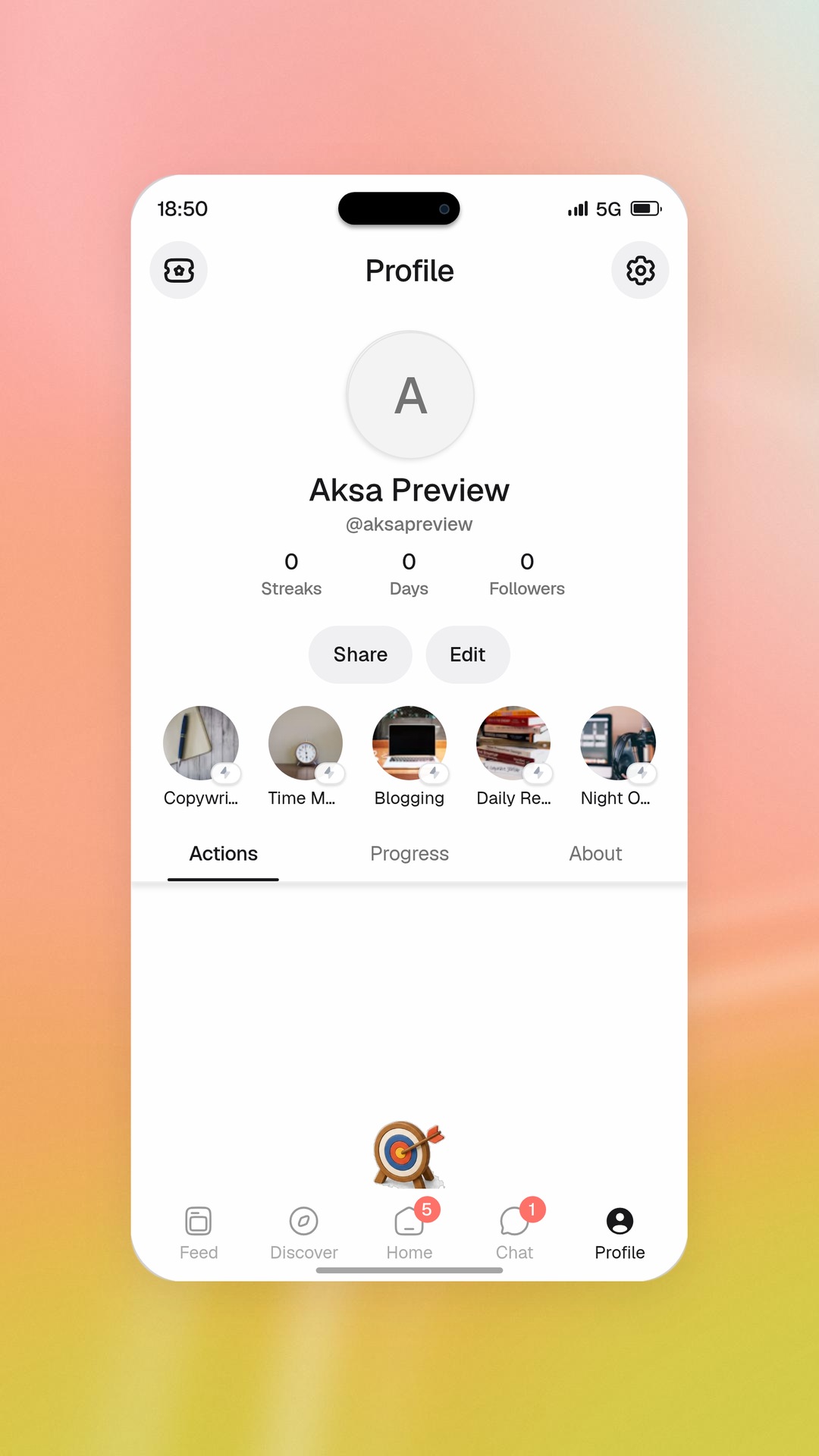
The direct answer
Aksa is a social platform with an AI agent. You keep a streak alive by making the daily unit small enough for your worst day, tying it to a fixed trigger, requiring proof you cannot fake, and deciding the recovery rule before you ever need it. Long streaks are engineered, not willed.
Every rule below targets one documented failure point. They work for any streak, and each maps to a concrete feature in Aksa, a social platform with an AI agent, where streaks move only on verified proof.
A note on honesty before the rules: this guide treats the streak as a strict contract, not a vibe. Some apps let you pause or repair a chain; Aksa does not, by design, because a streak that only moves on verified proof is a reputation, and reputations are worth protecting precisely because they cannot be edited.
Rule 1: shrink the floor until skipping feels silly
The single biggest streak killer is an oversized daily unit. "Run 5K daily" breaks at the first rain; "run ten minutes daily" survives almost anything. The floor is not the ambition; it is the insurance policy on the chain.
Duolingo's published data proves the principle at scale. In a November 19, 2020 post on the Duolingo blog, engineer Anton Yu reported that learners with the most intense daily goals were the least likely to hold a streak, and that reducing the daily requirement to a single lesson raised day-14 retention by 3.3 percent and lifted the share of daily learners on streaks by 10.5 percent within 20 days.
In Aksa, set the floor as the daily Action and treat anything above it as bonus. A Counter of ten pushups, a Timer of five minutes, one photo Submit. The streak counts the floor, and the floor is unmissable by design.
Rule 2: anchor to a trigger, not a time
Clock times shift; routines persist. Attach the action to something that happens every day regardless of schedule: after coffee, after the commute, before the shower. Anchored actions survive weekends, holidays, and time zones because the anchor travels with you.
Then set the app reminder at the anchor's natural hour in Aksa's notification preferences. The reminder is the backup for the days the anchor slips, not the primary mechanism.
Test the anchor by asking: does this trigger exist on my worst, weirdest day? "After morning coffee" survives a red-eye flight. "At 7am" does not.
There is a trust benefit on the other side too: when your streak is proof-backed, other people believe it. A 200-day chain built on photos, timers, and counters is evidence of character you can literally show, on your profile, in the room, on the leaderboard. Unverifiable streaks buy no such credibility, because everyone suspects the tap.
Rule 3: require proof you respect
A streak that moves on a tap will eventually move for nothing, and a streak that lies to you stops mattering to you. The chain stays sacred only if every link is real.
Aksa enforces this structurally: every daily Action runs on one of six proof primitives, Submit for photo or video, Answer for reflections, Counter for repetitions, Timer for focus sessions, Check-in for presence, and Confirm for binary commitments, and progress counts only verified proof, never an unverified tap.
The proof also builds your defense against doubt. The consistency heatmap, momentum chart, and 3-month Photo Calendar on your profile mean that on day 200 you can scroll back and see day 3. Streaks with archives are harder to abandon than streaks with only a number.
Rule 4: get a witness before you need one
Solo streaks depend on a single point of failure: your evening self. A witness, one friend or a small room, changes the economics of a tired day, because skipping becomes visible before it becomes permanent.
Aksa Action Rooms are built for this: members post daily proof in a shared space, claim cards broadcast verified actions with the streak attached, and cheers arrive as push notifications. In a company database pull from late September 2026, 36% of proofs received a social response.
Choose witnesses for reliability, not enthusiasm. The friend who posts daily and says little protects your streak better than the cheerleader who vanishes in week two.
One more pre-decision: define what does NOT break the streak in your own rules. If the floor is ten minutes and you did ten minutes, the day counts, even if it felt pathetic. Long streaks are killed as often by people moving their own goalposts mid-bad-week as by any external event. The floor is the contract; honor it exactly, no more and no less.
Rule 5: pre-decide the bad-day protocol
Travel, illness, and deadline weeks are not surprises; they are certainties with unknown dates. Decide the protocol now: on travel days the floor shrinks to two minutes, on sick days the action converts to an Answer reflection, on deadline weeks the trigger moves to morning.
Write the protocol where the streak lives. A note in the room chat or the goal description is enough. Under stress you will not invent a good protocol; you will only follow one that already exists.
And use offline resilience: Aksa saves proof locally and syncs when connectivity returns, so dead zones and flights never force a broken link. The chain should bend around your life, not snap on it.
Rule 6: run the 24-hour recovery rule
Every long streak holder has the same secret: they missed, once or twice, and they had a rule for it. After any miss, the next day's floor action is non-negotiable. One miss is an event; two misses are a new pattern; the rule exists to stop the second miss, not to mourn the first.
Aksa's weekly rhythm adds a clean-slate mechanism on top: the Weekly Arena resets Individual, School, and City leaderboards every Monday at 00:00 UTC, so competition standing forgives on a schedule even while your personal record stays honest.
Skip the compensation trap after a miss. Doubling tomorrow to pay for today re-inflates the daily unit and sets up the next break. Return to the floor, quietly, and let the chain resume.
Rules 7 to 9 and the setup
Rule 7: celebrate milestones loudly. Claim cards and cheers exist because recognition at day 30, 100, and 365 is the interest the streak pays. Rule 8: never let the app be the only record of your intention; tell one human the goal in words, because spoken stakes survive deleted apps. Rule 9: review the system monthly, not the streak. Ask whether the floor is still small, the anchor still holds, the room still watches, and adjust the machinery instead of judging yourself.
The full setup takes one evening:
Do those, and the streak stops being something you defend and becomes something that defends you.
- 1. Set the floor version of your daily action, sized for your worst day, as the Action in Aksa.
- 2. Anchor the action to an existing daily routine, with one reminder at the anchor's hour.
- 3. Choose the proof primitive that makes skipping impossible to fake: photo, timer, counter, reflection.
- 4. Join or create an Action Room with one to four reliable witnesses.
- 5. Write the bad-day protocol for travel, illness, and crunch weeks into the room chat.
- 6. Agree the 24-hour recovery rule, then complete today's floor action immediately.
FAQ
What is the most common reason streaks break?
An oversized daily unit meeting the first hard day. Travel, illness, and busy weeks only break streaks whose floor was set for good days. Duolingo's published experiment showed intense daily goals produced the fewest streaks. Shrink the floor until skipping feels silly, and the chain survives real life.
Should I use streak freezes or pause features?
That is a personal contract question. Duolingo's Streak Freeze keeps people returning, per its January 2022 blog data, but a pausable streak is a softer contract. Aksa takes the strict line: streaks move only on verified proof. Many people find the stricter number more meaningful, and meaning is what protects the chain.
What do I do the day after my streak breaks?
Run the 24-hour rule: complete the floor action that day, no exceptions and no compensation doubling. One miss is an event; the second consecutive miss is the pattern. Then check the heatmap honestly: the new chain starts today, and a visible archive keeps the old record as evidence you can rebuild.
How do I keep a streak while traveling?
Pre-decide a travel protocol: shrink the floor to two minutes, anchor the action to a routine that travels like morning coffee, and rely on offline proof. Aksa saves submissions locally and syncs when connectivity returns, so flights and dead zones never force a broken link.
Do streak apps actually improve consistency?
Only when the streak is real. A number that moves on taps inflates and then stops mattering. A streak that moves only on verified proof, backed by witnesses in an Action Room and a visible archive like Aksa's heatmap and Photo Calendar, becomes a reputation you protect, and protected reputations change behavior.
Is it unhealthy to care about a streak too much?
It can be, when the number replaces the goal. The streak is a delivery mechanism for the habit, not the habit itself. Keep the floor genuinely small, keep the recovery rule kind, and review the system monthly rather than obsessing daily. Aksa's weekly leaderboard reset builds scheduled perspective into the product for exactly this reason.