How to Learn an Instrument as a Busy Adult: 20 Minutes a Day
Learn an instrument as an adult with 20-minute daily practice, a provable session record, and realistic milestones. The method, the first 90 days, setup steps, and FAQs.
Published October 28, 2026 · 7 min read
The short answer
Learn an instrument as a busy adult with 20 minutes of structured practice every day - five on technique, ten on songs, five on something fun - proven daily with a dated record. Frequency beats duration: twenty minutes daily builds the skill; two weekend hours builds guilt.
This guide covers why adult learners quit, the structure of an effective 20 minutes, realistic milestones for the first 90 days, and the proof habit that keeps practice alive through the plateau.
Why adults quit instruments
The adult quit pattern is stable: buy the instrument, practice enthusiastically for two weeks, hit the first plateau where progress becomes invisible, miss a week, and discover the instrument in the closet in 2029. The cause is not talent or age - adult learners actually progress well with structure - it is the collision of an invisible-progress plateau with a schedule that has no protected slot.
Children survive this phase because someone else holds the structure: a teacher, a parent, a lesson time. Adults have to build the scaffolding themselves - a fixed daily slot, a defined session structure, and a record that shows progress the fingers cannot yet feel.
The second adult failure is the comparison habit. You are measuring your week three against a performer's year ten. The only honest comparison is your day thirty against your day one - which is exactly the comparison a dated record makes possible.
The 20-minute session, structured
Five minutes of technique: scales, chord changes, finger exercises - the unglamorous reps that build the machinery. Keep it the same every day for a month; variety here is procrastination in costume.
Ten minutes on songs: one piece at a time, broken into four-bar chunks, practiced slowly enough to play correctly. Speed is a byproduct of accuracy; playing fast and wrong just trains wrong.
Five minutes of play: noodle, improvise, revisit an old song, enjoy the instrument. This is the part that makes tomorrow's session voluntary - skip it and practice becomes a job, and jobs get quit.
Twenty minutes daily beats two hours Saturday for a neurological reason: skill consolidates between sessions, during sleep, so the number of practice days matters more than the number of practice hours. Six 20-minute days a week outperform one 2-hour day - same total time, dramatically more consolidation cycles.
The first 90 days, honestly
Days 1-30 are the noise phase: everything sounds bad and the fingers disagree with the brain. This is normal and temporary. The only goal this month is the streak - 30 sessions, however they sounded. Progress is happening in the wiring, not yet in the sound.
Days 31-60: the first song becomes recognizable. Chord changes slow from glacial to merely slow. This is where most adult learners either quit or convert - the plateau breaks, and the instrument starts giving back.
Days 61-90: two or three songs, cleaner changes, and the first moments that sound like music instead of practice. In a 2009 study by Lally and colleagues in the European Journal of Social Psychology, times to habit automaticity ranged from 18 to 254 days - the daily practice slot itself is now a habit, which means the instrument no longer requires a daily decision. From here the skill compounds quietly.
Proof for every session
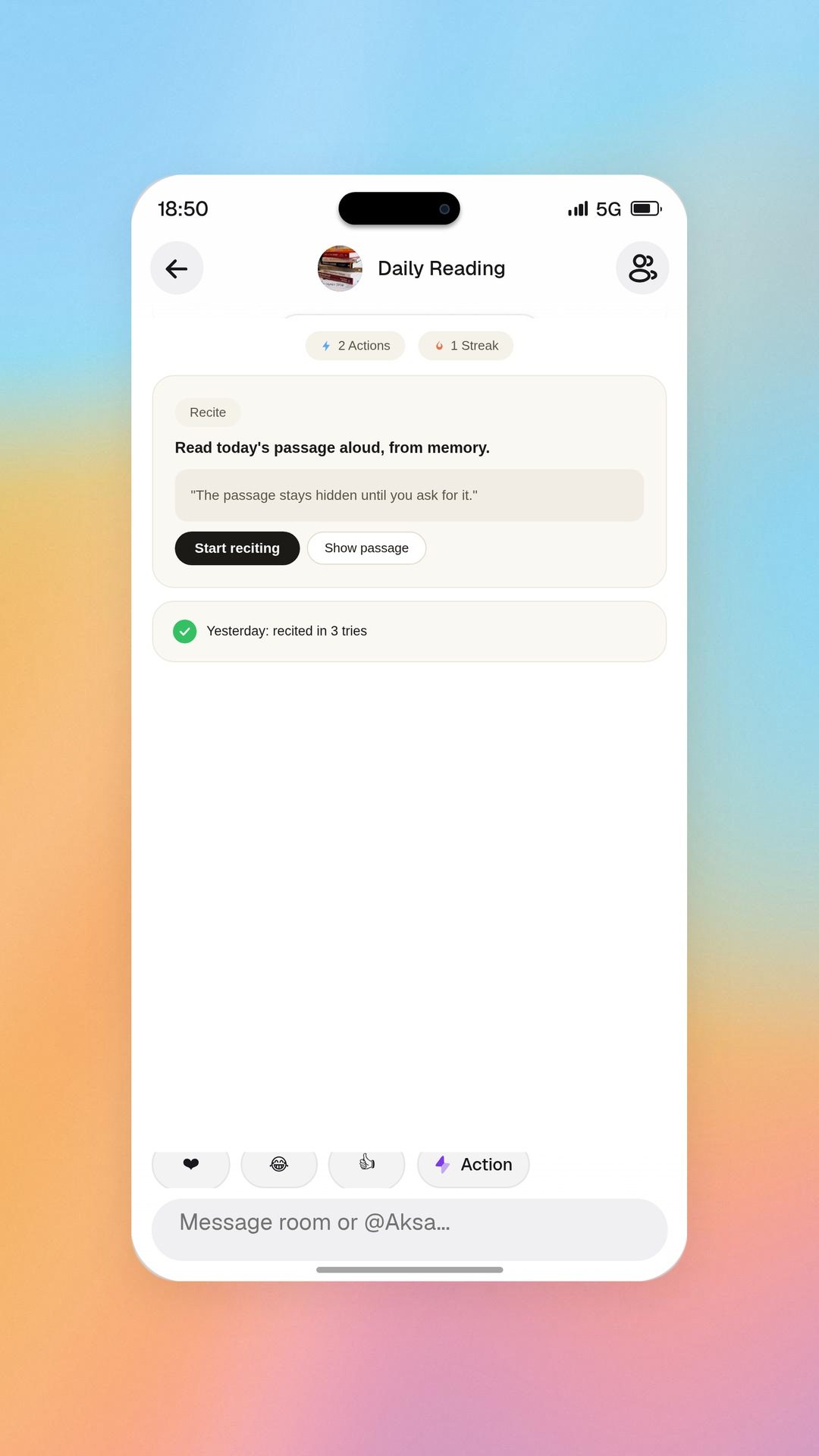
Aksa is a social platform with an AI agent. Practice maps cleanly onto its proof system: a Timer record for the 20-minute session, a written Answer with the day's note ('verse 1 clean at 70 bpm'), or a Photo of the practice corner with the instrument out of its case. Streak counts move only on verified proof days - the count becomes the record of the musician you are becoming.
The Aksa AI Action agent helps decompose 'learn the instrument' into provable daily actions at setup and answers questions when you stall - what to do when a chord change will not land, how to structure week two. It never marks a session done, because Verified Done requires durable proof and the verification rule for the Action.
Optional but powerful: a small Action Room of fellow learners. Posting 'day 19, the F chord finally stopped buzzing' to people who remember their own day 19 is a specific kind of fuel that no tutorial provides - and room posts land as compact rows, so the room's daily practice drumbeat stays light.
Set up practice in Aksa
Fifteen minutes tonight, and tomorrow is session one.
- 1. Create the Goal: 'Practice 20 minutes daily for 90 days' - one provable sentence.
- 2. Add a daily Action with your proof - a timer record of the session, or a one-line written note of what got practiced.
- 3. Set a Reminder for the practice slot - Repeat Every Day, Alarm switch if evenings disappear on you.
- 4. Stage the instrument tonight: out of the case, on a stand, in the room where the session happens - friction is the enemy.
- 5. Choose the first song tonight - one, not five - and break its first four bars out as this week's chunk.
- 6. Create or join a small learners' room - each friend who joins through your invite and finishes onboarding earns one month of Premium for both of you, up to five friends.
Teachers, apps, and self-teaching
The honest answer on instruction: any of the three works if the daily sessions happen, and none works if they do not. A teacher adds structure and error-correction; apps add pacing and convenience; self-teaching adds freedom and the risk of baked-in mistakes. Many adults combine: an app or book for the path, an occasional lesson for the correction.
Whatever the source, the record remains the constant. Lessons and apps supply content; they do not supply Tuesdays. The streak, the proof, and the room are the layer that makes any curriculum actually happen - which is why this guide is about the structure and not the syllabus.
The practice corner
Environment does half the scheduling work. A dedicated corner - instrument on a stand, tuner and pick or pedal in reach, chair at the right height, phone charger in another room - converts 'find twenty minutes and set up' into 'sit down and begin.' The two-minute start is the whole battle on tired days.
Keep the corner visible, not tucked away. An instrument you see is an instrument that gets played; the closet is where hobbies go to be forgotten. Every time you walk past the stand is a micro-reminder the habit exists - free advertising for tomorrow's session.
Playing with others, eventually
Around month three, music's secret weapon becomes available: other people. A beginner jam, a patient friend, an online group playing the same three chords - playing with humans converts practice from a discipline into a social event, and social events do not need streaks to survive.
Until then, the record and the room stand in. The duet is the destination; the daily 20 minutes is the road - and roads are walked one proven session at a time.
FAQ
Is 20 minutes a day enough to learn an instrument?
Yes - frequency beats duration for skill building. Learning consolidates between sessions during sleep, so six 20-minute days outperform one 2-hour weekend session at the same total time. Twenty minutes daily is roughly 60 hours in six months: enough for solid foundations on most instruments.
Am I too old to learn an instrument?
No - adults learn instruments successfully all the time, and adults often practice more deliberately than children. The real adult disadvantages are schedule and impatience, not capacity: no one protects your practice slot, and you compare your week three to a performer's year ten. Both are fixable with structure.
What is the easiest instrument to learn as an adult?
Ukulele and keyboard have the gentlest first month - simple chords come within days, which keeps motivation alive through the noise phase. Guitar is the most popular middle ground. But the honest answer is: the instrument you actually want to play, because desire is what survives day 40.
How should a 20-minute practice session be structured?
Five minutes of technique (scales, chord changes, finger exercises), ten minutes on one song broken into small chunks played slowly, and five minutes of free play. The structure keeps all three needs fed - machinery, repertoire, and joy - and the five minutes of play is what makes tomorrow's session voluntary.
Why did I stop improving after the first month?
You hit the plateau where progress moves from the sound to the wiring - it is normal, universal, and temporary. Days 31-60 are where the first song becomes recognizable. The learners who quit at the plateau and the ones who push through it had the same month one; the difference is a protected daily slot and a visible record.
Do I need a teacher to learn an instrument?
Not strictly - apps, books, and videos can carry the syllabus, and occasional lessons can correct what self-teaching bakes in wrong. What no curriculum supplies is the daily session itself. Structure the 20 minutes with proof and a fixed slot first; the instruction source is the second decision, not the first.