How to Plan Your Day: A 10-Minute Method That Survives Reality
A daily planning method that takes 10 minutes: one must-do, three should-dos, time blocks for the rest, and an evening proof habit that keeps planning honest. Steps and FAQs.
Published October 28, 2026 · 7 min read
The short answer
Plan your day in ten minutes: pick one must-do that makes the day a win, three should-dos that fit around it, block them onto real calendar time, and close the day with a two-minute record of what actually happened. The plan is small by design - small plans survive contact with reality, big ones become guilt documents.
This guide covers why most daily plans fail, the ten-minute method step by step, and the evening proof habit that turns planning from a ritual into a system.
Why most day plans die by 10 AM
The typical failed plan is a list of nine tasks written in a burst of morning optimism. It fails for three structural reasons: everything is marked equal, so nothing is protected; nothing is given a time, so everything floats; and the list reflects the day you wished you had, not the one on the calendar.
A plan that survives reality looks different: it is short enough to finish on a bad day, specific enough to start without thinking, and scheduled against the hours that actually exist. The planning fallacy - our systematic tendency to underestimate how long things take - means your honest first draft is probably still too big, which is why the method below caps the day at four items.
The test of a real plan: if the day explodes at 10 AM, can you still name the one thing that gets done? If yes, the plan survives. If the whole list dies together, it was a wish list.
The 10-minute method
Minute one to three: the must-do. Choose the single task that makes today a win if it is the only thing that happens. It must be specific and finishable - 'draft the intro section' not 'work on report.' Write it at the top; everything else is subordinate to it.
Minute three to six: three should-dos. The tasks that matter but do not define the day - the call, the errand, the review. Cap at three: a fourth always pushes one of the first three off the day, silently.
Minute six to nine: block them onto real time. Put the must-do in the day's best protected slot - for most people that is the first work hour, before the inbox starts bidding - and place the should-dos in the gaps that actually exist between meetings and commitments.
Minute nine to ten: the pre-decision. Write one when-then for the day's most predictable ambush: 'When the 3 PM slump hits, I take a ten-minute walk, not a feed.' Pre-made decisions survive the moment; spontaneous ones do not.
The evening close: two minutes that change the morning
A plan without a record is a theory. The evening close takes two minutes: mark what happened, mark what slipped, and write tomorrow's must-do while today's context is still loaded. That last step is the best-spent minute in the whole system - tomorrow starts pre-decided instead of blank.
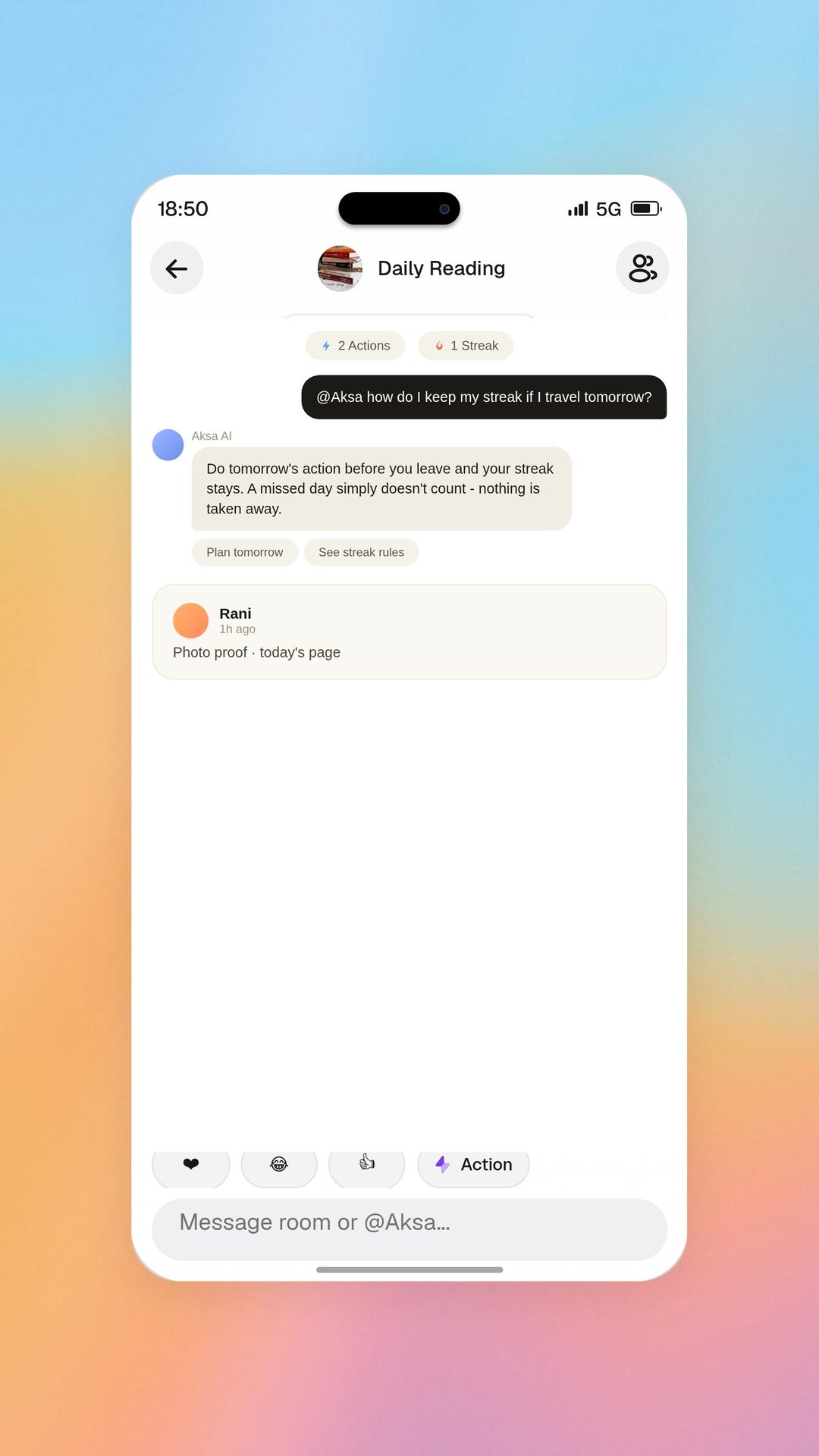
Aksa is a social platform with an AI agent. The evening close maps to a daily Action with proof - a written Answer naming the day's outcome, or a Confirm that the must-do shipped - and streak counts move only on verified proof days. A two-week streak of planned-and-closed days is a visible asset, and the profile's momentum chart makes the pattern readable at a glance.
The Aksa AI Action agent fits naturally here: it helps decompose a goal into provable daily actions at setup and can plan the next step when you stall - useful at the evening close when tomorrow's must-do is unclear. It never marks a day done, because Verified Done requires durable proof and the verification rule for the Action.
Proof the plan, not just the work
Most productivity tracking measures work output; planning itself is the behavior worth proving first, because the plan is the multiplier on everything else. A dated evening submission - 'planned: 4, shipped: 3, must-do done' - builds a record of planning accuracy, and accuracy is the skill that improves everything downstream.
Watch for the two failure patterns the record reveals. Chronic under-shipping means the plan is too big - cut the should-dos to two. Chronic must-do slippage means the protected slot is not protected - move it earlier or defend it harder. Both are one-line diagnoses you can only make from a record, never from a feeling.
In a 2009 study by Lally and colleagues in the European Journal of Social Psychology, the time to reach 95 percent of habit automaticity ranged from 18 to 254 days across participants. Give it 30 planned days before judging it.
Set up daily planning in Aksa
Ten minutes tonight, and tomorrow is the first planned day.
- 1. Create the Goal: 'Plan and close every weekday for 30 days' - one provable sentence.
- 2. Add a morning Action: the plan itself, proven with a written Answer - must-do plus three should-dos.
- 3. Add an evening Action: the close, proven the same way - what shipped, what slipped, tomorrow's must-do.
- 4. Set two Reminders: one for the planning slot and one for the close - Repeat Weekdays, Alarm switch on the morning one.
- 5. Keep the plan where the day happens - the plan you cannot see at 2 PM is a plan that died at 10 AM.
- 6. Review the week every Friday: must-do completion rate, the recurring ambush, one fix for next week.
Planning for chaotic days
The objection every planner hears: 'my days are unpredictable, planning is pointless.' Inverted. Chaotic days need the plan more, not less - because on a chaotic day the must-do is the only thing standing between you and a day spent entirely reacting. The should-dos may die; the must-do is the plan's whole point.
Scale the method to the chaos: on the worst days the plan is one line - the must-do and its protected slot. A one-line plan kept on a brutal day beats a beautiful plan abandoned. The record of chaotic days survived is, in the long run, the most useful part of the whole archive.
The weekly frame above the daily plan
Daily plans live inside a weekly shape, and the shape deserves ten minutes of its own - Sunday evening or Monday morning works. Look at the week's calendar, choose the week's one big outcome, and make sure at least three days have a protected slot pointed at it. A week with no protected slots is how months disappear.
The daily must-do then inherits from the weekly outcome on the days it can, and from the day's reality on the days it cannot. That two-level structure - one outcome per week, one must-do per day - is the whole architecture. Everything else is decoration, and decoration is what makes planning systems collapse under their own weight.
FAQ
What is the best time to plan your day?
Either the evening before or the first ten minutes of the morning - both work, and the choice is temperament. Evening planning pre-loads tomorrow while today's context is fresh; morning planning catches overnight changes. The wrong time is mid-morning, after the day has already been spent reacting.
How many tasks should a daily plan have?
One must-do and at most three should-dos. The planning fallacy makes every first draft optimistic, and a plan you finish beats a plan you abandon - a fourth item always pushes one of the first three off the day silently. Everything beyond four goes on next week's list.
Should I plan every hour of the day?
No - full-day scheduling is brittle and dies at the first surprise. Block the must-do into one protected slot and the should-dos into real gaps, and leave the rest open. The plan's job is to protect the important, not to choreograph the inevitable chaos.
What do I do when my plan falls apart by noon?
Salvage the must-do and let the rest go - that is what the must-do is for. A plan that can survive a 10 AM explosion is the whole design. At the evening close, mark what happened honestly and write tomorrow's must-do; a bad day is one data point, not a verdict.
Is a paper planner or an app better for daily planning?
Whichever you will actually open at 2 PM - the plan you cannot see is dead. Paper wins on friction-free visibility; an app wins on reminders, dated proof, and a searchable record. Many people run both: paper for the day's glance, the app for the streak and the record.
How do I plan my day when every day is different?
Plan around anchors instead of hours: after the morning coffee, before the first meeting, after lunch. On the most chaotic days the plan shrinks to one line - the must-do and its protected slot. Chaotic days need the plan more than stable ones; reacting all day is what happens by default without one.
What should I do with tasks that never make the daily plan?
Audit them weekly. A task rolled three times is telling you something: it is too big (break it into a finishable piece), not actually important (delete it), or missing a deadline (give it one). The rollover list is the most honest document in the whole system - read it without flinching.