How to Start a Side Project That Survives the Middle Weeks
Start a side project with a shippable v1, a provable weekly cadence, and public proof that survives month two. Scope rules, setup steps, and FAQs for projects that ship.
Published October 28, 2026 · 7 min read
The short answer
Start a side project by cutting the scope until version one ships in two to four weeks, scheduling two or three fixed work sessions a week, and proving every session with dated evidence of what got built. The project lives or dies on the boring middle - the system is built for exactly that stretch.
This guide covers why side projects die, the scope rules that keep them shippable, the weekly cadence, and the proof habit that carries a project past the point where novelty runs out.
Why side projects die in the middle
The arc is so consistent it is practically a law: week one is pure energy - setup, scaffolding, the fun 10 percent. Week three is the middle: the interesting decisions are made, what remains is work, and the sessions start slipping. By week six the repo is a monument.
The cause is not laziness; it is a feedback failure. A job pays you and a boss notices; a side project offers neither - effort goes in and nothing visible comes back for weeks. Effort without feedback stops, always, which is why the fix below is fundamentally about manufacturing feedback: small scope, shippable increments, dated proof, and witnesses.
The second cause is scope. The project people start is usually the project they dream about, not the project they can finish inside real life. A v1 that ships in three weeks creates its own momentum; a v1 that needs six months creates a graveyard.
Scope rules: build the small true thing
Rule one: v1 ships in two to four weeks of part-time work. Not the whole vision - the smallest version that does one true thing. A tool with one working feature, an article series with three published pieces, a shop with five listings. The cut will feel brutal; the shipping will feel like fuel.
Rule two: no new technology in v1. Learning a framework and building a project are two projects - do them sequentially or pick the one you actually want. The graveyard is full of projects that were secretly tutorials.
Rule three: write the v1 sentence before starting: 'In three weeks, a stranger can [do X].' If the sentence cannot be written, the scope is not cut enough. If it can, the project now has a finish line - and finish lines are what sessions get pointed at.
Rule four: park every expansion idea in a v2 list without judgment. The list lets you hear the idea without obeying it, and most v2 lists look silly in month three - which is exactly when you will be glad v1 shipped.
The weekly cadence
Two or three fixed sessions a week beats 'work on it when inspired.' Fixed means calendared: Tuesday and Thursday 8-9:30 PM, Saturday 9-11 AM - appointments with the project that other things schedule around, not into.
Each session starts with the one-line outcome it must produce: 'today the form validates,' 'today the draft reaches 800 words.' A session with a finish line ends with proof; a session with a vibe ends with tabs. Ninety focused minutes twice a week is twelve hours a month - a genuinely shippable amount of anything.
Protect the cadence with the week, not the day: if Tuesday dies, the session moves within the week, and the week still counts. In a 2009 study by Lally and colleagues in the European Journal of Social Psychology, times to habit automaticity ranged from 18 to 254 days, and a single missed opportunity did not materially affect formation - a rescheduled session is a kept cadence, not a broken one.
Proof and witnesses: manufacturing the feedback
Aksa is a social platform with an AI agent. A side project is close to the platform's native shape - each session's outcome becomes dated proof: a screenshot of the working feature as a Photo, the day's commit summary as a written Answer, a Counter of published pieces, a Timer for the session itself. Streak counts move only on verified proof days, and the profile's momentum chart turns a month of sessions into a shape you can see.
The Aksa AI Action agent handles the plan side: it helps decompose the project goal into provable actions at setup and answers questions when you stall - useful at the 'what is the next shippable slice' moment. It never marks work done, because Verified Done requires durable proof and the verification rule for the Action.
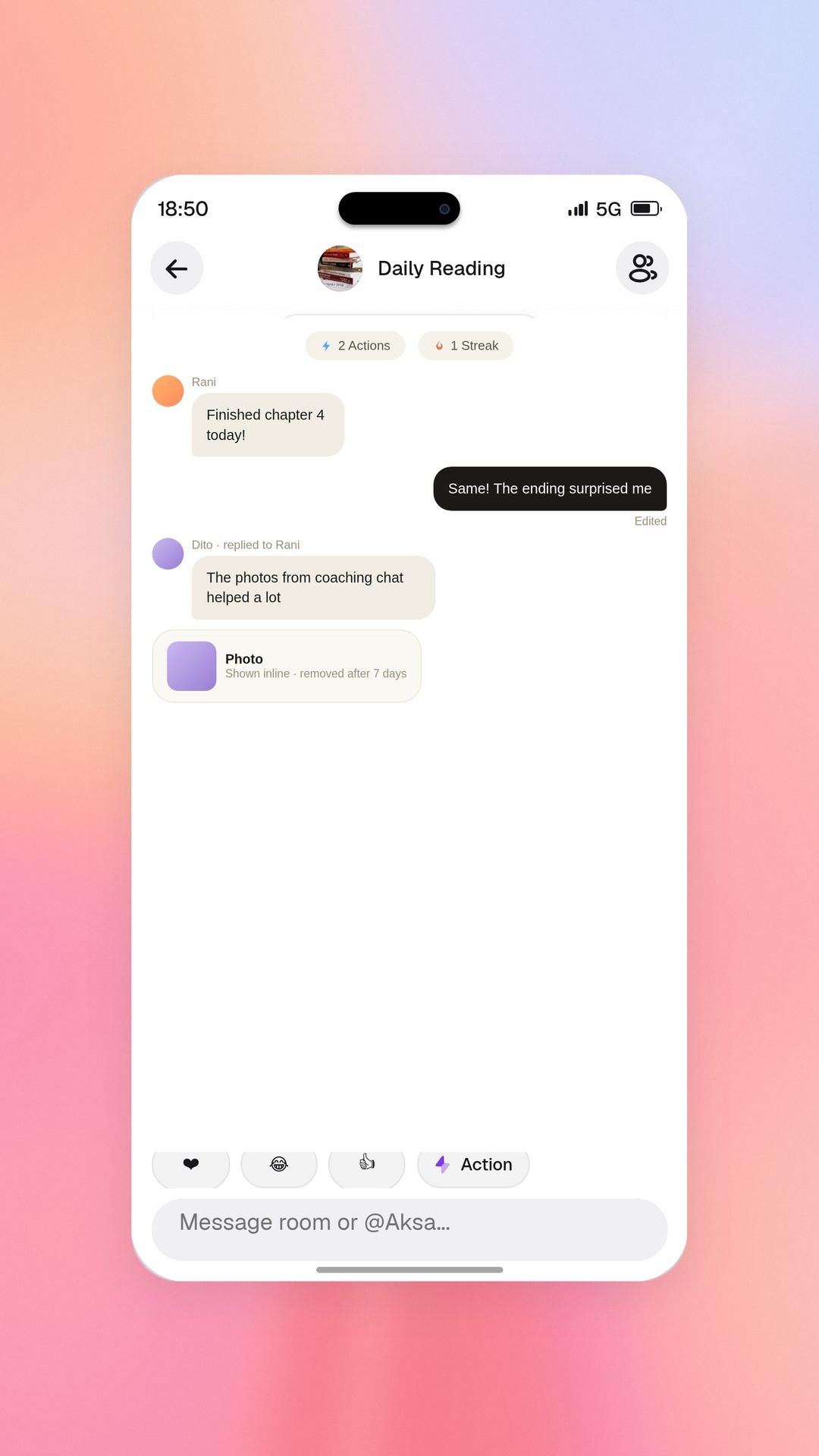
Then add the witnesses. A small Action Room of two to five people building their own projects converts private effort into shared momentum - you post your screenshot, they post theirs, and Tuesday's session has an audience. Room posts land as compact rows in room chat with reactions, so the feedback loop costs everyone about ten seconds.
Set up the project in Aksa
Twenty minutes tonight, and the project has a finish line.
- 1. Write the v1 sentence: 'In [2-4] weeks, a stranger can [do X]' - and cut the scope until the sentence is honest.
- 2. Create the Goal with the v1 sentence and the ship date.
- 3. Add session Actions on your fixed days with proof - screenshot, commit summary, counter, or timer.
- 4. Set Reminders for the fixed sessions - Repeat on those days, Alarm switch on.
- 5. Open the v2 list and park every expansion idea in it from day one.
- 6. Create an Action Room for the project - each friend who joins through your invite and finishes onboarding earns one month of Premium for both of you, up to five friends.
Shipping and what comes after
Ship v1 on the date even if it is rough - especially if it is rough. A shipped rough thing generates the feedback the middle was starving for: real users, real reactions, real evidence that the project exists. The date is a commitment device; honor it and the second version starts from momentum instead of guilt.
After shipping, choose deliberately: grow it, maintain it, or close it. All three are wins. The graveyard only claims projects that never chose - and a project you shipped and closed still taught you the two skills this whole guide is about: cutting scope, and finishing.
The middle weeks, honestly
Weeks three to five are the valley: the novelty is gone, v1 is not done, and every session starts with a negotiation. Expect it, name it, and plan for it - the valley is not a sign the project is wrong, it is the toll every finished thing charges.
Three tools carry you across: the v1 sentence taped where the sessions happen, the proof streak that makes skipping visible, and the room where other people's screenshots remind you the middle ends. Ship something small at the end of the valley and you own a skill most people never acquire: finishing without feeling like it.
FAQ
How do I find time for a side project with a full-time job?
Two or three fixed sessions a week - 90 minutes each, calendared like appointments - is twelve hours a month, enough to ship a small v1 in under two months. The key is fixed, not found: time for side projects is never discovered lying around, it is defended in advance.
Why do my side projects always die after a few weeks?
The feedback failure: jobs pay and bosses notice, side projects return nothing visible for weeks, and effort without feedback stops. The fix is manufactured feedback - a v1 small enough to ship in two to four weeks, sessions with finish lines, dated proof of every session, and two to five witnesses who see the record.
Should I learn a new framework for my side project?
Not in v1. Learning a technology and shipping a project are two different projects, and combining them is the most common scope-killer. Build v1 with tools you already know, ship it, then learn the new thing - or admit the learning was the project and enjoy it as that.
How small should version one really be?
Small enough that a stranger can do one true thing in two to four weeks of part-time work: one working feature, three published pieces, five listings. Write the sentence 'In three weeks, a stranger can do X' - if you cannot write it honestly, keep cutting until you can.
What is the best day and time to work on a side project?
The slot you can defend weekly - for most people that is two weeknights plus one weekend morning. The best time is a fixed time: inspiration-based scheduling produces two sessions in January and none in March, while Tuesday-Thursday-Saturday produces twelve a month.
What do I do when I lose motivation mid-project?
Check the scope before the motivation - the slump usually means v1 was too big and the finish line left sight. Cut the sentence smaller, ship the smaller thing, and let real feedback refuel you. And post the session's proof anyway: motivation follows evidence of progress more often than progress follows motivation.
How do I choose which side project to start?
Pick the one you would use yourself, with a v1 you can ship in under a month. Scratch-your-own-itch projects survive the middle because the feedback is personal - you are the first user - and small scope beats exciting scope every time. The best project is the one that gets finished.