How to Stay Consistent With Your Goals in 2026: A System That Actually Holds
Consistency is not about willpower. Learn a verified daily-action system with proof, streaks, and social accountability that keeps goals alive past week two.
Published October 24, 2026 · 7 min read
The direct answer
You stay consistent with goals by shrinking the daily action until it is almost impossible to skip, verifying that you did it with real proof, and making your progress visible to at least one other person. Motivation starts goals; only structure finishes them.
Everything in this guide builds that structure. Each step maps to a feature you can use today inside Aksa, a social platform with an AI agent, but the principles work even if you never open the app.
Why consistency breaks in week two
Research on habit formation gives a useful benchmark: a 2009 study by Phillippa Lally and colleagues at University College London, published in the European Journal of Social Psychology, found that new behaviors took an average of 66 days to feel automatic, with a range from 18 to 254 days. Week two is nowhere near automatic. It is the danger zone where novelty has faded and the habit has not formed yet.
Week two is also when the first missed day usually happens. A miss itself is not fatal. What kills the goal is the story you tell after the miss: that the chain is broken, so the goal is over. Consistency systems exist to interrupt that story within 24 hours, not to prevent every miss.
The third failure point is invisibility. A private goal lives entirely in your head, and your head is where excuses are cheapest. When no one can see whether you acted today, skipping costs nothing. Raising the cost of skipping, gently and socially, is the core move.
Shrink the action until it is boring
The most reliable daily action is the one you can complete on your worst day, not your best day. "Read one page" survives a fever. "Read 40 pages" does not. Duolingo's own product team learned this at scale: in a November 19, 2020 post on the Duolingo blog, engineer Anton Yu reported that learners with the most ambitious daily goals were the least likely to keep a streak, and that letting one single lesson extend the streak lifted day-14 retention by 3.3 percent.
Apply the same rule to your goal. Define the floor version of the action, the smallest unit that still counts. Ten pushups. One page. Five minutes of focused work. You can always do more, and on good days you will, but the floor is what you promise.
In Aksa this floor becomes the daily Action inside a Goal. Each Action runs on one of six proof primitives: Submit for photo or video evidence, Answer for written reflections, Counter for repetitions, Timer for focus sessions, Check-in for presence, and Confirm for simple binary commitments. You pick the primitive that matches the action, and the floor is now a concrete, checkable object instead of a vague intention.
Require proof, not promises
A checkbox you can tap without doing anything teaches your brain that lying is free. Verified proof changes the economics. When the streak only moves after a real photo, a finished timer, or a completed counter, the number on your profile starts to mean something, first to you and then to everyone who sees it.
This is the core design rule inside Aksa: progress counts only verified proof, never an unverified tap. A streak moves when evidence exists. That single constraint transforms a streak from a vanity counter into a reputation.
Proof also creates an archive. Aksa turns verified actions into a consistency heatmap, a momentum chart, and a 3-month Photo Calendar on your profile. On the days when motivation is gone, scrolling your own evidence is a stronger argument than any inspirational quote.
Make progress visible to people
Private goals fail privately. The fix is not broadcasting to the whole internet; it is choosing a small circle that will notice your absence. One friend, one room, one cohort. Visibility to a few specific people creates a gentle social cost for skipping, which is exactly what week two requires.
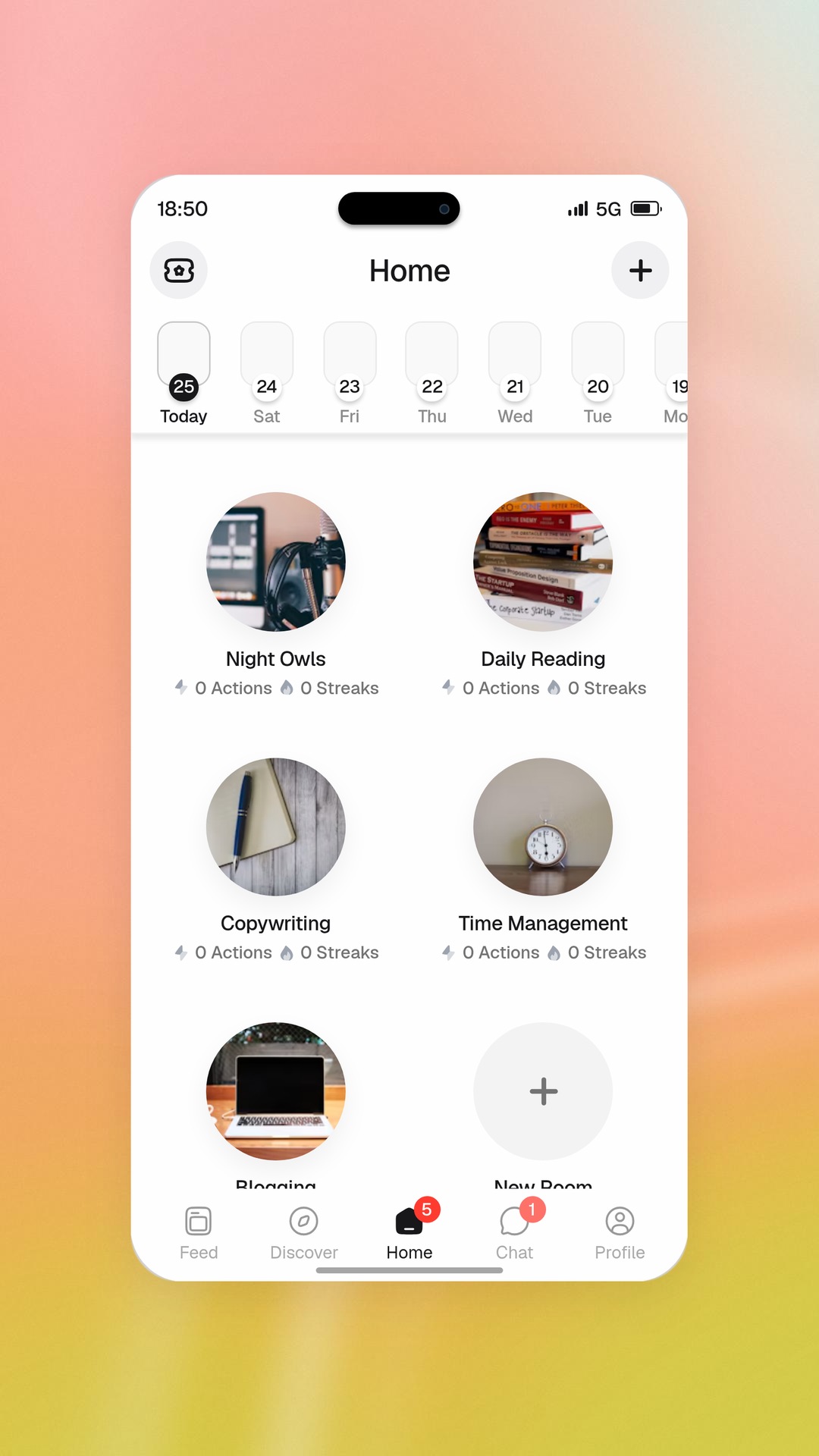
Aksa is built around this: Action Rooms are small collaborative spaces where members post daily proof, cheer each other's claims, and see who showed up. Aksa is a social platform with an AI agent that plans the daily action list inside those rooms, answers goal questions, and posts updates, so the room stays active even on days when nobody feels like organizing anything.
The platform passed 900 registered members in its first month, per a company database count in late September 2026, with early cohorts centered in Indonesia. Small numbers, but that is the point: accountability works in small groups, not in feeds of millions.
Set up the system in 15 minutes
Here is the exact setup sequence, using Aksa as the example because each step maps to a real feature:
Once the room exists, your only job is today's proof. Not the whole goal, not the month, just today's evidence. Consistency is the accumulation of days you stopped negotiating with yourself.
- 1. Write the goal in one sentence, then define the floor version: the smallest daily action that counts.
- 2. Create a private room of one in Aksa, or open Discover and clone one of the 94 seed actions as your starting template.
- 3. Attach the right proof primitive to the daily Action: photo Submit for anything visual, Timer for focus blocks, Counter for reps.
- 4. Invite one to four people into an Action Room, or join an existing room from the Discover hub, so someone sees your daily proof.
- 5. Set one daily reminder at the hour you are most reliable, not the hour you wish you were.
- 6. Do today's action immediately after setup, however small, so the streak starts at day one today.
Handle the inevitable miss
Plan the miss before it happens. Decide now what a legitimate rest day looks like, and decide the 24-hour rule: after any miss, the very next day is non-negotiable floor action, no matter how small. One miss is an event; two misses is a new pattern.
Your room helps here more than any willpower trick. When friends see a gap in your heatmap, a simple "you good?" message is often the entire intervention. Aksa's room chat, cheer notifications, and visible streaks exist so that silence is noticeable.
After a miss, resist the urge to compensate with a heroic double session. Heroics re-inflate the goal and set up the next failure. Return to the floor, rebuild the chain, and let the heatmap show a single grey cell surrounded by green.
Use competition carefully
Leaderboards are fuel for some people and poison for others. If ranking energizes you, Aksa runs three leaderboard modes, Individual, School, and City, with a Weekly Arena that resets every Monday at 00:00 UTC, so every week offers a fresh start regardless of last week's result.
If ranking discourages you, ignore it completely. The weekly reset means the leaderboard never becomes a permanent record of your worst week, and the top three finishers get winner spotlight cards, which keeps the competition light rather than punishing.
Either way, treat competition as seasoning, not the meal. The meal is daily verified proof in a room that notices you.
What week eight looks like
If the system holds, something shifts around week six to eight, matching the 66-day average from the Lally study: the action starts feeling like part of the day rather than an addition to it. You stop deciding and start executing.
Your Aksa profile by then holds a visible record: a heatmap with far more green than grey, a streak number backed by real evidence, and a Photo Calendar showing three months of actual moments, not intentions.
That archive becomes the argument that carries you through the next dip. Consistency stops being something you chase and becomes something you can point to.
FAQ
How long does it take to build a consistent habit?
The most cited benchmark is the 2009 Lally study in the European Journal of Social Psychology: an average of 66 days for a new behavior to feel automatic, with individual results ranging from 18 to 254 days. Expect roughly two months of deliberate effort before the habit carries itself, and design your system for that full window rather than for the first exciting week.
Is missing one day really a problem?
One miss is an event, not a failure. The danger is the second consecutive miss, which starts a new pattern. Use a 24-hour rule: after any miss, complete the smallest version of your action the very next day. A visible record like a heatmap makes the gap obvious to you and to your accountability partners.
Do I need an app to stay consistent?
No, but an app removes friction at the exact points where consistency usually dies: remembering, verifying, and being seen. Aksa combines all three with daily Actions, six proof primitives, and Action Rooms. A notebook and a committed friend can work too, as long as the proof is real and someone notices your misses.
What makes Aksa different from a habit tracker?
Aksa is a social platform with an AI agent, not a checkbox tracker. Actions require verified proof through six primitives like photo Submit and Timer, streaks only move on that proof, and Action Rooms plus Individual, School, and City leaderboards add the social layer where accountability actually happens.
How many goals should I run at once?
Start with one. Every additional goal splits your worst-day capacity, and consistency is decided on worst days. Aksa supports rooms of one and public Action Rooms, so one goal with one room is the right start. Add a second goal only after the first has survived at least three weeks without heroic effort.
What if my friends do not want to join?
You do not need existing friends. Aksa's Discover hub and Group tab list public Action Rooms and community cohorts you can join alone, and the Friend tab suggests peers. Accountability with strangers who share the goal often works better than accountability with friends who do not care about it.