How to Stick to a Diet: The System Beats the Willpower
Why diets fail structurally and how to stick to one: environment design, provable daily rules, a visible record, and a small group. Evidence-based tactics, setup steps, and FAQs.
Published October 27, 2026 · 7 min read
The short answer
You stick to a diet by making it a system instead of a series of decisions: one or two precise rules, an environment with no daily temptations to fight, dated proof of each clean day, and a small group that sees the record. Willpower spends; structure saves.
This guide covers why diets collapse mechanically, the four-part system that prevents it, and how to set the whole thing up so day 30 is easier than day 3 - not harder.
Nothing here requires a new personality. The research is consistent that adherence - not diet choice - is what predicts results, and adherence is an engineering problem with known solutions.
Why diets fail: the decision fatigue problem
The average diet asks you to win hundreds of small negotiations a day - every cupboard opening, every menu, every 'just this once' - and to win them all against an opponent that only has to win once per evening. That is not a willpower problem; it is a structural mismatch that no amount of motivation fixes.
The research-backed answer is to reduce the number of decisions, not to get better at making them. In a 1999 paper in American Psychologist, Peter Gollwitzer showed strong effects on follow-through from when-then implementation intentions: 'When I am offered dessert, I say I am set, thanks' is a pre-made decision, and pre-made decisions do not drain anything.
The second structural fix is the environment. Decades of eating-behavior research converge on the unglamorous finding that people eat what is visible and near - the candy dish on the desk, the snacks at eye level. Willpower-based dieters fight their kitchen daily; system-based dieters fight the supermarket once a week and live in peace.
Rule design: few, precise, checkable
A stickable diet has one to three rules with yes-or-no answers: 'no added sugar on weekdays,' 'no eating after 8 PM,' 'protein at every meal.' Each rule must be checkable at day's end without interpretation - 'eat healthier' fails this test completely, which is why it never survives February.
Fewer rules beat more rules for a specific reason: every rule multiplies the number of daily negotiations, and the diet breaks at its most negotiable point. One rule kept for 90 days changes your body; five rules kept for 11 days change nothing but your self-esteem.
Write the gray-area rulings before they come up: restaurant meals, birthdays, travel. A diet with no pre-written event policy will be decided by the event - in the moment, at the table, by the part of you that is hungry.
Proof and the visible record
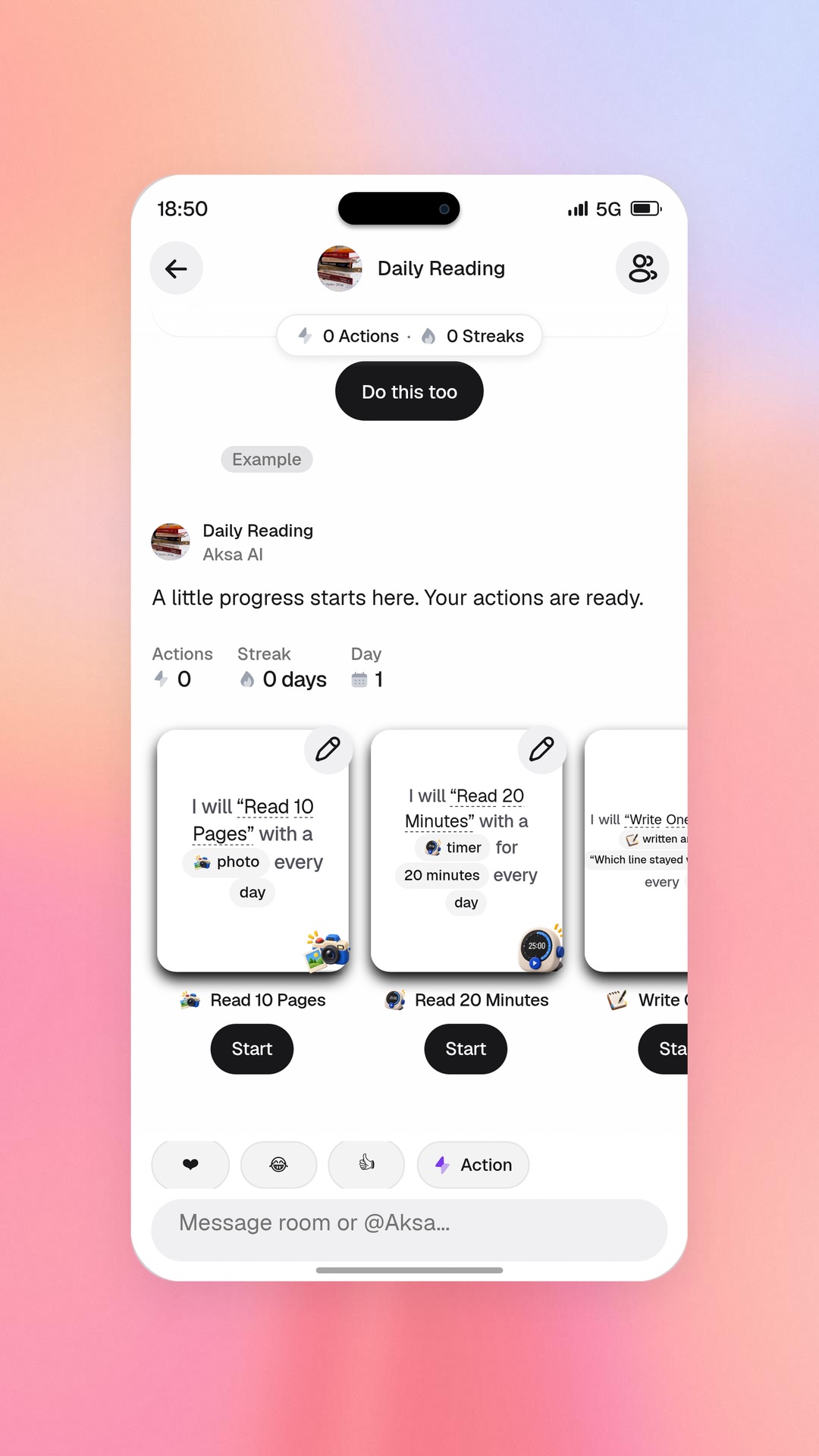
Aksa is a social platform with an AI agent, and diet rules map naturally onto its proof system. A photo of each meal is the strongest format - it is evidence of what actually happened, not a claim about it - and an avoidance Confirm covers rules like 'no eating after 8 PM,' where the day's proof is a dated confirmation that the rule held.
The streak on top is only meaningful because of the honesty layer: streak counts move only on verified proof days, never on intention. A 21-day food record is a genuinely useful artifact - patterns like 'weekend lunches are where it breaks' are invisible from inside the week and obvious on a heatmap.
Keep the record for yourself first. Proofs post into rooms and feeds where others can respond - the value is accountability, not performance, and you control the audience. The photo is for the record; the record is for the pattern.
The group: why quiet diets stay quiet
Solo diets fail silently, which is their defining defect: a broken rule costs nothing because nobody's world changes when you break it. A small room - two to five people, same rule style, daily proof - prices the slip without shaming it. You are not reporting to a judge; you are posting to people posting back.
The useful room norms: daily proof by a fixed evening deadline, reactions over lectures, and the ritual question after a miss - 'what will tomorrow's proof show?' In a 2009 study by Lally and colleagues in the European Journal of Social Psychology, habits take a median of 66 days to automate, with a range of 18 to 254 days - diet rules are habits with a longer fuse than most, which is exactly why the group matters past week two.
Each Action post in room chat is one compact row and back-to-back posts group together, so a room of daily food proofs stays readable - a feed of evidence, not a wall of noise.
Set up diet accountability in Aksa
Fifteen minutes tonight, and tomorrow is day one.
- 1. Write the Goal as one provable sentence with your rules attached: 'No added sugar on weekdays + no eating after 8 PM, 60 days.'
- 2. Add a daily Action per rule style: a photo of meals, or an avoidance Confirm submitted each evening.
- 3. Set a Reminder for the evening proof submission - Repeat Every Day, with the Alarm switch if notifications get buried.
- 4. Do the environment pass once, this week: the rule-breaking foods leave the house; the rule-following ones get front-row positions.
- 5. Create an Action Room, post the shared rules and event policies, and invite your people - each friend who joins through your invite and finishes onboarding earns one month of Premium for both of you, up to five friends.
- 6. Review the week every Sunday: streak, heatmap, and the one pattern to fix - then make exactly one change.
Slips, plateaus, and the long game
A slip is data about your rule design, not a verdict on you. Log it honestly, name the situation that produced it - late meeting, unplanned restaurant, stress - and adjust the rule or the environment once. The diet that survives month two is the one that got edited in week three.
Plateaus are the other test: the scale stalls, the novelty is gone, and the only thing still working is the system. This is when the record earns its keep - visible proof of 40 compliant days is evidence the process is intact while the metric catches up.
And zoom out: the goal was never the diet. It was the person who eats this way without thinking about it - and that person is built one proven day at a time, which is the only way anything durable is built.
A note on what this system is not
This is not medical guidance, and it is not for anyone with a history of disordered eating - for that, a clinician beats any app, and rules and streaks are the wrong tools entirely. The system here is for ordinary consistency: the person who knows what they want to eat and keeps not eating it.
It is also not a diet. Nothing here tells you what to eat - the rules are yours to choose with whatever nutritional guidance you trust. The system's only job is the part diets outsource to willpower: making the chosen rule visible, provable, and witnessed, day after day, until it is just how you eat.
FAQ
Why do I keep breaking my diet at night?
Because evening is when decision fatigue peaks and willpower is lowest - the diet's hundred daily negotiations are lost after dinner, not at breakfast. Fix it structurally: a precise evening rule ('no eating after 8 PM'), triggering foods out of the house, and an implementation intention for the specific moment the craving arrives.
How many diet rules should I set at once?
One to three, each with a yes-or-no daily answer. Every additional rule multiplies the daily negotiation count, and diets break at their most negotiable point. One rule kept 90 days changes your body; five rules kept 11 days change nothing.
Is a food diary actually effective?
Yes - self-monitoring is one of the most consistently supported behaviors in weight-management research. Photo-based food records lower the effort further while raising honesty: a picture of the meal is evidence, not a reconstruction. The diary works through awareness; adding a streak and a witness makes it work through accountability too.
Should my diet have a cheat day?
A declared weekly flexibility window works better than both rigid purity and unplanned 'cheating' - declared in advance, bounded, and logged like any other day. The failure mode is not the planned exception; it is the unplanned exception that teaches the rule it can be negotiated mid-moment.
How do I stick to a diet when eating out?
Decide the restaurant policy before you arrive: scan the menu online, pick the compliant option, and order first so others' choices do not sway yours. Events decided at the table are decided by the hungriest version of you - pre-written event rules are the entire difference.
What do I do after a bad week on my diet?
Treat it as a review, not a verdict: name the pattern in one sentence, make one change to the rule or environment, and resume with the next meal - not next Monday. Habit research (Lally and colleagues, European Journal of Social Psychology, 2009) found single misses did not materially derail formation; the spiral after the miss is the real threat.