How to Stop Being Lazy: It Is a System Problem, Not a Character Flaw
Why 'laziness' is usually unclear goals, oversized actions, or missing structure - and the five-part fix that works when motivation speeches fail. Evidence, steps, and FAQs.
Published October 27, 2026 · 7 min read
The short answer
You stop 'being lazy' by fixing the system the label is hiding: shrink the goal until today's step is embarrassingly small, attach it to a fixed trigger, require dated proof it happened, and let one other person see the record. Laziness evaporates when starting costs almost nothing and stopping costs something visible.
This guide covers what is actually underneath the feeling, the five-part fix, and how to set it up so the first week runs on structure instead of self-criticism.
What 'lazy' usually means
Call yourself lazy and nothing changes, because the label points at your character and your character is not the adjustable part. Look underneath the label and the same few causes keep appearing: the goal is fog ('get my life together'), the first step is huge ('write the thesis'), the day has no trigger ('sometime this weekend'), or the loop has no feedback ('does any of this even show?').
Each cause is mechanical, which is good news - mechanical problems have mechanical fixes. Fog gets fixed by specification. Huge gets fixed by shrinking. No trigger gets fixed by scheduling. No feedback gets fixed by proof. The person does not need upgrading; the setup does.
There is one honest exception worth naming: sometimes 'lazy' is exhaustion, depression, or burnout wearing a mask. If the flatness is everywhere - things you used to love included - and has lasted weeks, that is a health conversation, not a productivity one. The fixes below are for the ordinary kind, where the energy exists and the structure does not.
Fix one: make the first step stupidly small
The brain resists starts, not work - which is why 'write the report' stalls for days while 'open the document and write one ugly sentence' starts in seconds. BJ Fogg's Tiny Habits (2019) built an entire method on this: the behavior should take under two minutes at first, because a behavior that always starts is a behavior that often continues.
The two-minute version is not a trick to fool yourself; it is the correct unit of progress for a stalled system. In a 2009 study by Lally and colleagues in the European Journal of Social Psychology, habits reached a median of 66 days to automate, with a range of 18 to 254 days. Small is not the compromise. Small is the mechanism.
Fix two: a trigger that fires without you
Motivation-based plans start 'when I feel like it,' which is why they start rarely. Trigger-based plans start 'when X happens' - after coffee, at 6 PM when the laptop closes, right after lunch. In a 1999 paper in American Psychologist, Peter Gollwitzer showed strong effects on follow-through from when-then implementation intentions, because the cue does the work willpower was failing to do.
Design the trigger from your real day, not your ideal one. The 6 AM slot you have never once used is not a trigger; it is a fantasy. The coffee you make every single morning is. Bolt the new behavior to something that already fires daily and the start stops depending on your mood entirely.
Fix three: proof, so progress is visible
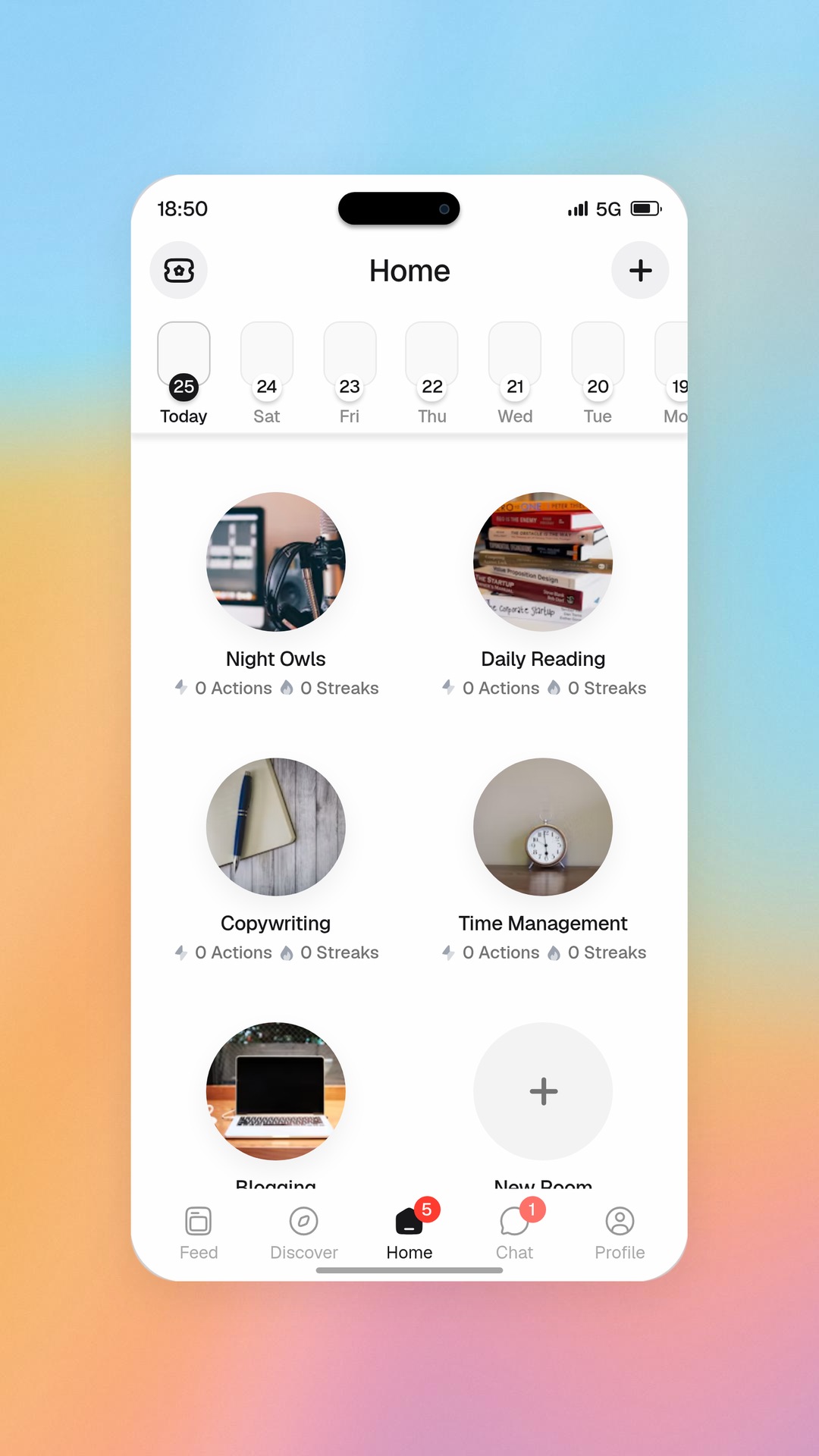
Part of what people call laziness is a broken feedback loop: effort that leaves no trace feels like it did not happen, and invisible effort stops. Aksa is a social platform with an AI agent. Every daily Action produces dated proof - photo, written answer, counter, timer, check-in, or confirm - and streak counts move only on verified proof days. The record makes the effort exist.
The effect compounds: a visible count of real days is the antidote to the feeling that you never do anything, because it is literally the evidence that you do.
Keep the proof honest and small. A photo of the opened document with one written sentence counts - it is dated evidence the step happened. The record's power comes from being literally true, not from being impressive.
Fix four: one witness
Private goals die privately; that is their core defect. One person who sees your daily proof changes the economics of skipping without adding any drama - a friend, a sibling, or a small Action Room of people running the same kind of goal. You are not being monitored; you are being accompanied.
An Action Room carries a member consistency heatmap and a feed of the day's proofs, so 'did today happen' is visible to the room without a single status meeting. The Aksa AI Action agent covers the planning side - decomposing the goal into provable daily steps and nudging when you stall - while never marking anything done, because Verified Done requires durable proof.
Set up the fix in Aksa
Fifteen minutes tonight, and tomorrow has a different shape.
- 1. Name the one stalled thing - not five - and write it as a provable sentence with a number and a date.
- 2. Shrink the daily step until it takes under two minutes to start: open the document, put on the shoes, wash one dish.
- 3. Add the step as a daily Action with a proof type - photo, answer, counter, timer, check-in, or confirm.
- 4. Bolt it to a trigger that already fires daily, and set a Reminder there for the first two weeks - Repeat Every Day or Weekdays, Alarm switch if needed.
- 5. Tell one person or create a small room - each friend who joins through your invite and finishes onboarding earns one month of Premium for both of you, up to five friends.
- 6. After seven days, grow the step slightly - and keep the streak visible the whole time.
Fix five: energy is infrastructure
Last and most skipped: the body runs the system. Chronic short sleep, no movement, and chaotic meals produce a person who looks lazy from the outside and is actually underpowered. Before concluding anything about your character, run two weeks of fixed wake time, a daily walk, and meals at roughly regular hours.
This is also why the fix order matters: start the tiny daily step now, and repair the energy base in parallel. Do not wait to feel like it first - the feeling is downstream of the structure, and the structure can start today, at two minutes a day.
The seven-day reset
If you want a concrete starting protocol, run one week of the minimum: one two-minute step, one trigger, one proof per day, one witness. Seven days is short enough to commit to without ceremony and long enough to produce the thing 'lazy' people claim not to have: a visible record of doing the thing daily.
At the end of the week, read the record before you read your mood. Seven proofs is evidence, and evidence argues better than affirmations - you are no longer a person who never follows through, because here are seven dated artifacts saying otherwise. Week two starts from that fact, not from the old story.
FAQ
Why am I so lazy even when I want to change?
Usually because wanting points at the goal while the system is broken at the start: the step is too big, the trigger is missing, or progress is invisible. 'Wanting' is not a mechanism. Shrink the first step to two minutes, attach it to a daily trigger, and make it leave dated proof - the wanting finally has machinery to run on.
Is laziness a real trait or a habit problem?
Mostly a habit and structure problem wearing a trait's clothes. The same person who 'cannot' start a report often spends focused hours on a game or hobby - the energy exists; the stalled task's setup is what differs. Genuine persistent flatness across everything, including things you love, is worth a health conversation rather than a productivity fix.
How do I force myself to start something I have been avoiding?
Do not force the task - shrink it until forcing is unnecessary. 'Open the document and write one ugly sentence' starts in seconds, and starts are what the brain resists, not work. Add a when-then trigger ('after coffee, I open the document') and the start stops depending on willpower at all.
Does keeping a streak actually help with motivation?
Yes - a visible count converts abstract effort into a concrete asset you protect. Duolingo's November 19, 2020 blog post by data scientist Anton Yu reported users hitting a 7-day streak were 2.4 times more likely to still be practicing the next day than learners without a streak - an observational link, not a causal promise. The catch: the streak must move only on real proof, or you stop respecting the number.
How long until the new behavior feels automatic?
In a 2009 study by Lally and colleagues in the European Journal of Social Psychology, habits reached a median of 66 days to automate, ranging from 18 to 254 days. Expect the first two weeks to need the reminder, weeks three to eight to feel increasingly normal, and automaticity somewhere after that.
What if I try the system and still do nothing?
Shrink again - the step is still too big or the trigger still wrong - and check the energy basics: sleep, movement, food. If the flatness covers everything including things you used to enjoy, and has lasted weeks, treat it as a health signal and talk to a professional. Some problems masquerade as laziness and deserve better tools.