How to Stop Doomscrolling: A Replacement System That Works in 2026
Doomscrolling is a habit loop, not a weakness. Break it by replacing the trigger, adding friction, and verifying the alternative with proof and accountability.
Published October 24, 2026 · 7 min read
The direct answer
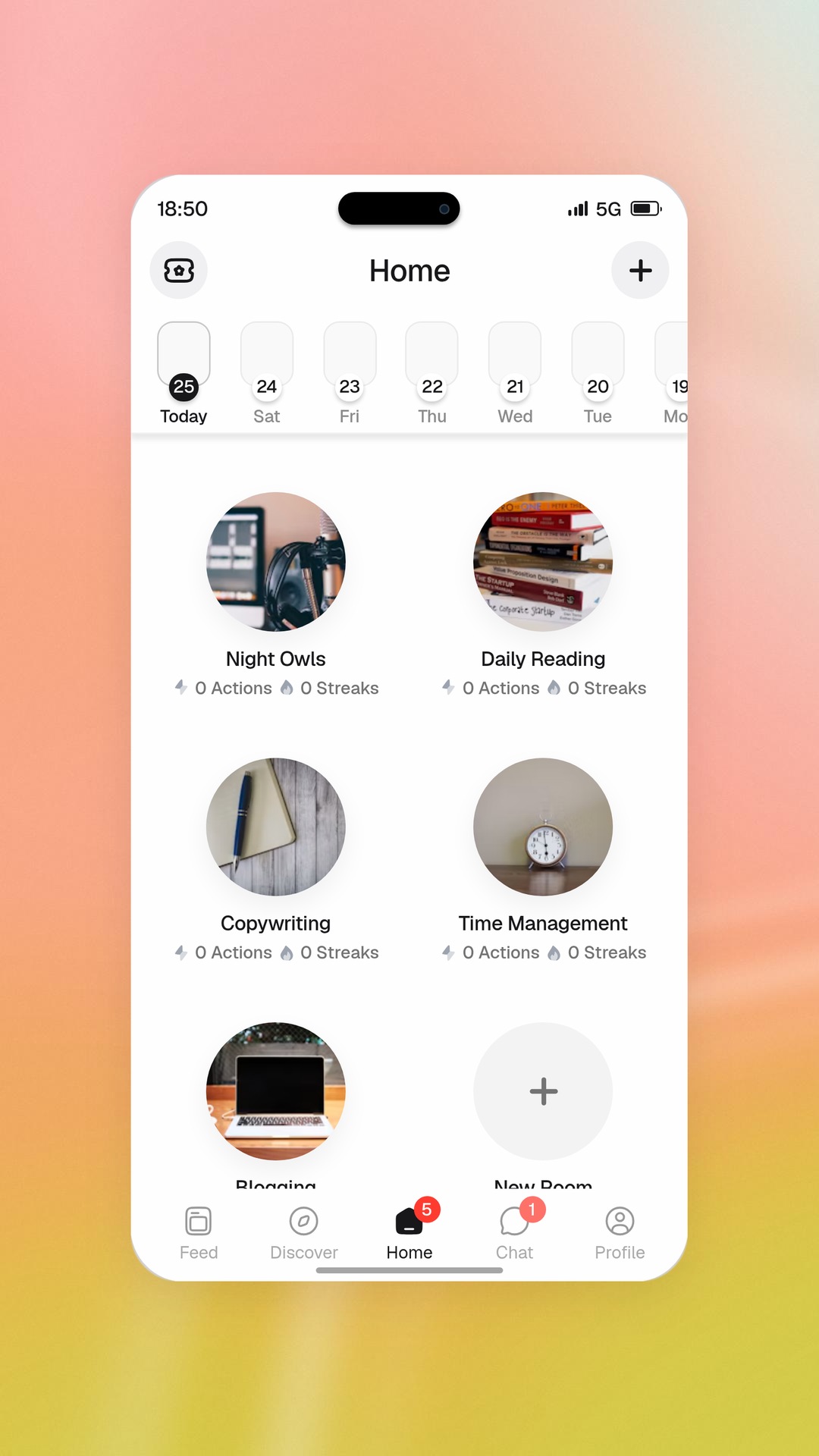
Aksa is a social platform with an AI agent. You stop doomscrolling by replacing it, not resisting it. Identify the trigger that starts the scroll, attach a small alternative action to that same trigger, verify the alternative with real proof, and let other people see whether you followed through.
Blocking apps and white-knuckle abstinence fail for most people because they leave a vacuum where the habit used to be. This guide builds the replacement instead, using a structure you can run inside Aksa, a social platform with an AI agent.
Why doomscrolling beats willpower
The scroll is engineered to win. Infinite feeds deliver variable rewards, the same reinforcement schedule that makes slot machines compelling: most pulls are boring, a few are delightful, and the next pull is always free. Your intention to stop is competing with thousands of engineers optimizing the opposite.
It also fills real needs. The evening scroll is often exhaustion management; the morning scroll is a soft start; the queue scroll is boredom anesthesia. A habit that serves three needs will not die from being forbidden. Each need has to be handed a different answer.
Finally, doomscrolling is invisible. Nobody sees you scroll for 90 minutes, and by morning even you have forgotten. Habits that leave no evidence are the hardest to change, because there is nothing to push against.
Step one: map your loop honestly
For three days, do not try to change anything. Just note every session: the trigger (bed, toilet, queue, couch), the rough duration, and how you felt after. Most people discover two or three dominant loops rather than a general problem.
The evening loop is usually the biggest and the most winnable, because it has a fixed location and time. Fixed loops can be re-engineered; ambient all-day grazing is harder, so win the fixed battles first.
A useful trick: log each session as an Answer reflection in Aksa. Writing "scrolled 70 minutes in bed, felt worse" once a day makes the invisible habit visible in your own proof history. Measurement alone often cuts the behavior before any system arrives.
Note what you are not doing in this step: deleting apps, announcing a digital detox, or vowing never to scroll again. Grand gestures feel strong and fail fast, because they attack the habit at its strongest point, the craving, instead of its weakest point, the record. You are building evidence for a replacement, and evidence is where habits are actually lost and won.
Step two: install the replacement at the trigger
For each mapped loop, choose a replacement that satisfies the same need with a defined end. Bedtime scroll becomes ten pages of a book. Queue scroll becomes a saved article or a two-minute breathing timer. Couch scroll becomes one episode with a chosen stop, not an infinite feed.
The replacement must be easier to start than the scroll. Keep the book on the pillow, the article saved to the home screen, the timer one tap away. Friction decides habits far more than intention does, so move the friction to the scroll's side: log out of the feed apps, remove them from the first home screen, charge the phone outside the bedroom.
Then make the replacement a daily Action in Aksa with a matching proof primitive: a Counter for pages read, a Timer for the breathing session, a photo Submit of the book's page. The Action gives the replacement the same one-tap convenience the feed had, plus something the feed never offered: evidence.
Step three: add witnesses to the new loop
A private replacement dies as quietly as the original resolution. Put the new habit where people can see it: an Action Room in Aksa where you post the daily proof, a friend who gets your claim card, a cohort running the same swap.
Social visibility changes the economics of a weak evening. When the room expects your reading Counter by 10pm, the bed scroll has competition: not willpower, but reputation. A company database count on October 1, 2026 recorded 375 proof posts from 40 contributors, the texture of small rooms where no post gets lost.
The AI agent keeps the structure warm. It plans the daily action list, answers questions about your goal, and posts updates in the room, so the system nudges you on the nights your friends are busy.
One honest boundary: Aksa does not block your apps or lock your screen. What it changes is the surrounding economy of the habit, the proof, the streak, the room, the record, so the scroll slowly stops being the cheapest comfort available. Pair that with your phone's own built-in downtime settings if you want hard limits too; the two approaches stack well.
Step four: protect the two danger windows
The first danger window is the first hour of the morning. A scroll that starts in bed taxes the whole day's attention. Move the charger out of the bedroom and put a morning Action in Aksa at the top of your day: a Timer for five minutes of quiet, a photo Submit of your made bed, anything that makes the first phone interaction a proof rather than a feed.
The second window is the 45 minutes before sleep. This is where the replacement book and the room claim card earn their keep: read, post the Counter, receive the cheers, phone down outside the room.
Weekends deserve their own plan, because unstructured time is feed time. Aksa Actions can run on weekday or weekend schedules, so set a lighter weekend floor rather than none at all. A loophole with rules beats an exception with none.
Keep a one-line nightly Answer reflection during the first month: what triggered the strongest urge and whether the replacement held. Patterns emerge within two weeks, and each pattern is a precise adjustment target, far more useful than a vague resolution to do better tomorrow.
What progress actually looks like
Expect the shape of change to be a staircase, not a slope. Week one: you catch the scroll mid-session a few times. Week two: the replacement wins some evenings. Week four: the scroll sessions shrink and the bed-book nights outnumber them. The 2009 Lally study at University College London found habits take an average of 66 days to automate, so budget two months, not two days.
Track the replacement, not the scroll. Your Aksa heatmap shows reading days accumulating in green; the scroll shrinks as a side effect rather than as a target. What gets rewarded gets repeated, and proof is the reward.
When a bad night happens, and it will, apply the 24-hour rule: the next evening's floor action is non-negotiable. One grey cell on the heatmap is a footnote; two in a row is a plot twist you do not want.
The setup checklist
Everything above fits in one evening:
By tomorrow night the scroll has competition, the competition has evidence, and the evidence has witnesses.
- 1. Map your scroll loops for three days: trigger, duration, and feeling after each session.
- 2. Choose one replacement per loop that meets the same need and has a defined end.
- 3. Move friction: log out of feed apps, clear the home screen, charge the phone outside the bedroom.
- 4. Create the replacement as a daily Action in Aksa with a matching proof primitive: Counter, Timer, or Submit.
- 5. Join or create an Action Room and post your proof there nightly.
- 6. Set one evening reminder at the start of your danger window, and keep the 24-hour rule after any miss.
FAQ
Why is doomscrolling so hard to stop?
Because it is a variable-reward loop engineered for retention: unpredictable payoffs keep you pulling the feed like a slot machine, and the behavior serves real needs like boredom relief and exhaustion management. Abstinence leaves those needs unanswered. Replacement, giving each trigger a different answer with proof and witnesses, is what actually holds.
Do screen-time limits and app blockers work?
They help as friction but rarely work alone, because they guard the old habit instead of building a new one. Most people route around a blocker within weeks. The durable fix pairs friction with a verified replacement activity and social accountability, so the need the scroll served is met another way.
What is the fastest win against doomscrolling?
Charge your phone outside the bedroom tonight and put a book on the pillow. The bedtime loop is the most common and the most winnable because it has a fixed place and time. Then verify the replacement: a nightly pages-read Counter in Aksa turns the swap into evidence the room can see.
How do I track progress without obsessing over minutes?
Track the replacement, not the scroll. Count reading days, timer sessions, or phone-free mornings as verified Actions, and let the heatmap show them accumulating. Measuring the good habit directly, instead of auditing the bad one, keeps the process rewarding rather than shaming.
Can an accountability partner help with phone habits?
Yes, because doomscrolling is invisible and therefore socially free. When your evening proof posts to an Aksa Action Room, skipping becomes noticeable, and noticeable skips are the ones we avoid. One partner or a small room is enough; the mechanism is being seen, not being watched.
How long does it take to break the doomscrolling habit?
Expect a staircase over roughly two months, matching the 66-day average for habit automation from the 2009 Lally study at University College London. Early wins come from friction and the evening replacement; full automaticity takes longer. Use the 24-hour rule after bad nights so single misses never become new patterns.