How to Stop Nail Biting: A 30-Day Plan for Breaking the Habit
Stop biting your nails with trigger mapping, competing responses, daily avoidance proof, and a streak you can see. The method, the 30-day plan, setup steps, and FAQs.
Published October 28, 2026 · 7 min read
The short answer
Stop nail biting by mapping your three trigger situations, installing a physical competing response for each, and recording every bite-free day as dated proof. You are retraining an autopilot, not fighting one - the record and the replacement behavior do what willpower cannot.
This guide covers why the habit is so persistent, the technique with the strongest track record, the 30-day plan, and the exact setup that keeps the record honest.
Thirty days is the frame because the autopilot starts weakening within two weeks and the record starts protecting you within one. The plan asks for about fifteen minutes of setup and one honest minute every evening.
Why nail biting survives every resolution
Nail biting is what clinicians call a body-focused repetitive behavior, and its defining feature is that it runs below awareness. The American Academy of Dermatology notes that the habit typically begins in childhood and can continue through adulthood - and that the damage is more than cosmetic: repeated biting can make the skin around the nails sore and can damage the tissue that makes nails grow, producing abnormal-looking nails over time.
The reason resolutions fail is timing: awareness arrives mid-bite or after, never before. You cannot out-willpower a behavior you do not notice starting. Every method that works moves the intervention earlier - to the trigger, to the hands, to the moment before the autopilot fires.
The good news is that the behavior is highly patterned. Almost everyone who bites does it in a small set of situations: driving, reading, watching screens, working through a hard problem, boredom, anxiety. A habit with three triggers is a habit with three places to attack it.
Step one: map your triggers for three days
Before changing anything, spend three days collecting data. Every time you catch yourself biting, note the situation in one line: where you are, what you are doing, what you felt just before. Do not try to stop yet - just catch and record.
By day three the pattern is usually embarrassingly clear: two or three situations account for most of the behavior. This map is the foundation of everything after, because a generic 'stop biting' plan fights everywhere and wins nowhere, while a mapped plan defends three specific positions.
Keep the map honest and small. Three triggers, one line each, written down - not a personality analysis. The goal is a list you can defend, not a story about why you are this way.
Step two: the competing response
The core technique from habit-reversal training is the competing response: a physically incompatible action you perform whenever the urge or trigger appears. For nail biting the classics are clenching a fist, sitting on your hands, holding a pen or stress ball, or clasping your hands together - anything that makes the biting motion impossible for one to three minutes while the urge passes.
The response has to be specific per trigger: hands on the wheel at ten-and-two while driving, a stress ball during screen time, a fidget ring at the desk. Generic resolve fails; a named object in a named place works.
Support it with the physical barriers the dermatologists recommend: keep nails trimmed short so there is less to bite, use bitter-tasting nail polish as a tripwire that catches the autopilot mid-action, and paint or cover your nails so there is nothing tempting to grab. Each layer catches a different failure mode.
Step three: proof and the visible streak
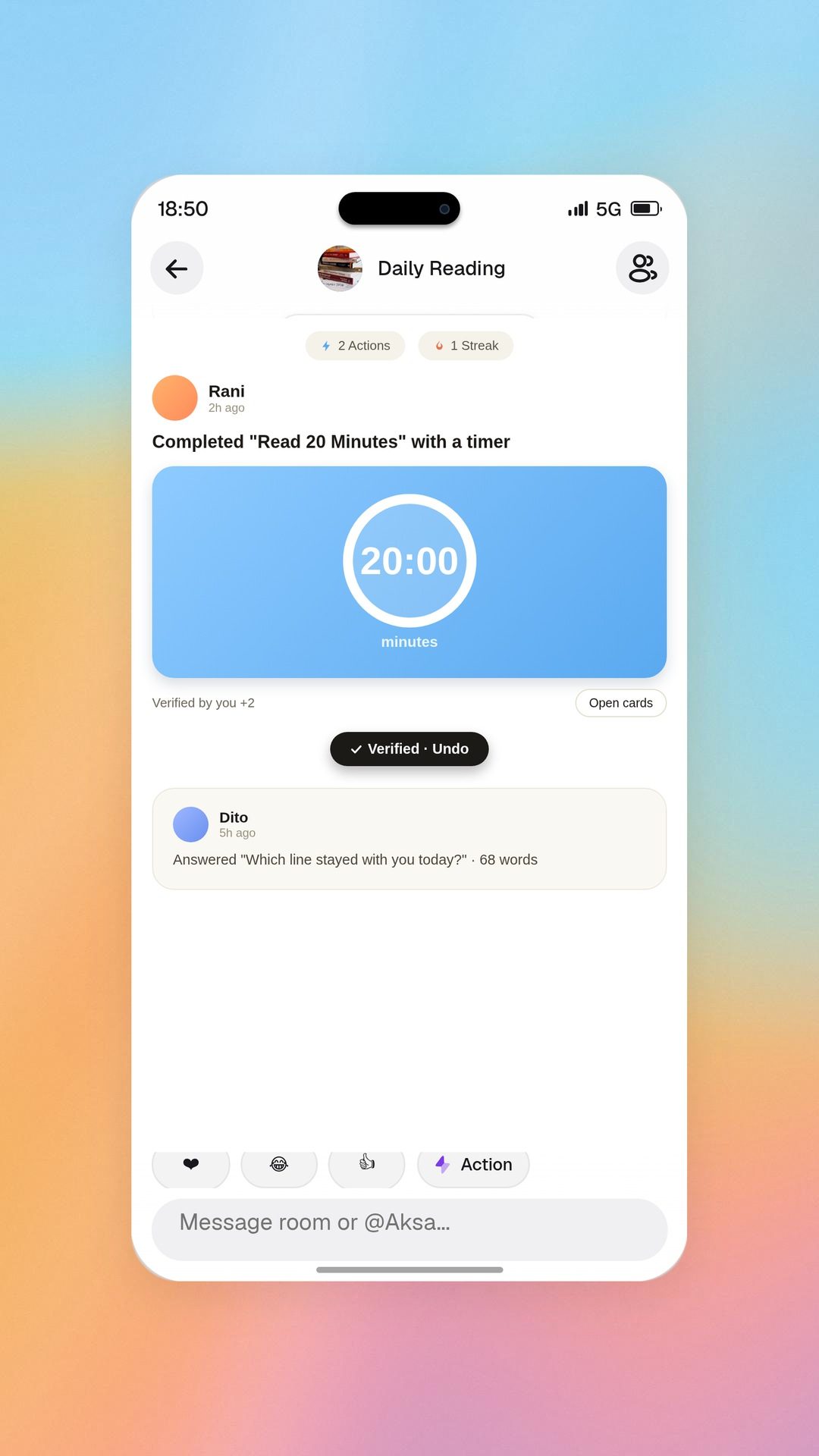
Here is where most solo attempts quietly die: a bite-free day looks exactly like a day you forgot to notice. Aksa is a social platform with an AI agent. An avoidance Confirm is a dated evening submission that the day stayed bite-free, and streak counts move only on verified proof days. The record makes the invisible progress visible, and visible progress is what you protect.
Add one witness: a partner, a friend, or a small Action Room, who sees the streak without policing your hands. In a November 19, 2020 post on the Duolingo blog, the company reported that users reaching a 7-day streak were 2.4 times more likely to still be active the next day than users without one - the first week of a count is when the protection kicks in, which is exactly the week nail-biting quits usually collapse.
Photograph the recovery if you want a second kind of proof: a weekly photo of the same hand in the same light makes three weeks of healing visible in a way memory never is. Progress you can see is progress you keep.
The 30-day plan
Days 1-3: map only. Record triggers, change nothing else. Days 4-10: competing responses live, bitter polish on, nails trimmed, evening proof begins. Expect several caught-in-the-act moments a day - catching one mid-bite and switching to the response counts as a win, not a failure.
Days 11-20: the autopilot weakens. Urges still arrive but the response fires faster. Nails start looking like nails; the weekly photo starts paying off. Days 21-30: the behavior becomes occasional and effortful rather than constant and automatic. In a 2009 study by Lally and colleagues in the European Journal of Social Psychology, the time to reach 95 percent of habit automaticity ranged from 18 to 254 days - and missing a single opportunity did not materially affect the process. A lapse is a data point, not a relapse, unless you let it become a streak of its own.
Day 30 is not the end of vigilance; it is the end of the acute phase. Keep the evening proof for another month and the competing responses on standby for stress spikes - the habit is old, and old habits test the fences after the guards change.
Set up the plan in Aksa
Fifteen minutes tonight, and tomorrow starts the map.
- 1. Create the Goal: 'Bite-free for 30 days' with your three triggers and their competing responses attached once mapped.
- 2. Add a daily Action with an avoidance Confirm - the evening proof of a bite-free day.
- 3. Set a Reminder for the evening submission - Repeat Every Day, Alarm switch if notifications get buried.
- 4. Stage the tools tonight: clippers, file, moisturizer, bitter polish, and one fidget object per trigger location.
- 5. Take the day-zero photo of your nails - the recovery timeline starts here.
- 6. Invite one witness or create a small room - each friend who joins through your invite and finishes onboarding earns one month of Premium for both of you, up to five friends.
When it is more than a habit
For most people nail biting is a stubborn habit with a mechanical fix. For some it sits in a heavier pattern - severe, bleeding, driven by anxiety that does not respond to technique - where the right tool is a professional, not a streak. Habit-reversal training delivered by a therapist is the established treatment, and it works.
There is no shame upgrade path here: if three honest weeks of mapped triggers and competing responses change nothing, that is information, and the next step is a clinician. The system in this guide is for the common case, and the common case is very winnable.
FAQ
Why is nail biting so hard to stop?
Because it runs below awareness - you catch yourself mid-bite or after, never before, so willpower always arrives late. The American Academy of Dermatology notes the habit typically starts in childhood and can persist into adulthood. Methods that work intervene earlier: trigger mapping, competing responses, and physical barriers.
Does bitter nail polish actually work?
It works as a tripwire, not a cure: the taste catches the autopilot mid-action and hands you the moment of awareness you never get naturally. Pair it with a competing response - something for the hands to do instead - or the awareness fades and the biting adapts around the taste.
What is a competing response for nail biting?
A physically incompatible action held for one to three minutes when the urge or trigger appears: clenching a fist, sitting on hands, holding a pen or stress ball, clasping hands. It is the core technique of habit-reversal training - you do not suppress the urge, you give the hands a different job until it passes.
How long does it take to stop biting your nails?
The acute phase is about 30 days of mapped triggers, competing responses, and daily proof. Full automaticity of the new pattern takes longer - habit research by Lally and colleagues (European Journal of Social Psychology, 2009) found times to 95 percent automaticity ranging from 18 to 254 days. Plan for a month of effort and a second month of protection.
Is nail biting harmful or just cosmetic?
More than cosmetic, per the American Academy of Dermatology: repeated biting can make the skin around the nails sore and damage the tissue that makes nails grow, producing abnormal-looking nails. It also raises infection risk around the nail bed. The stakes are moderate but real - and the fix is very achievable.
What should I do if I bite without noticing at all?
Add awareness layers that interrupt the autopilot: bitter polish as a taste tripwire, a band on the dominant fingers as a visual one, and a brief check-in alarm three times a day asking 'where are my hands right now.' Awareness is the first skill - the competing response only works once you catch the moment.