How to Track Multiple Goals Without Dropping Any of Them
Tracking several goals at once fails from overload, not ambition. Floors per goal, separate rooms, one dashboard, and a weekly review keep all chains alive.
Published October 25, 2026 · 7 min read
The direct answer
Aksa is a social platform with an AI agent. You track multiple goals by capping the list at two or three, giving each a tiny daily floor and its own proof, keeping one dashboard where every chain is visible at a glance, and reviewing the whole system weekly.
The ambition is fine; the default failure is structural. This guide sets up the structure for running several goals without quietly dropping the quietest one.
Why multi-goal tracking fails
The first failure is load: three goals at full intensity is a part-time job, and the first busy week bankrupts all three at once. Multi-goal systems fail together because they share one resource, your worst-day capacity.
The second failure is asymmetry. One goal is always louder, more social, or more fun, and it eats the others' days. Without explicit floors per goal, the quietest goal starves first, and its death is only noticed weeks later.
The third is scattered records: runs in one app, pages in a notebook, budget in a spreadsheet. When checking your goals takes four logins, you stop checking, and unreviewed systems decay within a month.
A fourth failure mode is review theater: a weekly spreadsheet session where numbers are copied and nothing changes. Reviews earn their keep only when they produce at most one concrete adjustment, a smaller floor, a new anchor hour, a swapped witness. If your review changes nothing for three weeks straight, the review is decoration and the system is quietly drifting.
Cap the list and floor every goal
Two goals is comfortable, three is the ceiling for most people, four is a hobby in itself. Choose deliberately: the goal that did not make the list is not abandoned, it is queued, and a queue is a promise with a date.
Give each goal a floor sized for your worst day: ten pushups, five pages, one glass before coffee. Research backs the math, from the 2009 Lally study's 66-day average for automation to Duolingo's November 19, 2020 finding that intense daily goals produced the fewest streaks. Small floors are what let three chains survive the same bad week.
Write the floors down where you will see them daily. In Aksa, each goal carries its own daily Actions, so the floor is the Action itself: a Counter for reps, a Timer for focus, an Answer for reflection, a Confirm for commitments.
Practical sequencing helps too: order your day's floors from most-skipped to easiest. The goal you are avoiding gets the first slot, when the day is fresh, and the goal you love becomes the reward. Sequencing sounds trivial and quietly decides which chain survives a hard month.
One proof standard across all goals
Whatever the goal, the rule is identical: progress counts only verified proof, never an unverified tap. Aksa's six primitives cover essentially any daily action, Submit for photos and video, Answer for writing, Counter for reps, Timer for sessions, Check-in for presence, Confirm for binary commitments.
A single proof standard is what makes multi-goal tracking cognitively cheap. You never wonder how a goal is going; every goal answers in the same currency, verified days, so comparing and reviewing takes seconds instead of a weekly archaeology dig.
The archives layer automatically: each goal builds its own heatmap and history, while the profile Photo Calendar and momentum chart roll everything into one visible record of the season.
Rooms also distribute the emotional load unevenly, in a good way: when your training week is flat, the reading room still cheers, and vice versa. Separate rooms mean a bad week in one goal never darkens the witnesses of another, which keeps each space's morale honest and specific.
Separate rooms, shared dashboard
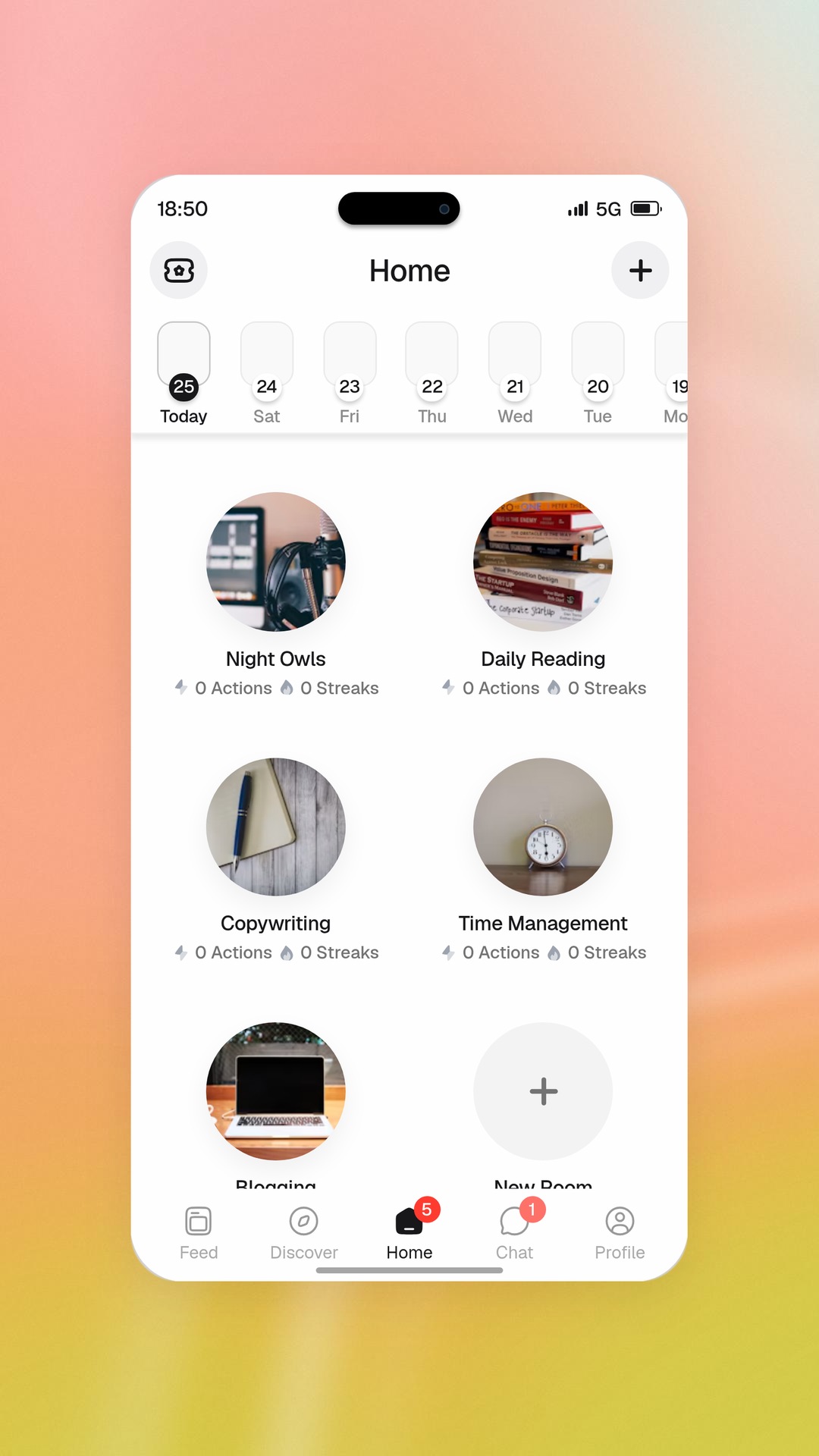
Give each goal its own Action Room with its own people. The running friends do not need to see the reading proofs, and goal-specific rooms keep every space on-topic and every witness relevant.
Then keep one dashboard for yourself: your Aksa profile, where every goal's streak, heatmap, and latest proof live one scroll apart. The daily check is one glance across all chains, which is what makes three goals feel like one system instead of three obligations.
Aksa AI reduces the juggling inside each room: it plans the daily action list, answers goal questions, and posts updates, so three rooms do not mean three times the organizing work for you.
Bring data to the review, not vibes: each goal's heatmap answers the three questions faster than memory can. Memory remembers the dramatic week, the heroic save, the embarrassing miss; the heatmap remembers all fifty-two days equally, which is the only fair basis for adjusting anything.
The weekly review that keeps all chains alive
Fifteen minutes every Sunday, same three questions per goal: did the floor hold on the worst day this week, is the floor still small enough, and does this goal still deserve its slot. The review is where multi-goal systems are actually managed; everything else is just logging.
Make one adjustment maximum per week. Systems thrash when every flat day triggers a redesign, and a goal that survives six unchanged weeks has earned trust that daily tinkering never builds.
Use the Weekly Arena reset, leaderboards across Individual, School, and City reset every Monday at 00:00 UTC, as the natural review trigger: last week's standing is final, this week is fresh, and the review fits between them.
Set up your multi-goal system today
Thirty minutes for the whole thing:
Then do today's floor for each goal, starting with the one you most want to skip. That order is deliberate.
One last discipline: never add a fourth goal to prove the system works. The system's success is exactly what tempts the overload that breaks it. Promotions come from the queue, at the Sunday review, one slot at a time. The list cap is the load-bearing wall of the entire design.
- 1. Cap the list: two or three goals, everything else written into a dated queue.
- 2. Set a worst-day floor for each goal, small enough to survive your busiest week.
- 3. Create each goal's daily Action in Aksa with the proof primitive that fits it.
- 4. Give each goal its own Action Room and witnesses; keep the profile as your single dashboard.
- 5. Set one reminder per goal at its anchor hour, and block fifteen minutes every Sunday for the review.
- 6. Complete today's floor for every goal now, hardest first, so all chains start today.
What a balanced season looks like
After a month, the dashboard tells the real story: not perfection, but three mostly-green heatmaps with the occasional grey cell, and no goal silently dead for a fortnight. That is what winning at multiple goals actually looks like.
The unexpected benefit is cross-goal momentum: a verified morning run lowers the friction for the evening reading session, because the system is already warm. Goals in one structure pull each other forward.
And when a goal completes or a season ends, the slot opens for the queue, with the structure already proven. You are not starting over; you are rotating crops in a field that works.
Seasons change by design, not by guilt. When a goal's season ends, mark it complete, thank the room, and rotate the slot. A system that makes rotation normal is a system you will still be running next year.
FAQ
How many goals can I track at the same time?
Two comfortably, three as the ceiling for most people. Every goal shares one resource: your worst-day capacity. Multi-goal systems fail together in the first busy week unless each goal has a tiny floor. Queue the rest with dates; a queued goal is a promise, not an abandonment.
How do I keep one goal from eating the others?
Explicit floors per goal and separate witnesses. The loudest goal always starves the quietest unless each has its own daily Action, its own Action Room, and its own verified chain. A shared dashboard, your Aksa profile with every streak one scroll apart, makes starvation visible before it becomes fatal.
Should I use one app or different apps per goal?
One system, one proof standard. Scattered records across four apps means four logins to check your life, which quietly ends the checking. Aksa's six proof primitives cover nearly any daily action, so every goal reports in the same currency: verified days on a heatmap.
What is a weekly goal review and do I need one?
Fifteen minutes, same three questions per goal: did the floor hold on the worst day, is it still small enough, does this goal still deserve its slot. Yes, you need it: logging without reviewing is how quiet goals die unnoticed. One adjustment maximum per week keeps the system stable.
What if all my goals collapse in the same bad week?
That is the classic shared-capacity failure, and the fix is floors, not effort. Shrink every floor until the whole set survives your busiest week, apply the 24-hour rule per goal after any miss, and let the Weekly Arena's Monday 00:00 UTC reset give the next week a clean start.
When should I drop a goal from my list?
At the weekly review, deliberately, not mid-week impulsively. If a goal has failed its floor three weeks running and no longer excites you, move it to the dated queue and promote the next goal. Dropping on schedule is strategy; dropping on a bad Tuesday is just a miss with extra steps.