How to Train for a 5K: An 8-Week Plan That Survives Real Life
An 8-week beginner 5K training plan with three runs a week, daily proof for every session, and the accountability structure that gets you to the start line. Plan, setup, and FAQs.
Published October 27, 2026 · 7 min read
The short answer
Train for a 5K with three runs a week for eight weeks: two easy run-walk sessions and one longer weekend run, progressing from mostly walking to a continuous 30-40 minutes. Every session gets dated proof, and a small group sees the record - the plan builds the fitness, the accountability makes sure the plan happens.
Below: the week-by-week schedule, the pacing rules that keep beginners uninjured, and the setup that turns a printed plan into 24 completed sessions.
Why 5K plans fail before week four
The beginner 5K failure is almost never physical. An 8-week run-walk progression is gentle enough for nearly any healthy adult - the failure is that 24 scheduled sessions meet 24 chances to skip, and a plan on paper has no opinion about being ignored. Week one is exciting, week three is wet and busy, and a missed Wednesday silently becomes a missed plan.
The two injuries that do sideline beginners come from the same root as the skipping: doing too much. Running too fast on easy days and jumping distance too quickly both trace to treating each session as a performance instead of an appointment. The fix for all of it is the same: make the session the goal - small, scheduled, and proven - and let the 5K arrive on its own.
In a 2009 study by Lally and colleagues in the European Journal of Social Psychology, habits took a median of 66 days to automate - almost exactly the length of an 8-week plan. You are not just training for a race; you are installing a running habit, and the 5K is the celebration at the end of the installation.
The 8-week schedule
Three runs a week - say Tuesday, Thursday, Saturday - with at least one rest day between sessions. Weeks 1-2: alternate 1 minute of easy running with 2 minutes of walking for 20 minutes. Weeks 3-4: run 3 minutes, walk 1, for 25 minutes. Weeks 5-6: run 8 minutes, walk 1, for 30 minutes. Week 7: run 12 minutes, walk 1, twice, then a 30-minute continuous easy run on the weekend. Week 8: two easy 25-minute runs, then the 5K itself at the weekend - run easy, walk if needed, finish smiling.
Every run is an easy run. Conversational pace - you could speak full sentences - is not a beginner concession; it is how endurance actually gets built. If you cannot talk, you are running too fast, and running too fast is how week four ends in a sore knee and a quiet abandonment.
Miss a session and the rule is simple: never stack two missed weeks. One missed run is nothing - reschedule within the week or let it go. The pattern to defend is the week, not the individual day.
Proof for every session
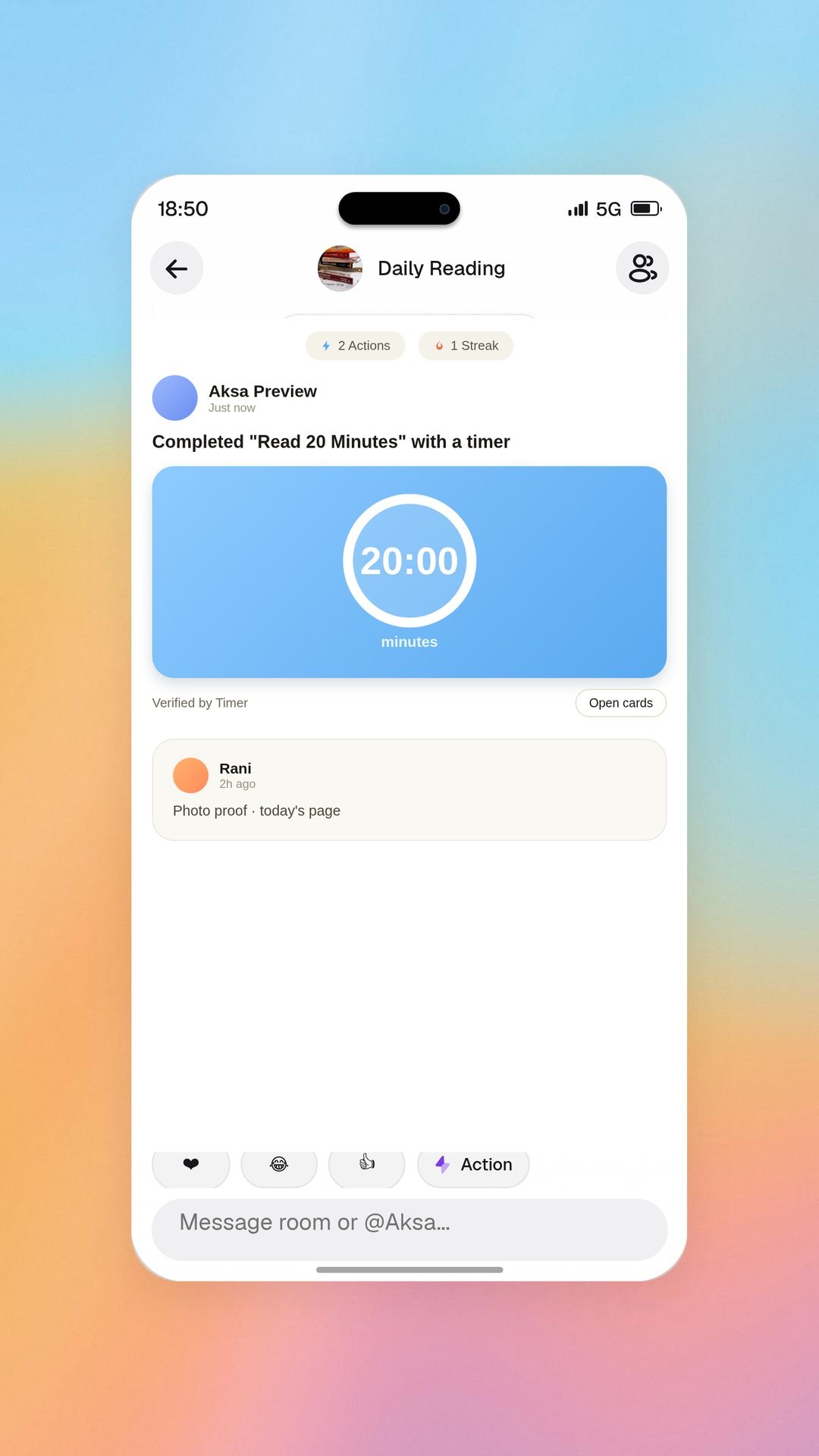
A plan you report on is a plan you complete. Aksa is a social platform with an AI agent, and running maps cleanly onto its proof formats: a Timer record for the session length, a Counter for run-walk intervals, or a Photo from the route - each produces dated evidence the session happened. Streak counts move only on verified proof days, so by week six your record means something.
The Aksa AI Action agent covers the planning friction: it helps decompose the 5K goal into provable daily actions at setup and answers questions when you stall - what to do about a tight calf, whether to repeat a week - while never marking a run done without proof. The agent handles the plan; you handle the shoes.
One honest-keeping rule: record what happened, not what was scheduled. A 20-minute session when 25 was planned is a proven 20-minute session - the record's value comes from it being literally true, and a training log you trust is worth more than a flattering one.
Set up the plan in Aksa
Ten minutes tonight, and Tuesday is session one.
- 1. Create the Goal as one provable sentence: 'Complete a 5K on [date], 24 sessions over 8 weeks.'
- 2. Add a daily Action on your three run days with a proof type - timer for the session, counter for intervals, or a route photo.
- 3. Set a Reminder for each run day - Repeat can be any days you choose, so Tuesday-Thursday-Saturday fits exactly; use the Alarm switch for early runs.
- 4. Pick your 5K now: a local race, a parkrun-style free weekly 5K, or a self-timed route on a fixed date - the date is what makes week eight real.
- 5. Create an Action Room for the group - each friend who joins through your invite and finishes onboarding earns one month of Premium for both of you, up to five friends.
- 6. Review the room heatmap every Sunday and plan next week's three sessions around your real calendar - the Weekly Arena resets every Monday.
Race week and race day
Week eight is a taper, not a test: two short easy runs early in the week, then rest. Fitness is banked; freshness is what you are buying now. Lay out clothes, pin the plan for the morning, and sleep two good nights - the night before the night before matters as much as the night before.
On the day: start slower than feels heroic. The most common first-5K mistake is running the first kilometer at adrenaline pace and surviving the rest. Run the first half easy enough to chat, then speed up only if the legs vote for it. Walk breaks are legal, normal, and used by plenty of finishers.
Then the important part: submit the proof. The finish photo - bib, clock, sweaty grin - is the artifact the whole 8-week record was building toward, and in the room it lands as the week's best post. Claim cards make milestone proofs shareable outside the app, which is how one person's finish recruits the next person's week one.
After the finish line
The 5K was the deadline; the habit was the point. Keep the three-day rhythm after the race with no distance pressure - the worst outcome of a great 5K is never running again, and it happens to a large share of first-timers who built fitness on a deadline with no plan for the week after.
Set the next provable goal within a week of finishing: another 5K to run it faster, a 10K in twelve weeks, or simply 'three runs a week through winter.' The system - the actions, the proofs, the room - stays exactly as it is; only the sentence changes.
The gear-free warm-up and the two rules of staying healthy
Start every session with five minutes of brisk walking and finish with five minutes of easy walking - no stretching routine required, no gear, no complexity. The warm-up walk is part of the session, so it goes in the timer proof and counts toward the day's total.
Rule one for staying healthy: increase nothing by much. The schedule above already encodes the conservative progression - follow it instead of your enthusiasm. Rule two: a niggle that changes how you move gets two rest days, and if it is still there, a week. Beginners lose months to injuries they ran through for pride and lose nothing to injuries they rested early.
FAQ
Is 8 weeks enough to train for a 5K from zero?
For a healthy adult, yes - an 8-week run-walk progression is the standard beginner timeline, starting at 1-minute run intervals and building to a continuous 30-40 minutes. If you are starting from a fully sedentary base, add two walking-only weeks at the front and treat the plan as 10 weeks.
How many days a week should a beginner run for a 5K?
Three, with at least one rest day between sessions. Two easy run-walk workouts and one longer weekend run build endurance while keeping injury risk low - more days add fatigue faster than fitness for beginners, and missed sessions pile up into quiet abandonment.
What pace should I run during 5K training?
Conversational pace - slow enough to speak full sentences. If you cannot talk, you are running too fast for the purpose of the session. Easy pace builds the aerobic base that carries you 5 kilometers; speed is a later project, and forcing it early is how beginners get hurt.
Is it OK to walk during a 5K race?
Completely. Run-walk is a legitimate race strategy, not a failure - plenty of experienced runners plan walk breaks. Finishing a 5K with walk breaks beats not starting because continuous running felt mandatory.
What do I do if I miss a week of training?
Repeat the missed week instead of jumping ahead. A lost week costs nothing but seven days; jumping back into week five's volume on week three's legs is where injuries come from. The 5K date can move - your knees are less flexible.
Do I need special shoes or gear to start 5K training?
Decent running shoes that fit, and nothing else is essential. Get shoes from a running shop if you can - fit matters more than brand or price. Everything else - watches, apps, outfits - is optional decoration on the only two things that matter: three sessions a week and proof they happened.