Language Learning Streaks: How to Keep Daily Practice Alive for a Year
Language streaks die when life gets busy and the app is the only witness. Keep yours alive with verified proof, a floor lesson, and people who notice.
Published October 25, 2026 · 7 min read
The direct answer
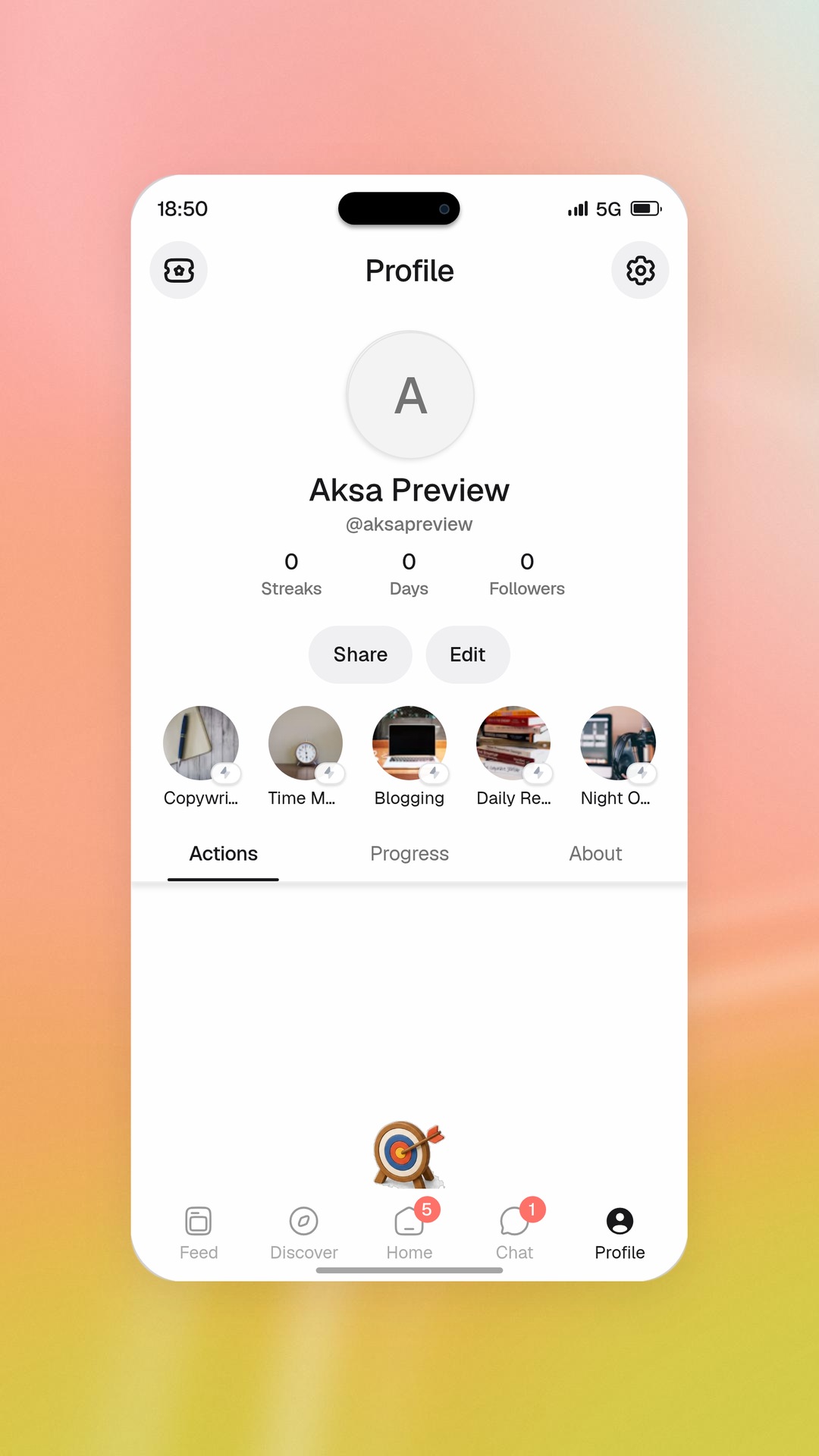
Aksa is a social platform with an AI agent. You keep a language learning streak alive by shrinking the daily lesson to an unmissable floor, verifying practice with real proof, and adding human witnesses, because the app alone will not notice when you quietly give up.
Course apps are excellent teachers and inconsistent babysitters. This guide builds the accountability layer that carries your streak through busy seasons, travel, and the month-three slump.
What the streak data actually says
Duolingo has published unusually candid streak research. In a November 19, 2020 post on the Duolingo blog, engineer Anton Yu reported that learners reaching a 7-day streak are 2.4 times more likely to return the next day, and that letting a single lesson extend the streak, instead of requiring the full daily goal, raised day-14 retention by 3.3 percent.
In a January 31, 2022 post, Duolingo's Osman Mansur reported more than 6 million people on streaks of 7 days or longer, and credited Streak Freezes, pauses of up to two equipped at a time, with lifting daily active learners. The lesson from both posts: tiny daily units and forgiveness mechanics keep people practicing.
The same posts quietly reveal the limit: the streak measures lessons inside one app. It cannot see your conversation practice, your podcast listening, your flashcards on paper, or any of the real-world exposure that actually builds fluency.
There is also useful math in how Duolingo frames motivation: a new streak feels bigger each day because going from 2 to 3 days is a 50 percent jump, while 200 to 201 is half a percent. Early streaks run on excitement; long streaks must run on structure, which is why the accountability layer matters more the longer you have held the chain.
Why year-one streaks really die
Ask anyone who lost a 200-day streak and the story is never 'I stopped caring.' It is a wedding, a work crisis, a flight, a flu. The streak died because the daily unit was sized for normal life and normal life was temporarily unavailable.
The second cause is the freeze illusion: protective mechanics soften the contract, and softened contracts slowly stop feeling binding. A streak you can pause without cost becomes optional, and optional practice is the first thing busy weeks cut.
The third cause is loneliness. An app streak is a private contract with a company. When you break it, a cartoon owl is disappointed, which turns out to be a weaker force than a real friend noticing.
The fourth cause is goal drift: somewhere around month four, 'learn Spanish' quietly became 'keep the number green,' and when the number lost its meaning, the practice followed. A verified-proof streak keeps the two welded together, because every link in the chain is an artifact of real exposure, not a tap.
Build the floor-and-proof system
Set the floor at one lesson or five minutes of any language exposure, whichever happens first on a bad day. One lesson is the unit Duolingo's own data vindicated; five minutes of podcast, flashcards, or reading counts the same in your system because fluency does not care which app delivered the reps.
Verify the floor in Aksa with a matching primitive: a photo Submit of the completed lesson screen, a Timer for podcast or conversation minutes, a Counter for flashcard reps, or a one-line Answer in the language you are learning. Progress counts only verified proof, so the streak you build is evidence, not taps.
The Answer-in-the-language option is secretly the strongest: one sentence a day in your target language compounds into a 365-entry writing journal inside your proof history, which is itself a fluency asset no course app gives you.
Add human witnesses
Create an Aksa Action Room for language practice: two to six learners, any languages, same daily floor. Each verified session posts a claim card with your streak, and cheers land as push notifications. The room does not need to study the same language; it needs to expect your daily proof.
Mixed-language rooms work beautifully because the commitment is identical even when the content differs: everyone shows up, everyone posts, everyone is seen. In a company database pull from late September 2026, 36 percent of proofs received a social response, so recognition is a reliable part of the loop.
Aksa AI keeps the room steady during everyone's exam weeks and holidays: it plans the daily action list, answers goal questions, and posts updates, so the room's heartbeat never depends on one member's free time.
Exam and deadline weeks get their own protocol too: floor drops to one lesson before noon, because evening-you in a deadline week cannot be trusted, and noon is a promise morning-you can keep. Write it down in the room before the week starts; protocols invented mid-crisis are just wishes.
Protocols for the streak killers
Travel: the floor shrinks to five minutes of any exposure, done at the airport if needed. Aksa saves proof offline and syncs when you land, so dead zones never cost a link in the chain.
Sick days: the floor converts to an Answer reflection, one sentence about anything, in the target language if you can manage it, in your own if you cannot. The chain bends; it does not break.
After a true miss, the 24-hour rule: next day's floor is non-negotiable, no compensation marathons. And remember the Weekly Arena resets Individual, School, and City leaderboards every Monday at 00:00 UTC, so a bad week never permanently stains your standing.
Set up your streak system today
Fifteen minutes:
Keep your course app for the curriculum. Aksa is not a teacher; it is the witness that keeps you showing up to your teacher.
Invite the friend who keeps saying they want to learn alongside you: each friend who joins through your invite and finishes onboarding earns one month of Premium for both of you, up to five friends. A language room of two is the easiest accountability structure ever built, and the cheapest.
- 1. Set the floor: one lesson or five minutes of any language exposure, whichever a bad day allows.
- 2. Create the daily Action in Aksa with the proof primitive that fits: Submit, Timer, Counter, or Answer.
- 3. Create or join a language practice Action Room with two to six learners.
- 4. Write the travel and sick-day protocols into the room chat before you need them.
- 5. Set one reminder at your usual practice hour, Repeat Every Day.
- 6. Do today's floor right now, one lesson or five minutes, and post the proof.
What a year of this looks like
Day 365 is not a number on a cartoon counter; it is a heatmap with three hundred-plus verified days, a Photo Calendar of lesson screens and café tables, and a journal of sentences in a language you could not read a year ago.
The fluency arrives as a side effect of the chain. Five to fifteen verified minutes a day is roughly 30 to 90 hours of practice a year, before counting the good days that ran long, and hours are the currency fluency is paid in.
Most importantly, the witnesses saw it happen. A year-long streak with an audience is a story you get to keep telling; a private one is just a number that resets.
FAQ
How do I not lose my language streak on busy days?
Shrink the floor before busy days arrive: one lesson or five minutes of any exposure counts. Duolingo's own 2020 data showed a single lesson extending the streak raised day-14 retention by 3.3 percent. Verify the floor in Aksa with a photo, timer, or one-line reflection, and let a room of learners expect it daily.
Are streak freezes good or bad for learning?
Duolingo's January 2022 blog post credits Streak Freezes with keeping learners returning, so as retention design they work. The trade-off is softness: a pausable streak is a weaker contract. Many learners pair the app's freeze for emergencies with a stricter personal rule, verified daily proof in Aksa, so the real chain stays honest.
Does a streak actually make you fluent?
The streak makes you practice; practice makes you fluent. Five to fifteen verified minutes a day compounds to 30 to 90 hours a year, which is the input fluency runs on. The streak is the delivery mechanism, and verified proof plus witnesses is what keeps the delivery running through busy seasons.
What counts as language practice for a streak?
Anything with real exposure: a course lesson, podcast or video minutes, flashcard reps, reading a page, or writing and speaking. In Aksa each maps to a proof primitive, Submit, Timer, Counter, or Answer, so your streak can follow your learning life instead of being hostage to one app's lesson format.
How do I restart after losing a long streak?
Same day, floor session, no mourning. The 24-hour rule matters more than the number: one miss is an event, two is a pattern. Your Aksa heatmap preserves the old run as evidence you can rebuild, and the room's cheers make day one of the new chain feel like continuation rather than defeat.
Should I join a language learning community or practice alone?
Both, layered. Alone for the reps, community for the accountability. An Aksa Action Room of two to six learners gives you witnesses without scheduling overhead: post proof, get cheers, notice each other's gaps. The course teaches the language; the room protects the practice.