New Year Resolution App: Keep Your Resolution Past Quitter's Day
Why resolutions die by mid-January and how a proof-based resolution app - daily actions, verified proof, streak counts, and a small room - carries a goal past Quitter's Day into spring.
Published October 26, 2026 · 7 min read
The short answer
A resolution survives January when it stops being a sentence and becomes a daily system: one provable goal, a small daily action, dated proof every day, a streak that counts only real submissions, and two to five people who see the record. Set that system up in December, and January becomes execution instead of reinvention.
This guide covers why resolutions collapse on a schedule, the four-part system that prevents it, and the exact setup - plus what to do differently this December so next January is not a repeat of the last one.
The resolution failure schedule
Resolution failure is so consistent it has a name. Strava, analyzing its activity data, popularized 'Quitter's Day' - the second Friday of January - as the point where resolution-driven activity falls off a cliff. That puts the average resolution's lifespan at under two weeks.
The failure is structural, not moral. A resolution is a yearly intention with no daily specification: 'get fit' does not say what happens at 6:30 AM on a wet Tuesday. It has no evidence standard, so 'I basically kept it' is indistinguishable from keeping it. And it is private, so abandoning it is free - nobody's week changes when yours quietly ends.
The third week of January is where all three gaps hit at once: the novelty is gone, the action was never specified, and nobody noticed the first missed day, which made the second one easy. Any system that fixes resolutions has to fix specification, evidence, and witnesses - all three, because the weak one fails first.
Part one: a goal you can actually check
Rewrite the resolution as one provable sentence with a number and a date. 'Read more' becomes 'finish 12 books by December 31.' 'Get fit' becomes 'complete 100 workouts by July 1.' The sentence should make a stranger able to check whether it happened - that is the whole test.
Then decompose it into a daily action small enough to survive your worst day. The daily action is the real resolution; the yearly number is just its sum. In Aksa, goals are written as provable sentences and the Aksa AI Action agent helps decompose them into provable daily steps at setup - the agent plans and answers goal questions, but never marks anything done, because Verified Done requires durable proof and the verification rule for the Action.
Part two: daily proof and a streak that means something
Every day the action produces a dated artifact: a photo, a written answer, a counted total, a timed session, a check-in, or a confirmation. Aksa is a social platform with an AI agent, and these are the six proof formats - photo, answer, counter, timer, check-in, and confirm, including avoidance confirms for goals about not doing something.
The streak on top of that proof is the retention engine, but only if it is honest. In a November 19, 2020 post on the Duolingo blog, data scientist Anton Yu reported that users reaching a 7-day streak were 2.4 times more likely to still be practicing the next day - the count works because it is costly to lose. A streak that moves on unchecked taps trains you to disrespect it; streak counts move only on verified proof days.
The whole platform is built around that loop: action, proof, count, repeat.
Part three: the room
The resolution needs an audience small enough to matter. A room of two to five people - friends chasing the same goal shape, or strangers in a room built around it - turns January from a private negotiation into a shared project. You are not announcing your resolution to the internet; you are submitting evidence to a few people who submit theirs back.
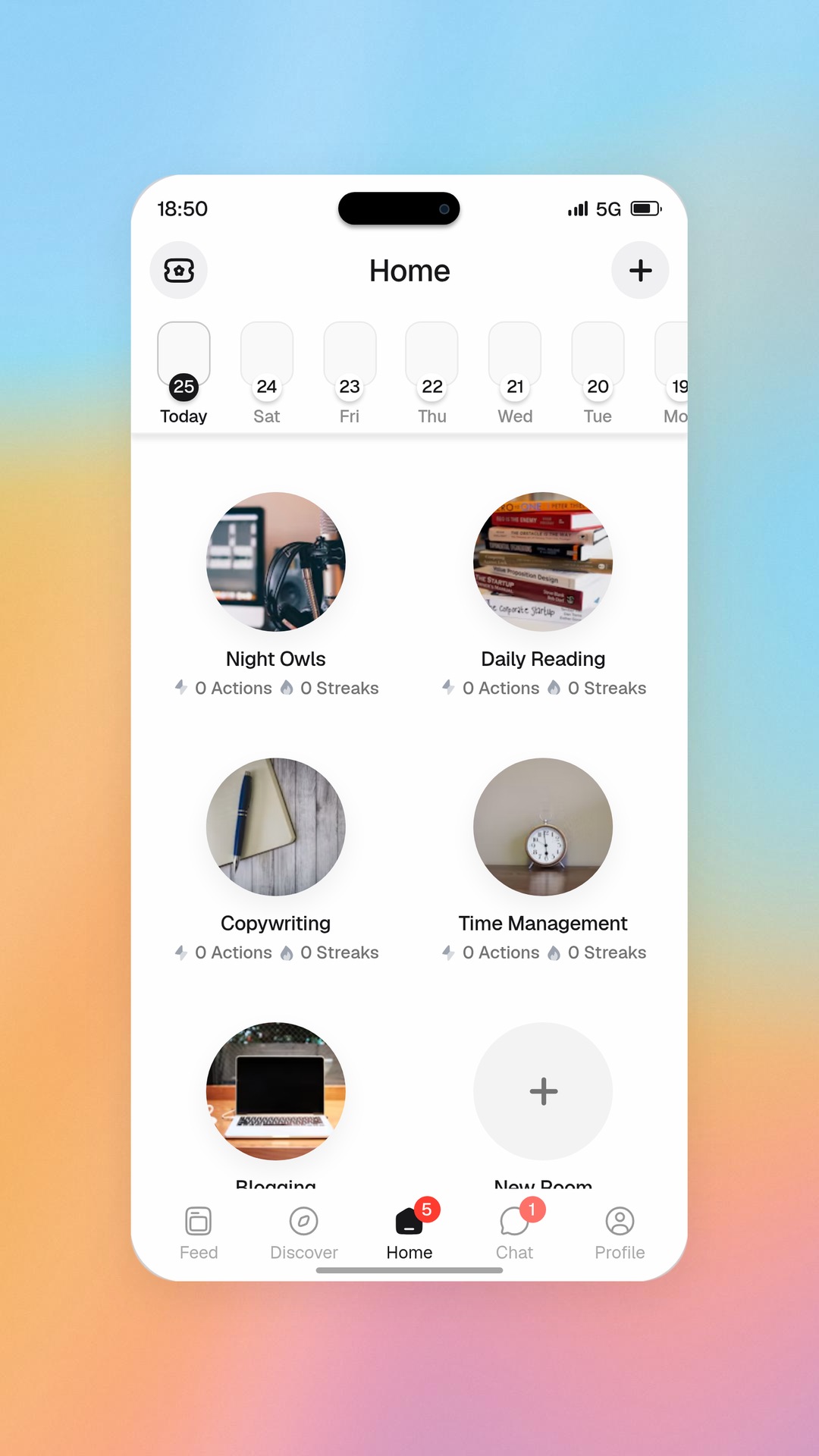
Rooms work because they make the pattern visible without anyone policing it. An Action Room carries a member consistency heatmap and a feed of the day's proofs - a gap on your row is visible to you first, and the room's momentum makes the next day's submission the path of least resistance.
The Weekly Arena adds a competitive rhythm without permanent stakes: leaderboards - Individual, School, and City - reset every Monday at 00:00 UTC, so a bad week is an event with an ending, not an identity. You lost the week, not the resolution.
Part four: set it up before January
The single highest-leverage move is timing: build the system in late December so January 1 is day one of execution, not day one of setup. Do it in five steps.
- 1. Write the resolution as one provable sentence with a number and a date, and create the Goal in the app.
- 2. Add the daily Action with its proof type - sized to your worst plausible January day, not your best December intention.
- 3. Set a Reminder at the action's real time - Repeat can be Every Day, Weekdays, Weekends, or any days, with an Alarm switch for mornings that need an actual ring.
- 4. Create or join an Action Room before January 1 and agree the proof standard with the group - each friend who joins through your invite and finishes onboarding earns one month of Premium for both of you, up to five friends.
- 5. Do three rehearsal days in late December. A streak that starts before January is worth protecting when Quitter's Day arrives.
- 6. Schedule a 30-minute weekly review on Sunday - read the heatmap, name the miss pattern, resize the action if needed.
When the streak breaks in February
It probably will, and the research says that is fine: in a 2009 study by Lally and colleagues in the European Journal of Social Psychology, habits took a median of 66 days to automate - with a range of 18 to 254 days - and single misses did not materially affect the process. The resolution only dies if the first miss becomes the story.
Treat the miss as a review item: what produced it, and does the daily action need resizing? Log the cause, submit the next day's proof on time, and let the new streak start. A resolution that survives February is mostly made of honest restarts - the people with 300-day streaks in December are the ones who restarted fastest in February.
Why this December matters more than this January
Every January the same trade gets offered: motivation now in exchange for nothing later. The better trade is December setup in exchange for January momentum. Spend one evening this month building the goal, the daily action, the proof standard, and the room - then let January's fresh-start energy push a system that already exists.
If you are reading this after January 1, the same logic applies with today's date. A resolution that starts on a random Thursday with a proof system behind it beats the one that started January 1 with nothing but intent - the calendar contributes a push, but only the system converts it into 300 days.
FAQ
What percentage of New Year's resolutions fail?
Most estimates put failure rates high - the consistent finding across sources is that the majority of resolutions are abandoned within weeks, not months. Strava's activity data popularized the second Friday of January as Quitter's Day, the point where resolution-driven activity drops sharply. The mechanism matters more than the exact number: vague goals with no daily system fail on schedule.
When should I set up my resolution system?
In late December, before January 1. Build the goal, the daily action, the reminder, and the room ahead of time, and run two or three rehearsal days. A streak that already exists on January 1 is something you protect; a system you plan to build 'next week' is a resolution about a resolution.
Is it better to start a habit on January 1 or any other day?
January 1 has a real psychological advantage - fresh-start dates boost commitment - but the date contributes motivation, not structure. Pair the fresh start with daily proof and a room, and you get the boost without the Quitter's Day cliff. If you are reading this in October, start now; the best resolution is the one with a 60-day streak by January.
How many resolutions should I make at once?
One with a daily system beats five with good intentions. Every additional daily action multiplies the odds of a total-collapse day. Add a second resolution only after the first survives February - by then the system is proven and installing the next one is mostly copy-paste.
What do I do when I break my resolution streak?
Log the miss, name its cause, resize the daily action if the cause is structural, and submit the next day's proof on time. Research on habit formation (Lally and colleagues, European Journal of Social Psychology, 2009) found single misses did not materially derail habits - fast restarts are the skill, not perfect runs.
Do I need other people for a resolution to work?
Not strictly, but a witness changes the economics of quitting. Private resolutions can be abandoned for free; a resolution with two to five people seeing the record makes every skip visible, including to yourself. Rooms of strangers working the same goal shape work as well as friends - shared context beats prior closeness.