Pomodoro Technique Guide: Focus in 25-Minute Blocks That Actually Count
The Pomodoro Technique explained and upgraded: 25-minute timed blocks with proof, real breaks, and a daily record. History, method, common mistakes, setup, and FAQs.
Published October 27, 2026 · 7 min read
The short answer
The Pomodoro Technique is single-tasking in 25-minute timed blocks separated by 5-minute breaks, with a longer break after four blocks. It works when each block has one named task, interruptions are captured instead of served, and every finished block leaves a dated record you can count at the end of the day.
This guide covers where the method came from, why 25 minutes is the right default, the mistakes that quietly break it, and the setup that turns blocks into a measurable daily practice.
Where the technique came from
Francesco Cirillo developed the method in the late 1980s as a university student, timing himself with a tomato-shaped kitchen timer - pomodoro is Italian for tomato. He later formalized it in a short book, and the core loop has survived almost forty years of productivity-fashion cycles essentially unchanged: pick one task, set 25 minutes, work until the bell, take five minutes off, repeat.
The durability is the evidence. Techniques survive decades only when they solve a real mechanical problem, and this one solves two: the start problem (25 minutes is short enough that starting costs little) and the drift problem (the timer makes attention a bounded commitment instead of an open-ended intention).
Notice what the original method already contained: a named task per block, a record of finished blocks, and planned breaks. Modern attention science keeps arriving at the same conclusions - single-tasking outperforms switching, and rest between bouts sustains output - but Cirillo's kitchen timer got there first.
Why 25 minutes works
Twenty-five minutes sits at a useful pressure point: short enough that no task is too big to start ('I only owe this 25 minutes'), long enough to get real work in. The deadline is the mechanism - attention behaves differently when the commitment is bounded, the way a runner's pace changes when the finish line is visible.
The break is load-bearing, not decoration. Five minutes away from the screen - stand, water, window - resets the next block's attention. People who skip breaks to 'save time' find their fourth block running at half power; the method trades 10 minutes of rest for four honest blocks, and honest blocks are the only kind worth counting.
Cal Newport's Deep Work (2016) made the broader case that sustained single-tasked attention is the scarce skill of knowledge work - and that it must be trained in bounded sessions, not summoned by willpower. A pomodoro is the smallest unit of that training: one bounded session, one task, no switching.
The five mistakes that break the method
Mistake one: no named task per block. 'Work on the project' is not a task; 'draft the introduction section' is. The block needs a finish line it can actually cross.
Mistake two: serving interruptions live. The method's rule is capture and continue - a thought, message, or request gets written on a list and handled after the bell, not during the block. Every live-served interruption teaches your environment that blocks are negotiable.
Mistake three: skipping the break. The 5 minutes is part of the technique, and dropping it converts sustainable focus into a slow burnout.
Mistake four: pretending the block happened. A pomodoro interrupted at minute 12 by a 'quick check' that became fifteen minutes is not a pomodoro. Cirillo's original rule is blunt: a broken block does not count, and you start a new one.
Mistake five: no record. A day of blocks you cannot count is a day you cannot review - and the count is what turns a trick into a practice.
Make every block provable
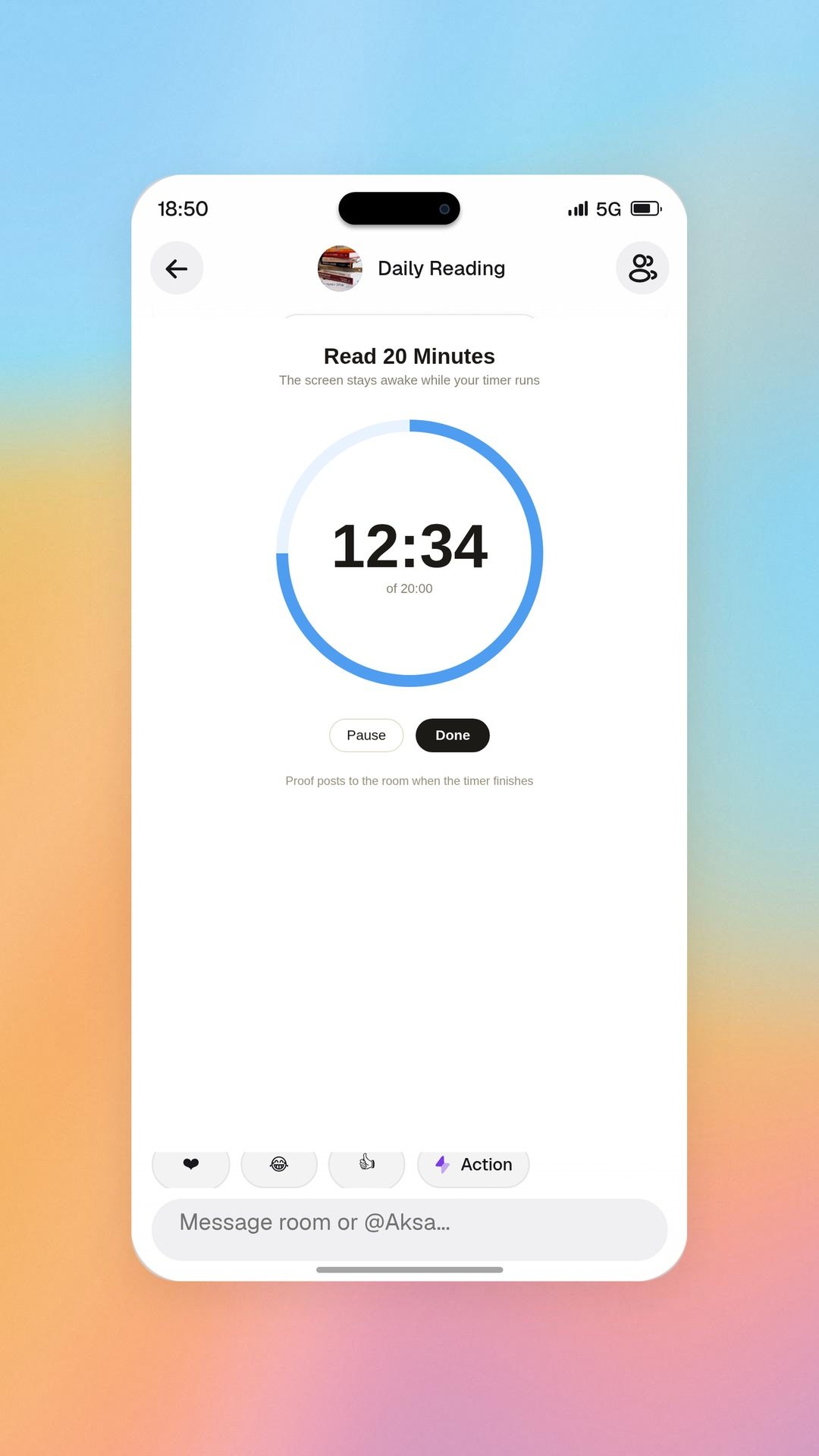
Aksa is a social platform with an AI agent, and the pomodoro maps directly onto its proof system: the Timer format records a bounded focus session as dated evidence - countdown or stopwatch, with a confirm step on early finishes - so a day's focus becomes a countable record rather than a feeling.
The honest-record rule matters here exactly as in Cirillo's original: a block abandoned at minute 12 is not a 25-minute block, and streak counts move only on verified proof days. The timer record shows what the day actually contained - which is the entire point of keeping it.
A daily focus goal works well as a provable sentence: 'Complete 6 pomodoro blocks every weekday.' Aksa AI can help decompose the goal into provable daily actions at setup and plan the next step when a task is too big for one block - while never marking a block done, because Verified Done requires durable proof and the verification rule for the Action.
Set up pomodoro tracking in Aksa
Five minutes of setup, and today's first block counts.
- 1. Create a Goal with a daily block target sized to your real day - 4 blocks is a solid start, 8 is a full deep-work day.
- 2. Add a daily Action with the Timer proof format for focus sessions.
- 3. Before each block, write the one task it owns - if the task needs three blocks, name this block's finish line.
- 4. Keep a capture list beside you during blocks: interruptions get written down and handled at the bell, never served live.
- 5. Set a Reminder for your first block of the day - Repeat Weekdays fits most schedules; starting the day with a finished block changes its whole trajectory.
- 6. Review the week's blocks every Friday: total count, best day, and the interruption that keeps showing up - that recurring interruption is next week's one fix.
Beyond 25 minutes
The 25/5 rhythm is the default, not the law. Once the habit is stable, many people stretch to 50/10 for deep work - the structure is what matters: bounded work, named task, real break, honest count. Writers and programmers often find the longer block better once starting is no longer the problem.
What should not change with experience is the record. The day you stop counting blocks is usually the day the blocks start leaking - the count is not training wheels, it is the load-bearing wall. Keep the timer, keep the proof, and let the block lengths flex around them.
A first day on the method
Try it today rather than studying it further. This afternoon, pick the task you have been avoiding, name its first 25-minute slice, start the timer, and work until the bell. Take the five-minute break standing up. That single loop teaches more than any guide - including the rest of this one.
Most people are surprised by two things on day one: how little 25 minutes of true focus feels like, and how much it produced. The gap between those two impressions is the entire argument for the technique.
Using pomodoros with a team or a room
Focus is usually framed as a solo sport, but a shared block rhythm has its own power: a small room where everyone logs their daily blocks turns an invisible practice into a visible one. You are not comparing output - four honest blocks and eight honest blocks are both good days - you are simply making the practice countable and witnessed.
For students and remote teams, a synchronized block - everyone starts the same 25 minutes, wherever they are - recreates the library effect: nobody is watching your screen, but the shared timer makes switching feel like leaving the room.
FAQ
Who invented the Pomodoro Technique?
Francesco Cirillo, in the late 1980s, as a university student using a tomato-shaped kitchen timer - pomodoro is Italian for tomato. He later formalized the method in a book, and the core loop of 25-minute single-tasked blocks with 5-minute breaks has remained essentially unchanged for nearly four decades.
Why 25 minutes and not an hour?
Because 25 minutes is short enough that starting costs almost nothing - which solves the procrastination problem - while long enough for real progress. The bounded deadline focuses attention the way a visible finish line changes a runner's pace. Once the start habit is solid, many people stretch to 50-minute blocks.
What do I do when a pomodoro gets interrupted?
Capture the interruption on a list and continue the block if it is quick; if the block genuinely breaks, it does not count - start a fresh one. Cirillo's original rule treats an abandoned pomodoro as void, and the strictness is what keeps the day's count meaningful.
Does the Pomodoro Technique work for creative work?
Yes, with longer blocks once the start problem is solved - many writers and designers run 50/10. The technique's core is not the 25 but the structure: one named task, bounded time, a real break, and an honest record. Creative work benefits from all four.
How many pomodoros make a productive day?
Four solid blocks is a genuinely focused day for most people; eight is a deep-work outlier. Honest blocks are exhausting in a way half-attention never is - judge the day by finished, recorded blocks, not by hours near the desk.
What should I do during the 5-minute breaks?
Leave the screen: stand, water, a window, a short walk. The break resets attention for the next block, and spending it on your phone converts it into a context switch instead. After four blocks, take the longer 20-30 minute break - it is part of the method, not a reward.