Quit Caffeine Challenge: 30 Days to Reset Your Energy
A 30-day quit caffeine challenge with taper rules, withdrawal survival tactics, daily avoidance proof, and a room doing it with you. Plan, setup steps, and FAQs.
Published October 27, 2026 · 7 min read
The short answer
A quit caffeine challenge works when you taper for the first week instead of stopping cold, define exactly what counts as caffeine, and submit dated proof of every clean day to a small group. The taper saves you the worst of withdrawal; the proof and the streak carry you through the rest.
Below: why cold turkey fails, the day-by-day plan, what withdrawal actually feels like, and the exact setup in Aksa.
Thirty days is long enough for tolerance to reset and short enough to see the end from the start line. The people who fail this challenge do not fail on chemistry - they fail on undefined rules and invisible slips, both of which this guide removes.
Why quitting caffeine cold turkey fails
Caffeine is a daily-use psychoactive substance with a genuine withdrawal syndrome - that is not drama, it is pharmacology. The FDA cites up to 400 milligrams per day as an amount not generally associated with dangerous, negative effects for healthy adults, which is also a quiet admission of how normal heavy daily use is: 400 mg is roughly four cups of brewed coffee.
Quit overnight and the brain's adaptation - extra adenosine receptors built up to work around the daily caffeine - suddenly has nothing to work around. The result is the classic withdrawal stack: headache, fatigue, irritability, and fog, typically starting 12-24 hours after the last dose and peaking around day two. Facing that while also trying to have a normal work week is why most cold-turkey quits end by day three.
The taper is not weakness; it is engineering. Cutting intake by roughly a quarter every few days lets the receptors down-regulate gradually, turning a week of misery into two weeks of mildness. The challenge still has a clean-day streak - it just starts counting fully caffeine-free days after the taper week, with tapered days proven as their own honest category.
Define the rules before day one
Caffeine hides in more places than coffee: black and green tea, energy drinks, colas, pre-workout powders, chocolate, and some pain relievers. Write your list on day zero - which sources are out entirely, and whether decaf (which still contains a few milligrams) is allowed. Most challengers allow decaf and ban everything else.
Decide the taper schedule now, not mid-headache. A workable version: days 1-3 at half your normal intake, days 4-6 at a quarter, day 7 at zero or decaf only, and days 8-30 fully clean. Write the actual numbers - 'half' of an undefined habit is another negotiation waiting to happen, so count your current daily milligrams roughly before you start.
And pick the reason you will say out loud. 'I want mornings that belong to me' survives a headache; 'I guess coffee is bad?' does not. The challenge needs a sentence you believe, because day five will ask for it.
The 30 days, honestly
Days 1-6 (the taper): mild headaches and a flat afternoon or two. Manageable, especially with water, earlier nights, and the knowledge that this is the hard part arriving early and diluted instead of late and concentrated.
Days 7-10 (first fully clean days): the fog. Mornings feel wrong without the ritual - which tells you something important: half the addiction was the cup, the warmth, and the pause. Replace the ritual, not just the molecule: decaf, herbal tea, or hot water with lemon keeps the ceremony while the chemistry resets.
Days 11-20: energy starts self-generating. Mornings arrive without the debt-collector feeling, and the afternoon crash loses its grip. Most people report the clearest heads of the month here - the brain is finally running on its own adenosine schedule.
Days 21-30: design the exit. Some people stay off entirely; most settle on a permanent rule - one coffee before 10 AM, none after noon, or weekends only. In the whole idea of the challenge is simple: the challenge ends, the record of proven days is what remains.
Prove every clean day
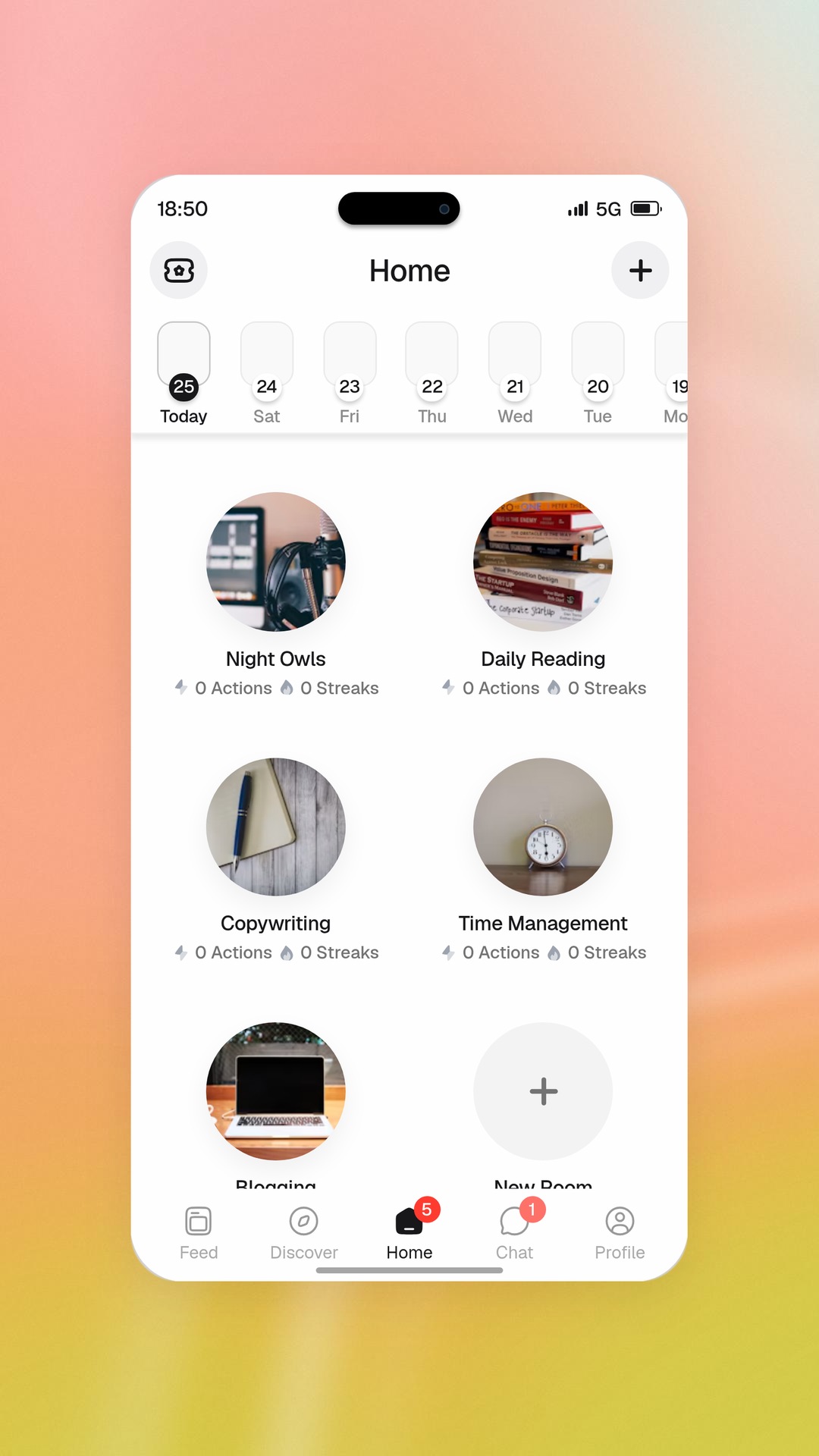
Aksa is a social platform with an AI agent. Avoidance goals are first-class: the Confirm format covers avoidance explicitly, so each evening's proof is a dated confirmation that the day stayed inside your caffeine rules - and the Aksa AI Action agent types 'not doing it' goals as Self avoid when it plans the challenge with you.
The streak that builds on those confirmations is the retention engine. In a November 19, 2020 post on the Duolingo blog, data scientist Anton Yu reported that users reaching a 7-day streak were 2.4 times more likely to still be practicing the next day than learners without a streak - an observational link, not a guarantee, but a streak you own is a streak you protect, and day 9's headache meets day 8's count.
Run it in a small Action Room: two to five people, same rules, nightly proofs. The member consistency heatmap makes everyone's week visible at a glance - and there is something uniquely steadying about watching someone else's clean day 6 while your own head is pounding.
Set up the challenge in Aksa
Ten minutes tonight, and tomorrow starts the taper.
- 1. Write the Goal: 'No caffeine for 30 days (7-day taper, then clean)' with your exact source list and taper numbers attached.
- 2. Add a daily Action with an avoidance Confirm - the evening proof that the day met the day's rule (taper target or fully clean).
- 3. Set a Reminder for the evening submission, Repeat Every Day, with the Alarm switch if notifications get buried.
- 4. Stock the replacements before day one: decaf, herbal tea, or your chosen ritual substitute.
- 5. Create an Action Room, post the shared rules, and invite your people - each friend who joins through your invite and finishes onboarding earns one month of Premium for both of you, up to five friends.
- 6. Review the room heatmap every Sunday - the Weekly Arena resets every Monday, so even a rough week ends and a clean one begins.
After day 30: keep the recalibration
Thirty caffeine-free days reset tolerance substantially - the first coffee after a clean month hits like the first coffee ever did. That is the opportunity: with sensitivity restored, a small amount does the work a large amount used to, and the permanent rule can be modest and satisfying.
Whatever rule you keep, keep one piece of the challenge structure: the definition. 'One cup, before 10 AM' is a rule; 'cutting back' is a drift back to 400 mg with better intentions. The challenge's real product was never the month - it was the sentence you can check.
The tactics that carry the hard days
Water first: withdrawal headaches respond better to hydration than most people expect, and a tall glass at each craving point gives the hands something to do. Sleep more during week one - the withdrawal fatigue and the catch-up sleep your caffeine debt was masking are the same nap, and it is legal to take it early.
And use the when-then plan for the predictable ambush: 'When the 2 PM slump hits, I walk for five minutes and drink a glass of water.' In a 1999 paper in American Psychologist, Peter Gollwitzer showed strong effects on follow-through from implementation intentions - the pre-made decision is what survives the slump, because the slump is exactly when fresh decisions get made badly.
FAQ
How long does caffeine withdrawal last?
Symptoms typically start 12-24 hours after the last dose, peak around day two, and fade over roughly two to nine days for most people. A one-week taper compresses the worst of it into mildness, which is why the challenge tapers first and counts fully clean days from day eight.
How much caffeine per day is considered safe?
The FDA cites up to 400 milligrams per day - roughly four cups of brewed coffee - as an amount not generally associated with dangerous, negative effects for healthy adults. Individual sensitivity varies widely, and the challenge is less about danger than about dependence: many people at 'safe' levels still cannot function without it.
Is decaf allowed on a quit caffeine challenge?
In the standard version, yes - decaf contains only a few milligrams per cup, a small fraction of regular coffee's 80-100 mg. The ritual replacement matters more than the trace chemistry. Whatever you decide, write it into the day-zero rules so the question never gets negotiated mid-craving.
Will quitting caffeine give me more energy?
After the withdrawal window, most people report steadier energy: no morning debt to repay, no afternoon crash, and natural sleepiness arriving on schedule. The first two weeks feel worse before they feel better - the payoff is energy that generates itself instead of borrowing against tomorrow.
Should I quit caffeine cold turkey or taper?
Taper for a week - half your intake for days 1-3, a quarter for days 4-6, then zero. Cold turkey concentrates the headache-fatigue-fog peak into days you still have to function; the taper dilutes the same chemistry across a manageable week. Same destination, far less misery.
What counts as caffeine besides coffee?
Black and green tea, energy drinks, colas and other sodas, pre-workout powders, chocolate (small amounts), and some pain relievers. Write your full source list before day one - the hidden sources are where 'I quit coffee' quietly fails to be a caffeine quit.