Quit Sugar Challenge: 30 Days Without Added Sugar, With Proof
A 30-day quit sugar challenge with daily avoidance proof, craving tactics that work, and a room of people doing it with you. Rules, setup steps, a day-by-day roadmap, and FAQs.
Published October 26, 2026 · 7 min read
The short answer
A quit sugar challenge works when 'no added sugar' is defined precisely, each day ends with dated proof of a clean day, and a small group sees the record. Define the rules on day zero, submit an avoidance confirmation daily, and protect the streak through the brutal first week.
Below: the definition that removes 90 percent of the arguing, the day-by-day texture of 30 days, craving tactics with evidence behind them, and the exact setup in Aksa.
Define 'sugar' before day one or lose by day three
Most quit-sugar attempts die in definitional fog: is fruit allowed? Honey? The granola bar that says 'natural'? Without a written rule, every craving becomes a negotiation, and negotiations at 4 PM go to the craving.
The cleanest working definition for a 30-day challenge: no added sugars and no foods with sugar in the first three ingredients - fruit is fine, juice is not, honey and syrups count as sugar, and obviously sweet foods (soda, candy, pastries, sweetened yogurt, most sauces with sugar high on the label) are out. Write your exact list of gray-area rulings before the challenge starts; the goal is that no decision is ever made hungry.
The scale of what you are cutting is worth knowing: the American Heart Association recommends limiting added sugar to no more than 36 grams per day for men and 25 grams for women. Thirty days off added sugar is not a stunt - it is a reset to a level the guidelines already assume.
What the 30 days actually feel like
Days 1-3 run on resolve and are easy to overrate. Cravings are mild, smugness is high. Do not use this window to relax - use it to clear the kitchen, because the challenge is won or lost on what is within arm's reach later.
Days 4-10 are the trough. Headaches, irritability, and a 4 PM voice making very reasonable-sounding arguments are all normal. This is where the room matters: posting today's clean-day proof while watching three other people post theirs is a stronger argument than the voice.
Days 11-20 are quieter than you expect. Cravings fade from constant to occasional, fruit starts tasting like dessert again, and the streak count starts feeling like property. The risk shifts from cravings to complacency - the birthday cake exception, the 'basically savory' muffin.
Days 21-30 are about the exit. Decide before day 30 what the new normal is: which foods return, in what form, and what the permanent rule is. A challenge without an exit plan tends to end with a binge that erases the point.
Craving tactics with evidence behind them
Tactic one: implementation intentions for the predictable moments. In a 1999 paper in American Psychologist, Peter Gollwitzer showed that when-then plans have strong effects on follow-through. 'When the 4 PM craving hits, I eat an apple and drink a glass of water' beats 'I will resist' because the decision is pre-made.
Tactic two: change the environment, not the willpower. Every study of self-control reaches the same practical conclusion - people who resist temptation best are the ones who encounter it least. No sugar in the house beats heroic daily resistance to sugar in the house.
Tactic three: surf the urge for 15 minutes. Cravings crest and fall like waves; the standard craving-management technique is to set a timer, do anything else, and re-check when it rings. Most cravings do not survive a quarter hour of waiting - and a challenge structure makes waiting easier, because giving in has a visible cost: today's proof does not get posted.
Set up the challenge in Aksa
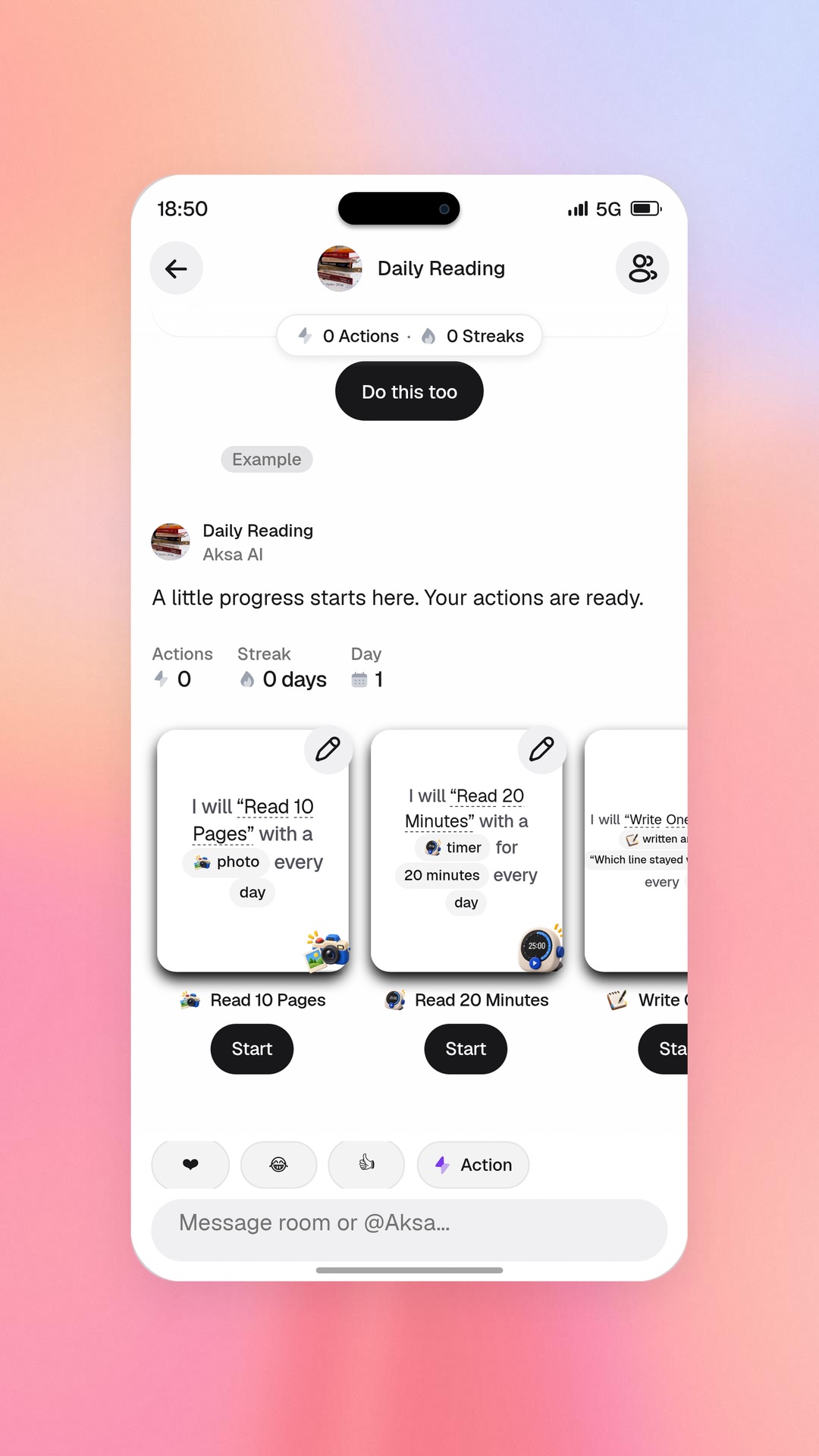
Aksa is a social platform with an AI agent. Avoidance goals map naturally onto its proof system - Confirm supports both positive and avoidance goals, so a clean day is itself provable evidence. Setup takes five minutes.
- 1. Create a Goal like 'No added sugar for 30 days' with your written definition of what counts as sugar attached.
- 2. Add a daily Action with an avoidance Confirm: the day's proof is confirming the day stayed clean - submit it each evening, not the next morning.
- 3. Set a Reminder for the evening submission - Repeat Every Day works for a 30-day run; add the Alarm switch if silent notifications get buried.
- 4. Create an Action Room, post the shared definition and gray-area rulings, and invite your group - each friend who joins through your invite and finishes onboarding earns one month of Premium for both of you, up to five friends.
- 5. Clear the kitchen before day one: out of the house beats in the bin at 4 PM.
- 6. Watch the streak count and room heatmap build - both count only verified proof days, so a clean-day record stays honest.
When someone slips
Someone in the room will eat the cookie. The healthy room norm is: log the miss honestly, name the situation that produced it, and post the next clean day on time. In a 2009 study by Lally and colleagues in the European Journal of Social Psychology, single misses did not materially derail habit formation - the median habit took 66 days to automate - so one cookie is data, while the shame spiral after the cookie is the actual threat.
The streak count resets and the challenge continues. Thirty days with one logged slip is a better outcome than 30 days of quietly redefined rules, because only the first version leaves you with a record you can trust - and a definition of sugar that survived contact with reality.
After day 30
The valuable residue of a quit-sugar month is not purity - it is recalibration. Sweetness thresholds genuinely shift: foods that tasted normal in week one taste aggressively sweet in week five, and most people find their long-term intake settles far below where it started without further effort.
Keep one piece of the structure: the written rule. 'Dessert on weekends' or 'no sugar in coffee, ever' - one sentence you decided at full strength, not mid-craving. The challenge ends; the rule is what you keep.
Eating out and social events during the challenge
Restaurants are the highest-risk environment in the month because sugar hides in sauces, dressings, marinades, and bread. The working rules: order grilled over glazed, dressing on the side, water or soda water instead of anything with a syrup gun, and skip the dessert menu entirely rather than 'just looking.' Most menus have three or four safe mains; find them fast and stop reading.
For birthdays and celebrations, decide your line before you arrive - the two workable ones are 'politely skip the cake, no explanation owed' or 'one declared exception day, logged in the room.' What does not work is deciding in front of the cake. The challenge's definition document should name your event policy on day zero, because the event will definitely happen sometime in the 30 days.
FAQ
Is fruit allowed on a 30-day no sugar challenge?
Whole fruit is allowed in the standard version of this challenge - it carries fiber and water that change how the sugar lands. Juice is not, since it is essentially the sugar without the structure. Whatever you decide, write it down before day one so the rule is never negotiated mid-craving.
How long do sugar cravings last when you quit?
The worst stretch is typically days 4-10, when headaches and irritability peak. Cravings fade from constant to occasional in weeks two and three, and individual urges usually pass within about 15 minutes if you wait them out - set a timer and do something else.
How do you prove a negative like 'I did not eat sugar'?
With a dated daily confirmation submitted the same evening, plus honesty about the fact that avoidance proof is self-reported. In Aksa, Confirm covers avoidance goals explicitly, and the group context is what hardens a self-report: a clean-day claim posted nightly to people doing the same challenge is a claim you keep honest.
What are the first foods to cut when quitting sugar?
Soda and sweet drinks first - they are the largest single source for most people - then candy, pastries, and sweetened yogurts, then the stealth sources: sauces, dressings, breads, and granola with sugar in the first three ingredients. Read labels for one grocery run and the list becomes obvious.
What if I slip and eat sugar during the challenge?
Log it, name the situation that produced it, and post the next clean day on time. Research on habit formation (Lally and colleagues, European Journal of Social Psychology, 2009) found single misses did not materially derail the process - the danger is the shame spiral, not the cookie.
Should I quit sugar cold turkey or taper down?
For a 30-day challenge, cold turkey with a precise definition works better than tapering, because tapered rules require daily judgment calls - and judgment calls at 4 PM go to the craving. The taper can come after day 30, when you design the permanent rule with a clear head.
Will quitting sugar for 30 days help me lose weight?
Many people lose some weight because cutting added sugar removes hundreds of easy calories a day, but treat that as a side effect rather than the metric. The durable wins are recalibrated taste, steadier energy, and a permanent rule you can keep - weight follows those, not the other way around.