Reading Challenge Apps: How to Actually Finish 20 Books This Year
A reading challenge fails when it is just a number going up. The app features that get books finished: verified proof, daily floors, and friends reading with you.
Published October 24, 2026 · 7 min read
The direct answer
Aksa is a social platform with an AI agent. A reading challenge app gets you to 20 books by tracking the daily reading session, not the finished book: a small daily floor of pages or minutes, verified with proof, and shared with people reading alongside you.
Finished-book counters feel motivating and fail quietly, because a book finished in month three gives you nothing to do today. This guide builds the daily system instead, with the exact setup inside Aksa, a social platform with an AI agent.
Why book-count challenges fail
The classic Goodreads-style challenge sets a yearly number and a progress bar. In January the bar moves fast. By March the display says you are twelve books behind pace, and every glance at it produces guilt rather than reading. Goals measured in distant outcomes punish you for the past instead of directing the present.
The second failure is the missing daily unit. "Read 20 books" contains no instruction for a tired Tuesday. Without a floor version, ten pages, fifteen minutes, the challenge depends on finding long, fresh reading windows, and adult life supplies those rarely.
The third failure is solitude. Reading is already a private act, so a private tracker adds nothing social to balance it. Nobody notices when the book stays closed for a week, and unnoticed weeks become abandoned years.
There is a fourth failure worth admitting: the challenge measures the least interesting part of reading. Nobody looks back on a year of reading and remembers the count; they remember three chapters that rearranged something in them. A good system tracks the daily session but stores the experience, which is why the reflection primitive matters more than any number on a progress bar.
Set the floor you can survive
Choose the daily floor from your worst realistic day, not your best: ten pages or fifteen minutes for most people. Duolingo's published experiment makes the principle concrete: in a November 19, 2020 post on the Duolingo blog, engineer Anton Yu reported that learners with the most intense daily goals were the least likely to hold a streak, and shrinking the daily requirement raised day-14 retention by 3.3 percent. Reading obeys the same math.
A small floor is not a small ambition. Ten pages a day is roughly twelve average books a year, before counting the many days you read past the floor. Floors protect the chain; ceilings are optional.
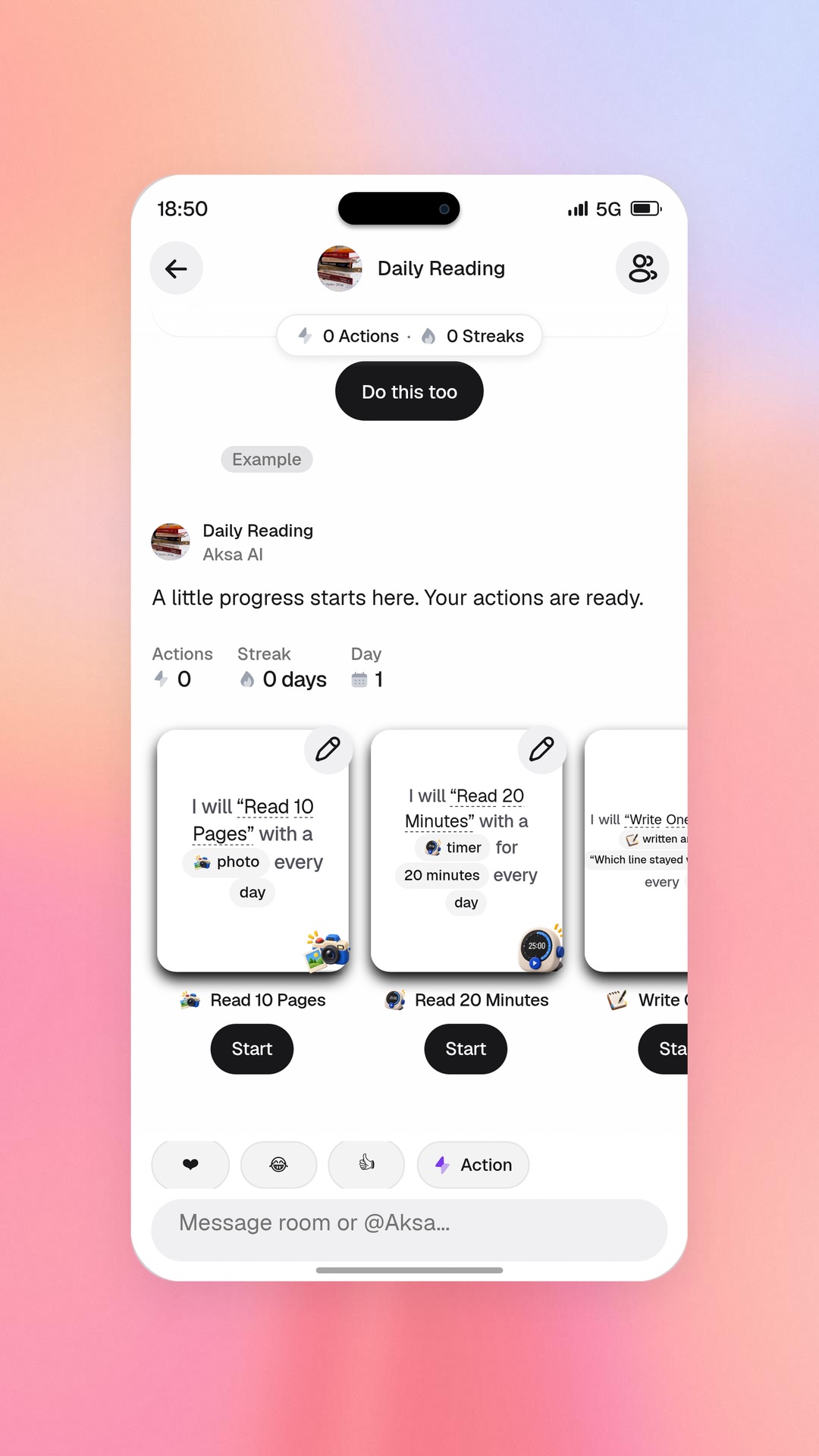
In Aksa the floor becomes your daily Action. Set it as a Counter for pages or a Timer for minutes, and the challenge now has a concrete daily object instead of a distant number.
Verify the session, not the claim
Honor-system reading logs drift. Under pressure, the estimated pages creep upward, and a number you cannot trust stops motivating you. Verified proof keeps the record honest and therefore valuable.
Aksa's six proof primitives map neatly onto reading: a Counter for pages finished, a Timer for a reading session, a photo Submit of the page where you stopped, an Answer for a one-line reflection on what you read. Progress counts only verified proof, never an unverified tap, so your page count always means what it says.
The reflection Answer is quietly the most powerful primitive for readers. One sentence per session, the argument, the image, the surprise, compounds into a personal reading journal inside your proof history, which turns the challenge into an archive you will actually revisit.
Read with a room
The social layer is what converts a resolution into a routine. An Aksa Action Room of two to five readers posts daily proof in the same place: pages, timers, photos, reflections. Claim cards announce each verified session with your streak, and cheers arrive as push notifications.
Rooms work for any reading style. A book-club room reads the same title and trades reflections. A parallel room reads different books and trades streaks. Both create the daily expectation that someone will see whether you read, which is the entire mechanism.
The AI agent keeps the room moving on flat weeks: it plans the daily action list, answers goal questions, and posts updates, so the space stays alive even when everyone is busy. You can also invite a friend directly, and each friend who joins through your invite and finishes onboarding earns one month of Premium for both of you, up to five friends.
Do not overlook the simplest long-game habit: finishing permission. Give the room authority to bless an abandoned book. Readers stall for months on a book they are not enjoying because quitting feels like breaking the challenge, when in fact the daily floor, not the title, is the commitment. Drop the book, keep the streak.
Use the long-game surfaces
Reading challenges are marathons, so use the surfaces built for marathons. Your Aksa profile carries a consistency heatmap, a momentum chart, and a 3-month Photo Calendar: three months of reading nights visible in one glance, which is a stronger argument on a lazy evening than any yearly progress bar.
If competition helps you, the Weekly Arena resets Individual, School, and City leaderboards every Monday at 00:00 UTC, so a slow week never permanently buries you. Top finishers get winner spotlight cards. If competition does not help, ignore it; the room and the streak are the real engine.
Travel and dead zones are where reading streaks usually die. Aksa saves proof locally and syncs when the connection returns, so the flight where you finally finished a novel still counts the moment you land.
Set up your reading challenge tonight
The whole system takes about fifteen minutes:
Twenty books a year sounds like a personality trait. It is actually ten verified pages a day, witnessed.
And the byproduct nobody warns you about: conversations change. A year of daily reading plus one-line reflections gives you a stocked mind, and the room gives you people who watched you stock it. The challenge ends; the library in your head and the readers in your corner stay.
- 1. Pick your first book and put it where the trigger happens: the pillow, the bag, the coffee table.
- 2. Set the floor: ten pages or fifteen minutes, written as the daily Action in Aksa.
- 3. Choose the proof: Counter for pages, Timer for minutes, plus an optional one-line Answer reflection per session.
- 4. Create or join a reading Action Room so one to four people see your daily proof.
- 5. Schedule one reminder at your most reliable reading hour, usually just before sleep.
- 6. Read the first ten pages tonight and post the proof, so the streak starts at day one immediately.
What a finished year looks like
By December the visible result is not just books finished. It is a heatmap with three hundred green days, a Photo Calendar of reading moments, a journal of three hundred one-line reflections, and a room of people who watched it happen.
The number of books will surprise you, because floors compound. Ten pages a day with occasional long Sundays lands most readers between fifteen and twenty-five books without a single heroic sprint.
More importantly, reading stops being a challenge and becomes the default evening. That identity shift, reader rather than aspiring reader, is the actual prize the app was holding for you.
FAQ
How many books can I realistically read in a year?
Ten pages a day compounds to roughly twelve average books a year, and fifteen minutes a day lands similar territory. Most consistent readers overshoot the floor regularly, ending between 15 and 25 books. The reliable predictor is not speed but daily proof: a verified session on your worst days keeps the chain alive.
Is it better to track pages or minutes?
Track whichever you cannot inflate. Pages suit steady-paced readers and map to a Counter primitive; minutes suit mixed materials like dense nonfiction and map to a Timer. Aksa supports both, and many readers log pages daily with a one-line Answer reflection to make the record a journal as well as a count.
How is a reading challenge app different from Goodreads?
Catalog apps count finished books, which gives you nothing to do on a tired Tuesday. Aksa tracks the daily verified session instead: pages, minutes, and reflections posted as proof to an Action Room of fellow readers, with a streak, heatmap, and weekly leaderboards. The daily unit is what actually gets books finished.
Can I run a book club through a reading challenge app?
Yes. Create an Aksa Action Room for the club, set a shared daily reading floor, and let each member post proof plus a one-line reflection per session. Claim cards and cheers keep energy up between meetings, and the room history becomes the club's shared reading diary.
What if I fall behind my yearly goal pace?
Ignore the yearly pace and protect the daily floor. Pace math produces guilt; daily proof produces books. Aksa's Weekly Arena resets every Monday at 00:00 UTC, so each week is a clean start, and a 24-hour rule after any missed day keeps single gaps from becoming abandoned months.
Does reading on a phone count for a reading challenge?
Absolutely, if you actually read. The format is irrelevant; the verified session is what counts. Many members read on phones and post a page-count Counter or a Timer session as proof. Just keep the reading app and the feed apps on different home screens, so the book is the easier tap.