Revenge Bedtime Procrastination: How to Stop Delaying Sleep
Revenge bedtime procrastination: why you sacrifice sleep for free time, the 2014 research behind the term, and a 4-part fix with evening proof that holds.
Published October 28, 2026 · 7 min read
The short answer
Revenge bedtime procrastination is staying up late for leisure despite expecting to feel worse tomorrow - and the fix is not an earlier alarm but a better day: reclaim small pockets of time that are yours, define an evening shutdown ritual, and prove each night's cutoff with a dated record.
This guide covers the research behind the term, why willpower fails at midnight, and the four-part fix that works on the cause instead of the symptom.
The pattern is common enough to have been named twice - the research term from 2014 and the 'revenge' framing that spread later - and both point at the same mechanism: control. Take the control back in daylight, and the night stops needing to steal it.
The research behind the term
Bedtime procrastination entered the literature in 2014, when Floor Kroese and colleagues published a paper in Frontiers in Psychology introducing it as a new area of procrastination research. In their online survey of 177 participants, bedtime procrastination was negatively associated with self-regulation - people who scored lower on self-regulation reported more of it - and it was related to insufficient sleep above and beyond general procrastination. In other words: it is its own behavior, not just regular procrastination that happens to occur at night.
The 'revenge' prefix came later, from the framing popularized around overworked schedules: people whose days contain no discretionary time take revenge on the day by stealing hours from the night. The description resonates because the mechanism is real - the late hours are the only ones that feel unowned.
The trap is that the revenge backfires. The stolen hours are low-quality leisure - half-watched shows, endless scrolls - purchased with tomorrow's energy, which makes tomorrow's day even less yours, which demands more revenge. It is a debt spiral, and like all debt spirals it is escaped structurally, not heroically.
Why willpower fails at midnight
The decision to keep scrolling happens at the day's lowest point of resources: you are tired, the couch is comfortable, and the phone is engineered by professionals to be more compelling than sleep. Kroese's finding that bedtime procrastination tracks low self-regulation is the formal version of what everyone feels - the part of you that would stop is exactly the part that is offline.
So the fix cannot live at midnight. Every effective intervention happens earlier: in how the day is structured, in what the evening contains, and in decisions pre-made at full strength. Midnight-you is not a negotiator you want at the table; the plan is to make sure midnight-you has nothing to decide.
Aksa is a social platform with an AI agent. An avoidance Confirm is a dated nightly submission that the cutoff held - the day's proof, submitted at the moment that used to be the negotiation. Streak counts move only on verified proof days, which makes the record a thing worth protecting precisely when protection is hardest.
Fix one and two: own the day, close the day
Fix one: schedule real leisure into the day. This is the counterintuitive core - bedtime procrastination is a symptom of leisure starvation, so the treatment is deliberate daylight leisure, not stricter nights. Thirty protected minutes that are unambiguously yours - a walk, a chapter, a game, a call - removes the debt the night was repaying. Put it in the calendar like a meeting, because everything else in your day is.
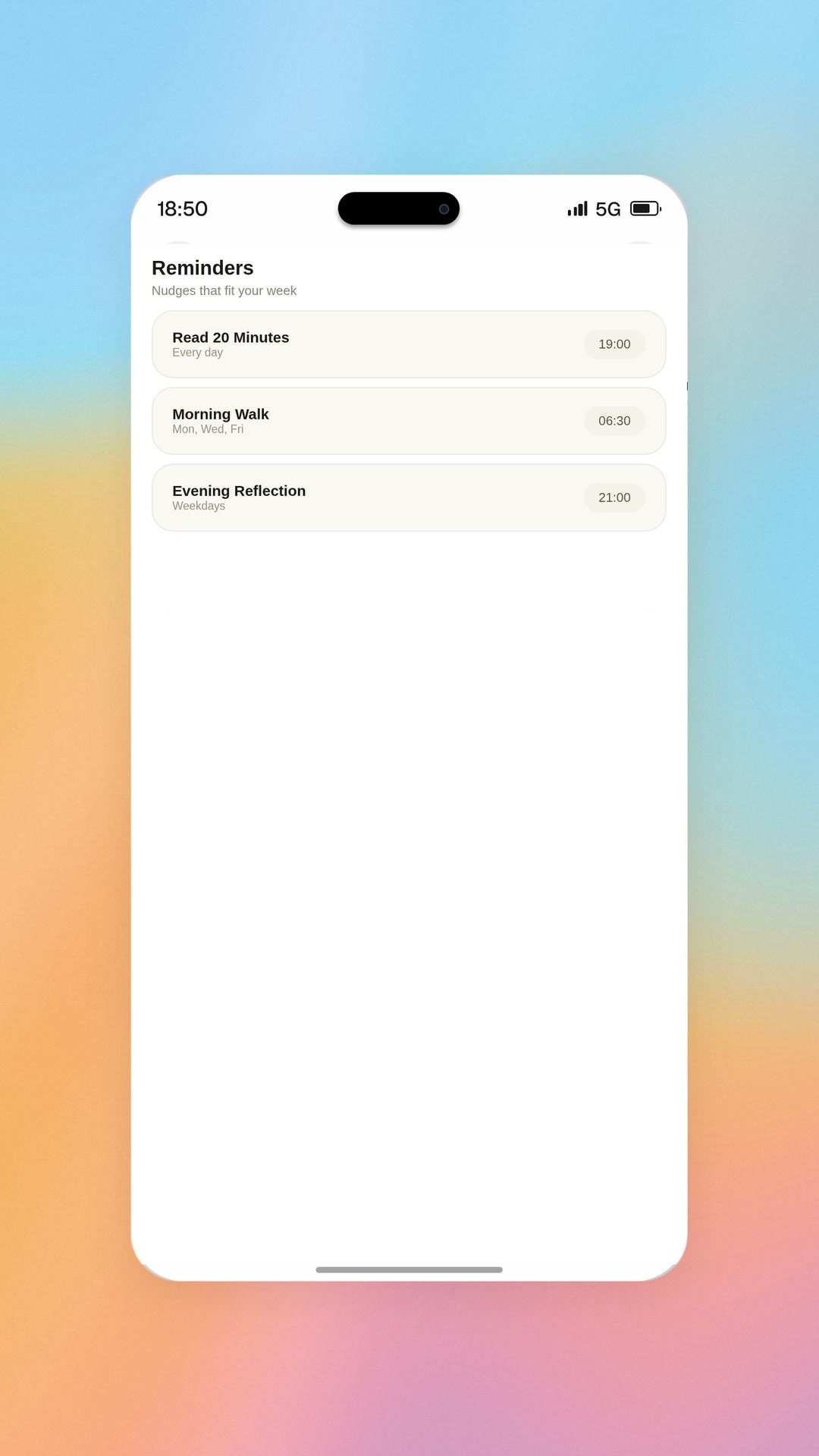
Fix two: a shutdown ritual with a named time. Pick the cutoff - say 10:45 - and build a short closing sequence: phone plugged in outside the bedroom, tomorrow's first task written down, ten minutes of something analog. The ritual is a trigger that replaces the drift; a Reminder can fire at the cutoff every night on Repeat Every Day, with the Alarm switch for people who need the ring.
Both fixes work on the same principle as every durable behavior change: the decision moves from the weak moment to the strong one. You decide at 7 PM what 11 PM does.
Fix three and four: the record and the replacement
Fix three: prove the cutoff nightly. A dated evening confirmation - 'screens down by 10:45' - turns an invisible intention into a visible streak. In a November 19, 2020 post on the Duolingo blog, the company reported that users reaching a 7-day streak were 2.4 times more likely to still be active the next day than users without one - the count becomes an asset, and assets get protected at exactly the moment the scroll calls loudest.
Fix four: give the night something better than revenge. The hours before sleep need a leisure option that does not eat tomorrow: a book on the pillow, a podcast with a sleep timer, a stretching routine. You are not banning pleasure - you are choosing pleasure that does not bill the morning.
Run the four together for 30 days and track what changes. In the 2014 Frontiers in Psychology paper, Kroese and colleagues tied bedtime procrastination to insufficient sleep - so the metric that matters is how you feel at 3 PM in week three, not how virtuous the nights feel. Most people report the afternoons arriving differently long before the nights feel easy.
Set up the fix in Aksa
Fifteen minutes tonight, and tonight counts.
- 1. Create the Goal: 'Screens down by [time] for 30 nights' - one provable sentence with your exact cutoff.
- 2. Add a daily Action with an avoidance Confirm: the nightly proof that the cutoff held.
- 3. Set a Reminder 15 minutes before the cutoff - Repeat Every Day, Alarm switch on - the ring starts the shutdown ritual, not the negotiation.
- 4. Move the phone's charger out of the bedroom tonight and put a book where the phone used to live.
- 5. Schedule tomorrow's 30 minutes of owned daytime leisure right now - the night is easier when the day is not starving.
- 6. Invite one person to a small room for mutual cutoffs - each friend who joins through your invite and finishes onboarding earns one month of Premium for both of you, up to five friends.
When the revenge is telling you something bigger
Sometimes bedtime procrastination is a habit; sometimes it is a flare. If your days genuinely contain zero owned hours - a brutal job, caregiving without relief - the night stealing is a signal about the day, and the durable fix is structural: a boundary at work, a traded shift of duties, one evening a week that is contracted to you.
A 30-day cutoff challenge will still help - the ritual and record work regardless - but treat a stubborn, resentful relapse pattern as data about the day, not failure at the night. In a 2009 study by Lally and colleagues in the European Journal of Social Psychology, times to habit automaticity ranged from 18 to 254 days, and a single missed opportunity did not materially affect formation: the record forgives the hard nights as long as you keep posting the honest ones.
FAQ
What is revenge bedtime procrastination?
Staying up late for leisure despite knowing you will feel worse tomorrow - typically as a reaction to days with no free time. The underlying behavior, bedtime procrastination, was introduced by Floor Kroese and colleagues in a 2014 Frontiers in Psychology paper, where it was tied to low self-regulation and insufficient sleep in a survey of 177 people.
Is bedtime procrastination the same as insomnia?
No - insomnia is the inability to sleep despite the opportunity; bedtime procrastination is delaying the opportunity itself. You can sleep, you just do not go. The distinction matters because the fixes differ: procrastination responds to structure, rituals, and pre-made decisions, while insomnia is a clinical issue with its own treatments.
Why do I stay up late even when I am exhausted?
Because the late hours are the only ones that feel like yours. The behavior is repayment for a day with no discretionary time - which is why the counterintuitive fix is scheduling real leisure into the day. Stricter nights alone fail; the debt the night was repaying has to be cancelled at the source.
How do I stop scrolling at night in bed?
Remove the option physically: charge the phone outside the bedroom and put a book where it used to live. Every in-bed rule fails because the scroll is engineered to beat a tired brain - the winning move happens at 10 PM, not at 1 AM. Pair it with a cutoff reminder and a dated nightly proof.
What time should I actually go to bed?
Work backward from a fixed wake time minus the sleep you need - for most adults that lands between 10:30 PM and midnight. The wake time is the anchor you control; hold it seven days a week and bedtime starts regulating itself, because sleep pressure builds evenly when mornings are consistent.
How long does it take to fix a bedtime procrastination habit?
Expect the first two weeks to need the ritual and reminder, and the pattern to feel natural around week four. Habit research by Lally and colleagues (European Journal of Social Psychology, 2009) found times to automaticity ranging from 18 to 254 days across people - protect the record for at least a month, and keep the charger outside the bedroom permanently.