Wake-Up Early Challenge: 30 Days to a 5 AM Habit That Sticks
A 30-day wake-up early challenge with daily proof, an alarm-backed reminder, and a group that sees whether you actually got up. Setup steps, rules, and FAQs.
Published October 26, 2026 · 7 min read
The challenge in one paragraph
A wake-up early challenge works when you fix one wake time for 30 days and prove it every morning to people who expect it. Pick your time, set an alarm-backed daily reminder, submit proof within a short window, and let a small group see your record - that is the whole system.
Everything below is the setup: the rules that keep the challenge honest, the exact steps to run it in Aksa, and the failure points to design around before day one.
Why waking up early fails without a system
The first week of any early-riser attempt runs on novelty. The second week runs on nothing. Sleep researchers call the underlying problem social jetlag - the gap between your weekday and weekend body clock - and a 2012 study by Roenneberg and colleagues in Current Biology linked larger social jetlag to chronic sleep loss and higher body weight. If your wake time swings by two hours between Tuesday and Saturday, your body never knows which morning to prepare for.
The fix is boring: one wake time, every day, for long enough that the body adapts. Boring goals need external structure, because the moment of decision - 5:00 AM, warm bed, phone in hand - is exactly the moment willpower is lowest. A challenge moves the decision out of that moment: the rule was set yesterday, the proof is due this morning, and someone will notice the gap.
Aksa is a social platform with an AI agent built around exactly this mechanic: people submit evidence of what they did, and the record accumulates whether or not motivation showed up that day.
The rules that make 30 days count
Rule one: one fixed wake time, seven days a week. A challenge that lets you sleep in on weekends resets your body clock every five days and you spend Monday re-earning what Sunday erased. If 5:30 AM is unsustainable on Saturdays, the honest target was never 5:30 - pick the time you can hold on your worst day of the week.
Rule two: proof within 30 minutes of waking, or the day does not count. A challenge without a deadline is a diary. The proof can be small - a photo of your made bed, your coffee, the sky outside - but it must exist and it must be on time. Streak counts in Aksa move only on verified proof, never on an unchecked intention, so the number on your profile means something by day 20.
Rule three: plan the first 10 minutes the night before. Waking up is not the goal; waking up to something is. Lay out clothes, water, and one defined task - stretching, journaling, a walk - so the alarm starts a sequence instead of opening a negotiation.
Rule four: get light and water before screens. The first input of the day sets its tone, and a phone handed over at 5:01 AM usually owns the next hour. Ten minutes of daylight or bright indoor light plus a full glass of water is a simple opening sequence that tells the body the day has started - and it photographs well as morning proof.
Set up the challenge in Aksa
The whole setup takes about five minutes in the app. Do it tonight, and tomorrow morning counts as day one.
- 1. Create a Goal named with the exact target, like 'Wake at 5:30 AM for 30 days' - write the outcome in one provable sentence.
- 2. Add a daily Action: a morning check-in or a photo proof such as your made bed or the view outside, due at your wake time.
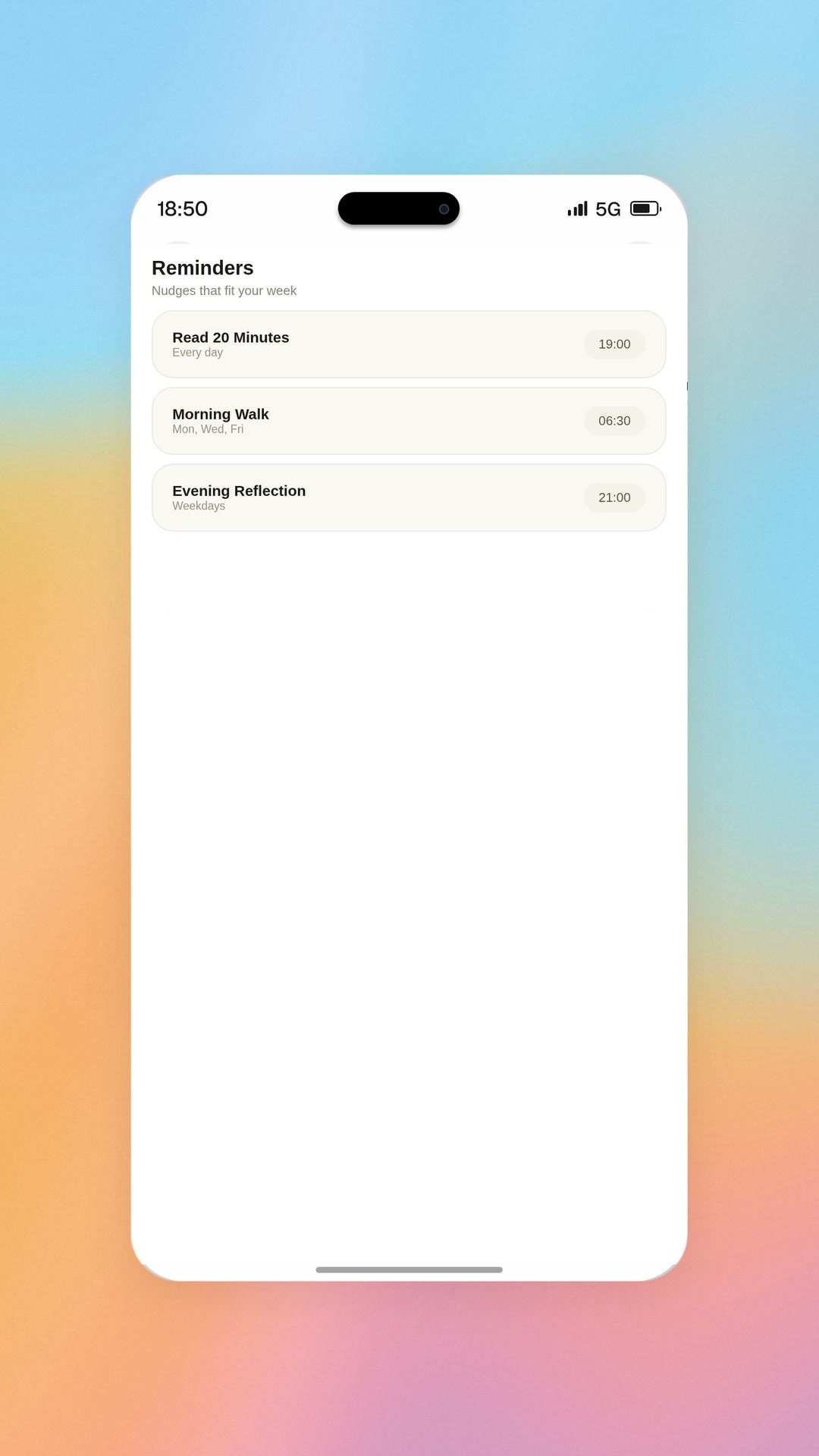
- 3. Set a Reminder on the Action a few minutes before the target time - Repeat is Apple Clock style: Every Day, Weekdays, Weekends, or any days you pick. Turn the Alarm switch on if you want it to ring as an alarm, not just a notification.
- 4. Create or join an Action Room for the challenge and invite two to five people chasing the same wake time - each friend who joins through your invite and finishes onboarding earns one month of Premium for both of you, up to five friends.
- 5. Agree the room rules on day one: proof within 30 minutes of your chosen wake time, no backfills, rest days only if declared the night before.
- 6. Submit proof every morning and watch your streak count and the room heatmap build - both count only verified proof days.
What to do when you break the streak
You will probably miss a morning. The research on habit formation is blunt about this: in a 2009 study by Lally and colleagues in the European Journal of Social Psychology, new habits took a median of 66 days to feel automatic - with a range of 18 to 254 days - and missing one day did not materially derail the process. What derails people is the second miss, because the first miss feels like failure and the story becomes 'the challenge is over.'
Treat a miss as data. Write one line in the room about why it happened - late night, alarm dismissed, weekend drift - and post the next morning's proof on time. The Weekly Arena resets leaderboards every Monday at 00:00 UTC, so even competitively, a bad week ends and a fresh one starts. Thirty consecutive perfect days is a nice story; 29 out of 30 with one honest miss is the same habit.
Keeping the habit after day 30
The 30-day frame is a starting line, not a finish. By the end, the challenge has built three assets that keep working without the challenge framing: a body clock tuned to one wake time, a visible history of proof that makes skipping feel costly, and a room of people whose morning rhythm now includes yours.
Keep the daily proof going after day 30 - drop the challenge language, keep the mechanic. Most people find the room is the piece they cannot replace alone: anyone can set an alarm, but an alarm does not notice when you ignore it. A room does.
A sample 30-day progression
Days 1-7 run on novelty and are easier than you expect - enjoy them, but do not trust them. Set everything out the night before from day one so the routine exists before motivation fades.
Days 8-14 are the danger zone: the novelty is gone, the adaptation has not arrived, and this is where most attempts end. This is the week the room matters most - a quick note that you are struggling reads as normal, because everyone in the room is in the same week.
Days 15-30 are where the payoff starts. Most people report waking before the alarm somewhere in week three or four, and the morning starts to feel like an asset instead of a fight. Protect the weekend rule hardest in this stretch: the habit is almost yours, and one sloppy Saturday can still send you back to week two.
FAQ
What is the best time to wake up for a 30-day challenge?
The best time is the earliest time you can hold seven days a week, including your worst Saturday. For most people with a 9-to-5 schedule that lands between 5:00 and 6:00 AM. Pick one fixed time - the body adapts to consistency, not to how impressive the number sounds.
How long does it take to become a morning person?
In a 2009 study by Lally and colleagues in the European Journal of Social Psychology, habits took a median of 66 days to become automatic, with a range of 18 to 254 days depending on the person and the behavior. A 30-day challenge gets you roughly halfway there - plan to keep the same wake time past the finish.
Should I wake up early on weekends too?
Yes, if you want the adaptation to stick. Sleep researchers call the weekday-weekend gap social jetlag, and a 2012 Current Biology study by Roenneberg and colleagues linked larger gaps to chronic sleep loss and higher body weight. A weekend lie-in of two hours is the equivalent of flying two time zones west every Friday and flying back every Sunday.
What counts as proof in a wake-up challenge?
Anything verifiable submitted within 30 minutes of your wake time: a photo of your made bed, the view outside, your coffee, or a simple check-in at the target hour. In Aksa, streak counts move only on verified proof days, so the record stays honest even when motivation does not.
What if I work night shifts or irregular hours?
Anchor the challenge to 'wake time relative to sleep,' not the clock: wake within 30 minutes of your planned rise time after each main sleep block. A fixed anchor - wake, proof, first task - matters more than the hour on the clock, and the reminder can be set for any days you choose.
Is it better to do the challenge alone or with a group?
A group wins for a simple reason: an alarm cannot notice you ignored it, but people can. A small room of two to five people with the same wake time gives every morning an audience, and the room's consistency heatmap makes a quiet miss visible without anyone having to call you out.