Walking Challenge Apps: Run a Step Challenge Your Friends Actually Finish
Most step challenges die in week two. The fix: daily proof, a survivable floor, small rooms, and a weekly reset. How to run a walking challenge that lasts.
Published October 25, 2026 · 7 min read
The direct answer
Aksa is a social platform with an AI agent. A walking challenge succeeds when daily steps are counted with proof, the floor is small enough for the busiest day, and a room of friends can see who actually walked, with a weekly reset so nobody is ever buried.
Most step challenges collapse in week two for predictable reasons. This guide fixes each one and sets the whole thing up in Aksa in about fifteen minutes.
Everything here assumes the challenge serves the walking, never the reverse. The day the leaderboard starts making evening walks feel like homework, shrink the floor and keep the streak intact. Consistency compounds; intensity mostly photographs well.
Why most step challenges die
The classic office step challenge starts with a bang and a spreadsheet. By week two the spreadsheet is stale, the leader is uncatchable, and half the group has quietly stopped logging. The structure, not the walking, failed.
Three design flaws cause it. First, all-or-nothing targets: 10,000 steps is motivating on a free Saturday and impossible on a desk-bound Tuesday, so Tuesdays get skipped and skips compound. Second, honor-system logging: numbers typed at week's end drift upward, and once the numbers are fiction the competition is fiction.
Third, no social texture: a challenge where nobody sees your daily effort gives you nothing on the day motivation runs out. Walking is repetitive by nature; the social layer is what makes repetition feel like progress.
Notice that none of these flaws is about walking. People keep enjoying the walks and abandon the challenge anyway, which tells you where to invest: not in route planning or gear, but in the logging, the floor, and the social fabric around the numbers.
Set a floor, not a fantasy
Pick the daily floor from the group's busiest realistic day: 5,000 to 7,000 steps for most desk workers, with 10,000 as a stretch goal, not the requirement. A floor everyone can hit daily beats a target half the room misses twice a week.
Duolingo's published experiment makes the principle concrete: in a November 19, 2020 post on the Duolingo blog, engineer Anton Yu reported that users with the most intense daily goals were the least likely to hold a streak, and shrinking the daily requirement raised day-14 retention by 3.3 percent. Steps obey the same math as language lessons.
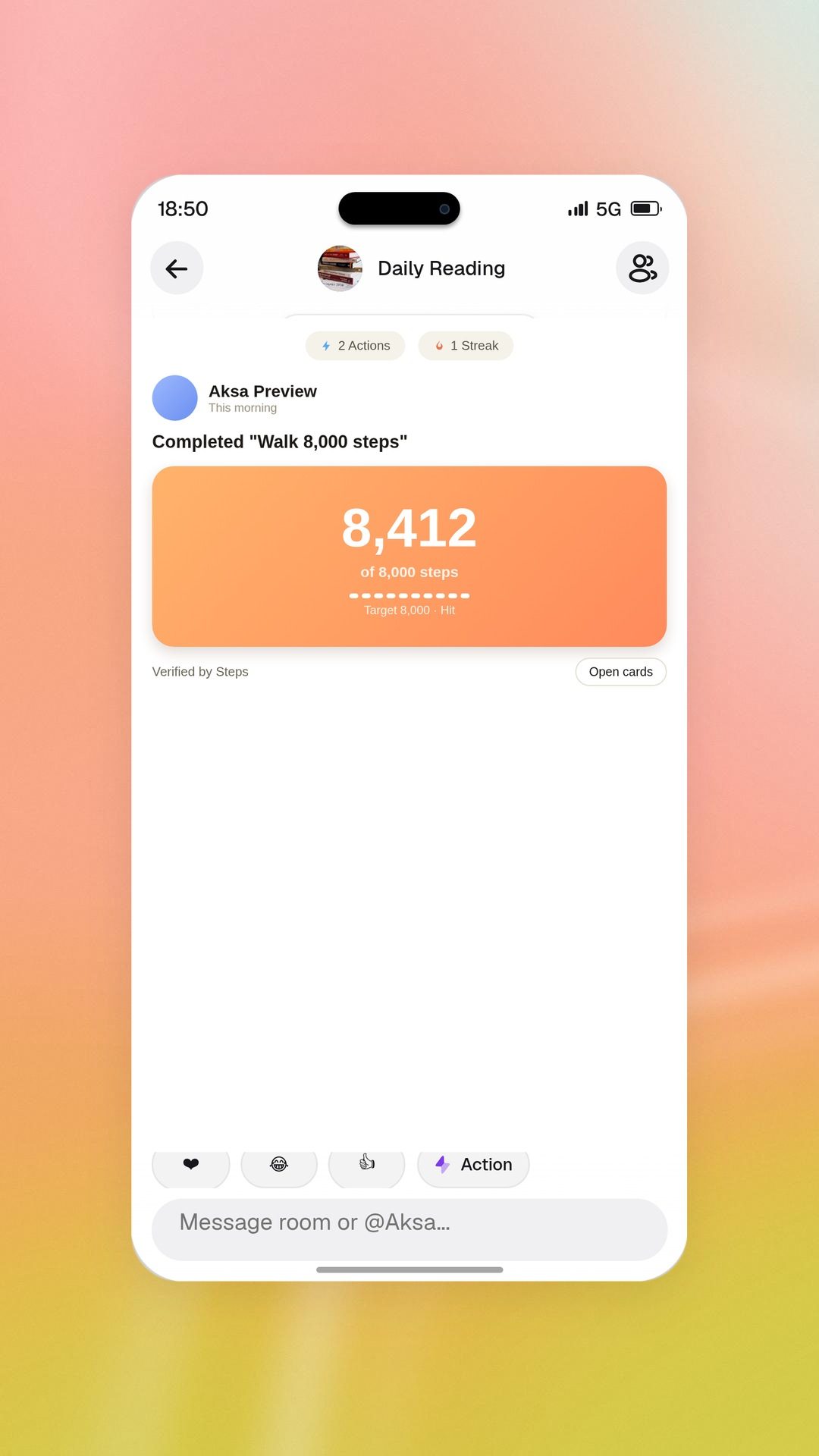
In Aksa the floor becomes a daily Counter Action: log steps as you walk, close the day when the count is real. Progress counts only verified proof, so the room's numbers always mean what they say.
Put the floor where the group actually lives, not where fitness content says it should be. For a room of commuters, the train-station walk may already deliver most of it; for remote workers, the floor must be manufactured deliberately, and knowing that difference on day one is what keeps week three from being a surprise.
Count honestly: manual and device-reported
There are two honest ways to count. The universal one is the Counter primitive: tap in your step total from your phone's health app or watch at day's end. It takes ten seconds and works on any device.
The second is device-read evidence: on accounts where the steps flag is enabled, Aksa's Counter can read a daily step total from Apple Health or Health Connect, presented as device-reported evidence with the source named, never as tamper-proof. Hand counting stays available either way, marked as unverified.
Whichever mode your room uses, agree it on day one and keep it identical for everyone. A challenge where one person syncs a watch and another estimates from memory stops being a fair race by day three.
A word on honesty incentives: the goal is a fair race, not a police state. Device-read totals and named sources exist so that trust costs nothing, and the streak only moving on real proof means nobody has to squint at suspicious numbers. When the counting is boring and transparent, the competition can be loud and fun.
Run it in a small room
Create an Aksa Action Room for the challenge: four to ten walkers is the sweet spot, small enough that every person's day is actually seen. Each verified walk posts a claim card with the streak attached, and cheers arrive as push notifications, so the day's walk earns recognition while the shoes are still warm.
Aksa AI removes the admin work that kills volunteer-run challenges: it plans the daily action list in the room, answers questions, and posts updates, so nobody has to play challenge manager after a long day.
The platform passed 900 registered members in its first month, per a company database count in late September 2026, which means rooms stay intimate. Your Tuesday walk is seen by name, not lost in a feed of strangers.
If your group spans fitness levels, handicap by improvement rather than totals: cheer the biggest week-over-week gains in the room chat, not just the biggest numbers. A challenge where the least fit walker can earn the loudest cheers is a challenge everyone stays in.
Use the weekly reset to keep it winnable
Uncatchable leaders kill challenges. Aksa's Weekly Arena resets its Individual, School, and City leaderboards every Monday at 00:00 UTC, with winner spotlight cards for the top three, so every Monday the race starts even and last week's slump is history.
This changes the psychology for everyone who is not in first place: instead of chasing a month-long gap, you are racing for this week's podium, which is always within reach of one good weekend.
For long-running groups, treat each week as a fresh mini-challenge with its own tiny stake, loser buys Friday coffee, and the month takes care of itself.
Set up your walking challenge today
Fifteen minutes, shoes optional until step six:
Then take a short walk immediately. Challenges that start today survive; challenges scheduled for Monday get negotiated.
Two upgrades for month two, if the group wants them: a weekend long-walk tradition logged as a second Action, and a rotating 'route captain' who posts one photo Submit from a new route each week. Small variations keep the room talking without touching the daily floor that holds the whole thing together.
- 1. Agree the daily floor with the group: 5,000 to 7,000 steps for most desk-bound groups, written into the room.
- 2. Agree the counting method, manual Counter or device-read, identical for every walker.
- 3. Create an Aksa Action Room, add the daily Counter Action, and invite four to ten walkers.
- 4. Set one evening reminder, Repeat Every Day, so nobody forgets to log.
- 5. Name the weekly stake, something small and social like coffee, tied to the Monday-reset leaderboard.
- 6. Walk and log today's steps right after setup, so everyone's streak starts at day one together.
Keep it alive past week two
Week two is where you lose people, so plan for it: a mid-challenge nudge in the room chat, one themed day (walk-and-talk meetings, lunch laps), and a Sunday look at the heatmaps together.
Handle misses with the 24-hour rule: after a missed day, the floor walk is non-negotiable the next day. One grey cell on the heatmap is a footnote; two in a row is a trend, and the room should say so kindly.
At four weeks, review as a group: keep the floor, raise it, or add a stretch tier. The challenge that adapts survives; the one that stays rigid gets quietly abandoned, and quiet abandonment is the only real failure mode.
FAQ
Is 10,000 steps a day a good target for a challenge?
As a requirement, usually not. Research on daily goals, including Duolingo's published retention experiments, shows intense daily targets break consistency. Set a floor of 5,000 to 7,000 steps that survives desk-bound days, and treat 10,000 as a stretch goal. Daily completion at a modest floor beats heroic targets hit twice a week.
Do I need a fitness watch for a walking challenge?
No. Any phone's built-in health app counts steps, and you log the total in Aksa's Counter in ten seconds. Where the steps flag is enabled for your account, the Counter can also read the daily total from Apple Health or Health Connect as device-reported evidence, with manual counting always available alongside.
How many people should join a step challenge?
Four to ten. Below four, one absence drains the room; above ten, individual days stop being seen and the social mechanism weakens. Aksa Action Rooms are built for exactly this scale, with claim cards and cheers keeping every walk visible by name.
What keeps a step challenge from dying after the first week?
Three things: a floor small enough for busy days, daily verified logging instead of end-of-week estimates, and a weekly reset so the race never becomes uncatchable. Aksa's Weekly Arena resets leaderboards every Monday at 00:00 UTC, which gives every walker a fresh winnable race each week.
How do we handle someone who stops logging?
Name it kindly and early, from evidence: the room heatmap shows the gap without anyone accusing anyone. Apply the 24-hour rule, floor walk the next day, and check whether the floor is too high for their schedule. Most dropouts are floor problems, not motivation problems.
Can we run the challenge across different time zones?
Yes. Each member's day closes on their local schedule, reminders fire at their local evening, and the weekly leaderboard resets at the shared Monday 00:00 UTC mark. Walking is asynchronous by nature, so a distributed room works exactly like a local one.