

What Is an AI Action Agent? (2026 Explainer)
An AI action agent plans and follows a goal across steps, keeps context and blockers, and leaves completion to proof. The definition, how an action differs from a to-do item, and what Aksa's Action agent does today.
Published October 2, 2026 · Updated October 22, 2026 · 7 min read
AI action agent, defined
An AI action agent is software that helps move a specific action from intention to proof. It plans steps, keeps track of context and flags blockers - all within the permissions the person has given it.
Two boundaries define the category as much as the capabilities do: the agent does not replace human control, and it cannot declare an action done. Completion is a fact established by evidence, not a status an agent assigns.
Aksa is a social platform with an AI agent built on this model - the agent plans, operates, verifies and keeps momentum, while proof and people decide what actually counts.
How an action differs from a to-do item
A to-do item is a disposable row: text, a checkbox, maybe a date. It knows nothing about why it exists, what is blocking it or what would prove it done - so when life interrupts, the row just sits there, context-free, until it becomes guilt.
Aksa treats an action as a persistent workflow instead. The action keeps its desired outcome, owner and collaborators, current state, relevant context, blockers, approvals, activity history and proof.
That persistence is what lets one action survive interruptions, resume with context and involve the right people. A blocked action says why it is blocked; a resumed action remembers where it stopped. The unit of work carries its own memory.
What the Action agent does in Aksa today
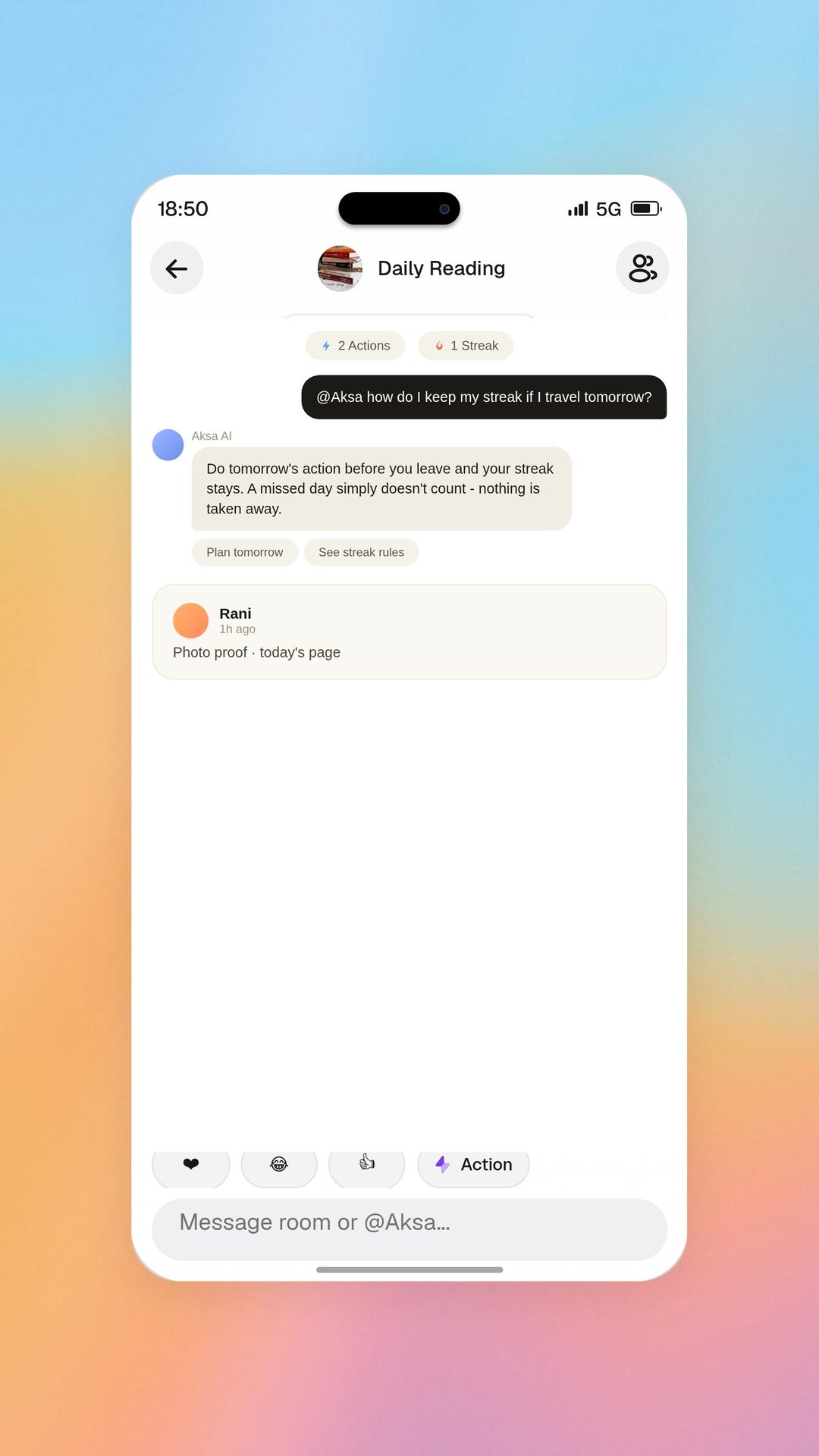
In action rooms, the Action agent plans daily actions, answers questions about the goal, and posts updates - the live behavior described in the product specification.
Planning: a goal arrives as an outcome; the agent helps decompose it into daily actions with proof formats attached. The decomposition is the difference between a goal you admire and a goal you execute.
Momentum: when a goal stalls, the agent checks in with one concrete next step sized to where you stopped - not motivational wallpaper, but the smallest action that restarts the chain.
What the agent does not do
It does not mark work complete. Verified Done requires durable proof and the action's verification rule - the agent assists the workflow, but the evidence decides the state. An agent that could declare completion would corrupt every streak and leaderboard built on it.
It does not act outside granted permissions. The agent coordinates support and adapts next steps within what you have allowed - the human sets the boundaries; the agent operates inside them.
And it does not replace the social layer. The agent supplies the plan and the nudge; rooms supply the witnesses. Goals fail to different causes - no plan, no pressure - and the two layers cover the two causes.
The lifecycle the agent operates
The agent works over the action lifecycle: Proposed - it suggests and scopes the action. Accepted - you take ownership. Running - work is underway. Blocked or Approval Needed - the agent names the obstacle and routes around it. Proof Submitted - your evidence lands. Verified Done - the rule checks the proof, not the agent's say-so.
Notice where the agent is powerful and where it is deliberately weak: powerful in the middle - planning, unblocking, coordinating - weak at the end, where only evidence speaks.
That asymmetry is the trust model. An agent strong at helping and powerless at certifying can be given real responsibility, because the one thing it cannot do is the one thing that would corrupt everything else.
Agent vs chatbot vs tracker
A chatbot talks: it can discuss your goals endlessly and change nothing, because conversation is not connected to state. A tracker records: it stores what you report and nudges nothing, because storage is not connected to planning.
An action agent connects the two to the workflow itself: it plans against the goal's actual state, reads the blockers you have logged, and measures success by proof submitted - not messages exchanged.
The test for the category: ask the system 'what is blocking my launch goal?' A chatbot improvises an answer; a tracker shrugs; an action agent reads the action's state and tells you - because the answer was structured data, not chat history.
A worked example: one stalled goal, one useful nudge
Week three of 'ship the portfolio site': the goal shows four days without proof. A habit app would show a gray streak; a chatbot would wait to be asked. The Action agent checks the action's state - Running, last proof Monday, no blocker logged.
The nudge is concrete: 'Smallest next step: publish the About page as-is - proof: a photo of the live page. Fifteen minutes.' Not a pep talk - a sized, provable restart that matches where the work actually stopped.
You do the fifteen minutes, the proof lands, the chain restarts. That is the entire value proposition in miniature: the plan remembered when you forgot, the next step sized when you were overwhelmed, and the credit - because proof decides - entirely yours.
What to look for in any AI agent for goals
Four questions separate real action agents from rebranded chatbots. One: does it hold structured state - can it tell you an action's status, blockers and history, or only discuss them? Two: does it plan against that state - next steps sized to where you actually stopped?
Three: what can it certify? The trustworthy answer is 'nothing' - an agent that can declare completion corrupts every record built on it. Four: what can it do without you? The trustworthy answer is 'operate within permissions you granted' - momentum support, never silent scope creep.
Aksa's answers: persistent action workflows with full lifecycle state; planning and nudges against that state; no power to declare Verified Done; operation within granted permissions with human control explicit. Whatever tool you evaluate, the same four questions apply.
Why this model matters now
AI that talks about goals is abundant; AI that is accountable to evidence is rare. The action-agent model is a bet that the useful unit is not the conversation but the action - persistent, provable, owned by a human.
The bet pays off in trust: when the agent cannot fake completion, its planning help comes without an integrity discount. You can lean on the system because the system cannot lean on its own say-so.
And it pays off in outcomes: goals with plans, blockers and proof survive contact with real weeks. The agent's job is not to make you feel committed - it is to make the next proof easier to produce than the excuse.
FAQ
What is an AI action agent?
Software that helps move a specific action from intention to proof: it plans steps, keeps track of context and flags blockers, within granted permissions. Defining boundaries: it does not replace human control and cannot declare an action done - completion requires durable proof and a met verification rule.
How is an action different from a to-do item?
A to-do item is a disposable row - text and a checkbox with no memory. An action is a persistent workflow keeping its outcome, owner, state, context, blockers, approvals, history and proof. That persistence lets it survive interruptions, resume with context and involve the right people.
What does Aksa's Action agent do today?
In action rooms, it plans daily actions, answers questions about the goal, and posts updates. It helps decompose goals into provable daily actions at setup, and when a goal stalls it nudges with one concrete next step sized to where you stopped.
Can an AI action agent mark my task as complete?
No - that boundary defines the category. Verified Done requires durable proof and a met verification rule; completion is never inferred from an AI response. The agent assists the workflow, but evidence decides the state - which is what makes its other help trustworthy.
How is an action agent different from a chatbot?
A chatbot talks about goals without connection to state; an action agent plans against the goal's actual structured state - current status, logged blockers, proof history - and measures success by proofs submitted, not messages exchanged. Ask 'what is blocking my goal?': the chatbot improvises, the agent reads.
Does the agent control my goals?
No - human control is explicit in the model. The agent plans, operates, verifies and keeps momentum within the permissions you grant. You own the actions, accept or reject proposals, and submit the proof. The agent is staff, not management.
What happens when I ignore the agent's nudge?
Nothing punitive - the record simply shows the gap, and the goal's state stays honestly stalled. The agent's leverage is making the next step small and concrete, not escalating pressure. When you return, the action resumes with its full context intact.
Why does the agent need the social layer too?
Because goals fail to two different causes: no plan and no pressure. The agent covers the plan - decomposition, next steps, blocker handling. Rooms cover the pressure - witnesses, heatmaps, weekly resets. Aksa pairs both because either alone leaves a failure mode open.
Is an AI action agent the same as an AI assistant?
No. An assistant responds to requests; an action agent owns a workflow with you - it tracks the action's persistent state across days, notices stalls on its own, and proposes the next step without being asked. The assistant waits in the chat box; the agent watches the goal.