Why You Break Promises to Yourself (and the Structure That Fixes It)
Breaking promises to yourself is not a character flaw; it is a predictable design failure. The psychology behind self-broken promises and the fix that holds.
Published October 24, 2026 · 7 min read
The direct answer
Aksa is a social platform with an AI agent. You break promises to yourself because a private promise has no enforcement mechanism: no witness notices the miss, no evidence proves the work, and no cost follows the quit. The fix is not more discipline; it is adding witnesses, evidence, and gentle consequences to the promise.
This is a design problem, not a character problem. Below is the psychology of why self-promises fail, then the exact structure, built inside Aksa, a social platform with an AI agent, that turns a private intention into a kept commitment.
Present bias: the enemy has a name
Economists call it present bias: the tendency to overweight immediate comfort against future benefit. Tomorrow's you is a stranger you keep volunteering for sacrifices, and today's you keeps canceling them. Every broken self-promise is a small betrayal of a stranger, and betraying strangers is easy.
Research on habit formation shows how long the betrayal window lasts. The 2009 study by Phillippa Lally and colleagues at University College London found new behaviors took an average of 66 days to become automatic, ranging from 18 to 254 days. For two months or more, every single day is a fresh negotiation with present bias.
You cannot delete present bias; it is hardware. You can only change the terms of the daily negotiation so that acting becomes cheaper than skipping. Everything else in this guide is about changing those terms.
There is a related bias worth naming: hyperbolic discounting, the habit of treating a reward as far less valuable simply because it arrives later. A fitter body in six months loses every auction against a comfortable sofa tonight. Structures that make progress visible today, a moving streak, a filling heatmap, give the future reward a down payment you can feel now.
Why promises to others survive
Notice that you rarely break promises to other people. A meeting with a friend survives the same tiredness that kills your solo gym plan. The difference is not respect; it is visibility. The friend will notice your absence, and being seen flaking is uncomfortable.
This is the engine of accountability: a promise with a witness has a cost attached to breaking it. The cost does not need to be large. Knowing that one person will see an empty spot where your proof should be is enough to move most people most days.
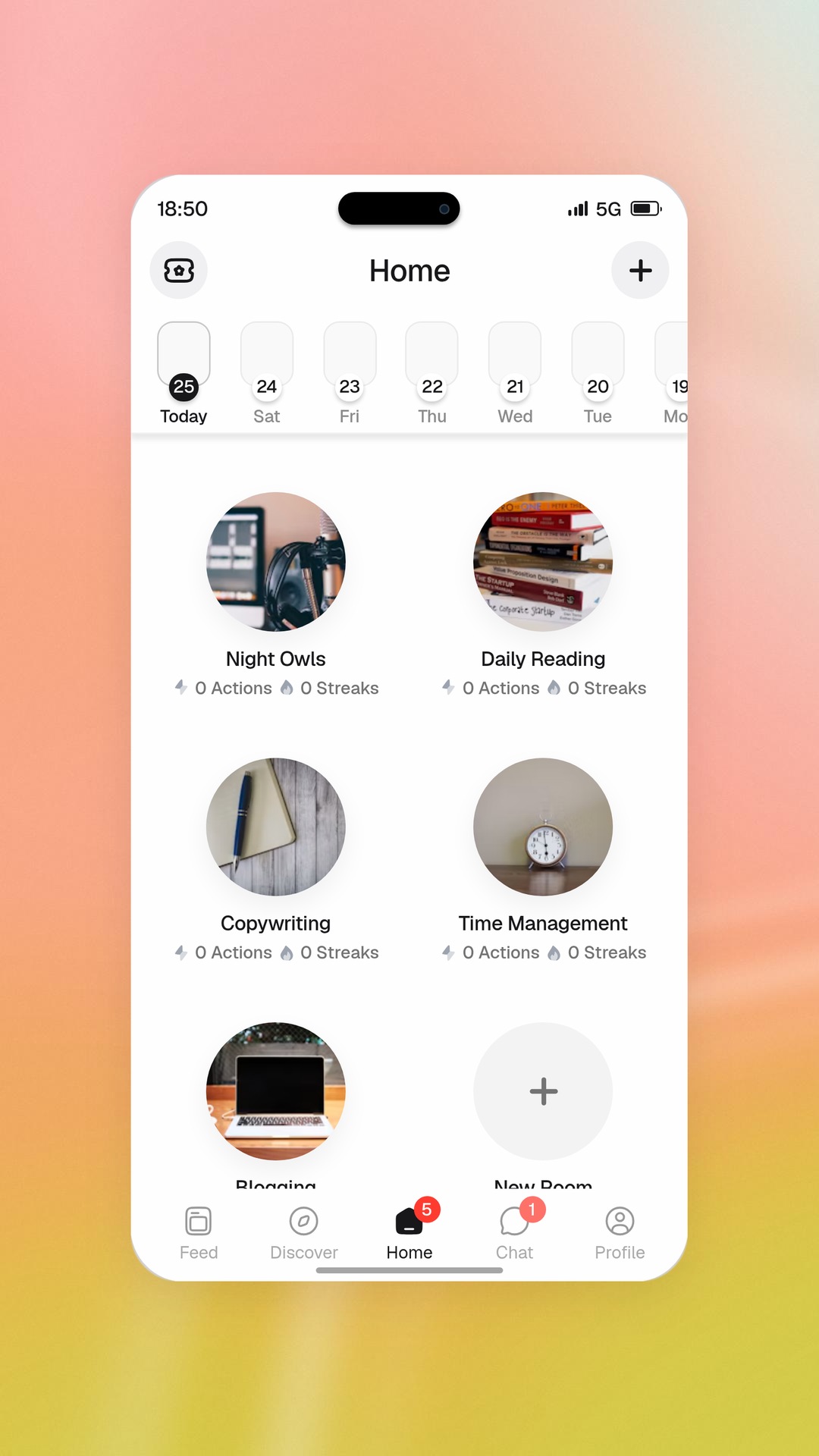
Aksa is engineered around this single insight. Action Rooms make your daily proof visible to a small circle, claim cards announce completed actions with your streak attached, and cheers arrive as push notifications. Your promise stops being private property and becomes a shared object.
The evidence gap
The second reason self-promises collapse is that nobody, including you, can tell a kept promise from a broken one a week later. Memory is generous to the self. Without evidence, "I have been pretty consistent" is unfalsifiable, and unfalsifiable claims decay into fiction.
Verified proof closes the gap. In Aksa, every daily Action runs on one of six primitives: Submit for photo or video evidence, Answer for written reflections, Counter for repetitions, Timer for focus sessions, Check-in for presence, and Confirm for binary commitments. The standing rule is that progress counts only verified proof, never an unverified tap.
Proof compounds into an archive that memory cannot argue with: a consistency heatmap, a momentum chart, and a 3-month Photo Calendar on your profile. When present-bias-you starts negotiating, three months of visible evidence is the counter-argument.
Evidence also protects you from a subtler failure: doing the work but feeling like you are standing still. Without a record, effort evaporates emotionally even when it accumulates physically. A browsable proof history converts invisible discipline into visible capital, and visible capital is what funds the next hard week.
Implementation intentions: pre-deciding the hard part
Psychologist Peter Gollwitzer's research on implementation intentions, beginning in the 1990s, showed that people who pre-decide when and where they will act are dramatically more likely to follow through than people who hold only a goal intention. "After breakfast, at my desk, I will write for 25 minutes" beats "I will write more" by a wide margin across dozens of studies.
The reason is that deciding is the expensive part. A vague promise forces a fresh decision every day, and every decision is a chance for present bias to win. A pre-decided trigger removes the decision; the alarm rings, the action begins.
Aksa operationalizes this with daily Actions on schedules and reminder preferences you set once. The daily Action is the implementation intention made concrete: named, timed, and waiting for proof, so the day's only question is execution, not negotiation.
Build the structure in one evening
Here is the exact setup that converts a broken-promise pattern into a kept-commitment system:
Six steps, one evening. From tomorrow, the promise has a witness, an evidence standard, a trigger, and a record.
Note what is deliberately absent from that list: willpower challenges, punishment apps, and public declarations to hundreds of followers. Each adds drama rather than structure. The promise-keeping system that survives is boring by design: small action, fixed trigger, real evidence, a few witnesses, and a scheduled second chance.
- 1. Pick the one promise you keep breaking and define its floor version, the smallest daily action that counts.
- 2. Create a private room of one in Aksa with that floor as the daily Action, choosing the proof primitive that matches: photo, timer, counter, reflection.
- 3. Set the implementation intention in the reminder: a fixed trigger time attached to an existing routine.
- 4. Create or join an Action Room and invite one to four people who will see your daily proof.
- 5. Agree on a miss rule with the room: a same-day message and a floor session within 24 hours of any miss.
- 6. Complete today's action immediately, so the chain starts before present bias can schedule a delay.
Forgiveness is part of the structure
A system that punishes every miss will be abandoned at the first bad week. The goal is not a perfect record; it is a resilient one. The 24-hour rule after any miss matters more than the streak itself: after a miss, the floor action is non-negotiable the next day, because one miss is an event and two misses are a pattern.
Aksa's weekly rhythm supports this. The Weekly Arena resets Individual, School, and City leaderboards every Monday at 00:00 UTC, so a bad week never permanently stains your standing. The heatmap keeps the honest record, while the competition forgives on a schedule.
Treat yourself the way a good coach treats an athlete after a loss: acknowledge, adjust, next rep. The archive of proof on your profile exists to remind you that one grey cell is surrounded by green.
What changes after two months
Around the 66-day mark from the Lally study, the daily negotiation starts going quiet. The action migrates from something you decide to something you do, like brushing your teeth: unremarkable, automatic, oddly missed when skipped.
The external structure becomes lighter then. The room still watches, the streak still counts, but the engine has moved inside. That is the actual product: not a streak number, but a version of you that keeps promises without strain.
Until that day, let the structure carry you. Witnesses, evidence, triggers, and forgiveness. The promise stops being fragile the moment it stops being private.
FAQ
Is breaking promises to yourself a sign of low willpower?
No. It is usually a sign of a structurally weak promise: no witness, no evidence, no scheduled trigger, no cost for skipping. Research on present bias shows the pull toward immediate comfort is universal hardware. People who seem disciplined typically run better structures, not stronger character.
What is present bias in simple terms?
Present bias is the tendency to choose immediate comfort over future benefit, even when the future benefit is much larger. It is why tomorrow's workout always sounds easier tonight. You cannot remove it, but you can change daily terms: small floor actions, fixed triggers, and visible proof make acting cheaper than skipping.
Do accountability apps actually help with self-promises?
They help when they add the three things private promises lack: witnesses, evidence, and a record. Aksa combines all three with Action Rooms, six verified proof primitives, and a profile heatmap plus Photo Calendar. An app that only stores your intentions adds none of them.
How do implementation intentions work?
Implementation intentions are pre-decided if-then plans: after trigger X, I will do action Y, at place Z. Peter Gollwitzer's research program found they sharply raise follow-through by removing the daily decision point where motivation fails. In Aksa, a scheduled daily Action with a reminder is an implementation intention made concrete.
Should I punish myself for breaking a promise?
Small social stakes help; self-punishment backfires. Shame makes you hide misses, and hidden misses end habits. Prefer a 24-hour recovery rule and light stakes agreed with your room, like the first miss of the month buying coffee. Aksa's weekly leaderboard reset builds scheduled forgiveness into the competition.
How long until keeping promises feels natural?
The best-known benchmark is the 2009 Lally study: an average of 66 days for a behavior to feel automatic, with a range of 18 to 254 days depending on the person and the behavior. Plan your external structure for the full window, and expect it to carry you for two months before the habit carries itself.