Work From Home Accountability: Stay Productive Without an Office
Work from home accountability without surveillance: provable daily outputs, visible streaks, a small peer room, and a weekly review. The system, setup steps, and FAQs.
Published October 27, 2026 · 7 min read
The short answer
Work from home accountability means replacing the office's ambient structure with three explicit pieces: a provable daily output, a visible record that only counts real work, and two to five peers who see it. The office used to supply all three for free; remote workers have to build them on purpose.
This guide covers why WFH drift is structural rather than personal, the system that replaces the missing structure, and the exact setup - no surveillance software, no screenshots of your screen, just proof of work.
Why remote drift is structural, not personal
The office was never just a building. It was a bundle of accountability machinery: a commute that forced a start time, colleagues whose glances made slacking visible, and a boss whose presence turned intention into obligation. Remote work removed the entire bundle in one move and handed the pieces to you, usually without instructions.
The research on remote productivity is genuinely mixed - some studies show gains, others show losses - but the consistent finding underneath both is variance: remote work amplifies whatever structure you bring. People with systems thrive; people running on vibes slowly slide. Stanford economist Nicholas Bloom's well-known 2015 study of a Chinese call center, published in the Quarterly Journal of Economics, found a 13 percent performance increase among home workers - but those workers kept fixed schedules and reported to managers. The structure stayed; only the building changed.
So the WFH question is not 'how do I get more discipline.' It is 'which pieces of the office do I need to rebuild deliberately.' There are three: the start signal, the evidence of work, and the witness.
Piece one: a start signal that does not negotiate
The commute's hidden function was a daily, non-negotiable transition into work mode. Remote workers need a synthetic one: same wake time, a short defined ritual, and work starting at a fixed hour. The ritual can be tiny - coffee, shoes on, desk - but it must be fixed, because the transition is what the brain uses to switch modes.
Implementation intentions do the formal work here. In a 1999 paper in American Psychologist, Peter Gollwitzer's research showed strong effects on follow-through from when-then plans: 'When it is 8:55, I close the kitchen, sit at the desk, and open the day's one must-do task' beats 'I start around nine-ish' because the cue is fixed and the decision is pre-made.
Protect the end of the day as hard as the start. A shutdown ritual - write tomorrow's first task, close the laptop, leave the desk - keeps work from colonizing every hour, which is the slower-burning WFH failure mode. Boundaries are accountability to future you.
Piece two: proof of output, not hours
Hours are the office's metric because hours are what an office can see. Remote work lets you upgrade to the better metric: output. Define the day's provable deliverable each morning - the report section drafted, the five calls made, the feature merged - and let the day be accountable to that, not to looking busy near a laptop.
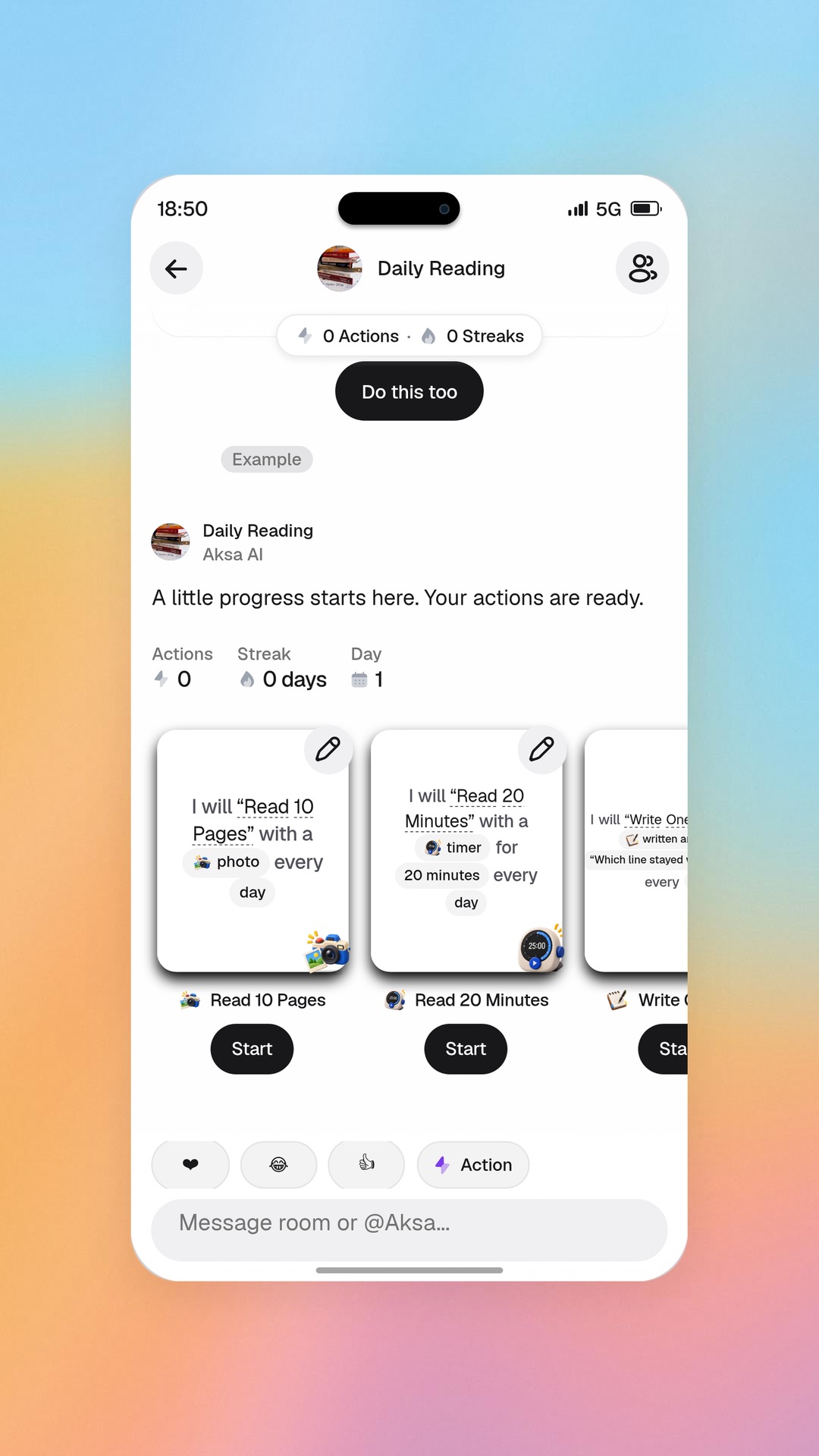
Aksa is a social platform with an AI agent. Every daily Action maps to one of six proof formats - photo, written answer, counter, timer, check-in, or confirm - so 'the day's deliverable' becomes a dated artifact instead of a claim. Aksa AI helps decompose a goal into provable daily actions at setup and plans the next step when you stall, but it never marks work done: Verified Done requires durable proof and the verification rule for the Action.
The record that builds is the other half of the value. Streak counts move only on verified proof days, and evidence posted in view of others tends to get seen and answered, which is the whole engine of keeping a remote routine alive.
Piece three: the peer room
You do not need a manager watching; you need a few people who notice. A small room of two to five other remote workers - same proof standard, no matter the field - recreates the only part of the office that actually mattered: the feeling that your day is visible to someone whose day is visible to you.
Keep the standard output-based and the tone light. Post the day's deliverable as proof, react to others, and say the useful thing when someone slips: 'what is tomorrow's one task?' An Action Room carries a member consistency heatmap and a feed of the day's proofs, so the week's pattern is visible without anyone writing status reports.
This is deliberately not surveillance. Aksa does not capture your screen, keystrokes, or hours. A proof is one artifact you chose to submit, visible in the room you posted it to, proving the day produced something. Accountability to peers you respect is motivating; monitoring by software is corrosive. The difference is who the proof is for.
Set up WFH accountability in Aksa
Ten minutes tonight, and tomorrow runs on the new system.
- 1. Create a Goal for the work rhythm - 'Ship one provable deliverable every workday' beats any hours-based target.
- 2. Add a daily Action with the proof type that fits your work: a written answer with the day's deliverable, a counter of calls or tickets, a timer for deep-work blocks.
- 3. Set a Reminder for the morning start ritual and the end-of-day proof submission - Repeat Weekdays fits most schedules, with the Alarm switch if the morning one gets snoozed.
- 4. Write tomorrow's first task at each day's shutdown - it is tomorrow's start signal, pre-made.
- 5. Create or join a small Action Room of remote workers and agree the proof standard - each friend who joins through your invite and finishes onboarding earns one month of Premium for both of you, up to five friends.
- 6. Review the week every Friday: streak count, room heatmap, and one adjustment for next week - the Weekly Arena resets every Monday, so each week starts clean.
The weekly review: your remote one-on-one
Office workers got feedback through a thousand daily micro-signals; remote workers get silence. A 30-minute Friday review replaces it: read the week's record as data, name the miss pattern in one sentence ('Wednesdays collapse when meetings run long'), protect what worked, and make exactly one change for next week.
The review is also where the honest questions live that no tracker answers: is the daily deliverable sized right, is the work still pointed at the right goal, is the boundary between work and home holding? The profile momentum chart and 3-month Photo Calendar make the longer arc visible at a glance - useful when the week felt bad but the month was actually fine, or the reverse.
When the system slips
Expect the drift to return around week three or four - the novelty wears off at the same time the routine stops needing it. The response is mechanical, not emotional: log the gap, identify which piece failed (start signal, proof, or room), repair that piece, and resume.
In a 2009 study by Lally and colleagues in the European Journal of Social Psychology, habits took a median of 66 days to automate - with a range of 18 to 254 days - and single misses did not materially derail the process. Remote work accountability is a habit about habits; give the system itself the same grace period you would give any behavior you are installing.
FAQ
How do I hold myself accountable when working from home?
Replace the office's three hidden structures: a fixed start signal (same time, same ritual), daily proof of output instead of hours, and a small group of peers who see the record. Self-discipline fills none of those gaps by itself - the structure does the work that willpower was failing to do.
Is time tracking a good WFH accountability method?
Hours measure presence, not output, and remote work finally lets you measure the better thing. Define each day's provable deliverable in the morning and hold the day accountable to producing it. Timed deep-work blocks are a useful proof format, but the deliverable is the metric that matters.
What if my job has no obvious daily deliverable?
Decompose the week: most 'unmeasurable' jobs produce countable units - calls made, sections drafted, tickets closed, decisions documented. Pick the unit closest to real progress and prove that daily. If nothing countable exists, the daily written answer 'what moved today, and what is blocked' is itself a strong proof.
How is peer accountability different from employee monitoring?
Direction and consent. Monitoring flows upward to an evaluator with power over you and usually captures everything; peer accountability flows sideways to equals and contains only the artifact you chose to submit. The first creates compliance theater, the second creates motivation - the research and the lived experience agree on which one lasts.
How do I stop working all the time when home is the office?
With a shutdown ritual as fixed as the start ritual: write tomorrow's first task, close the laptop, physically leave the workspace. Accountability runs in both directions - the system that makes you start on time should also make you stop, because chronic overwork is the slower WFH failure mode.
Can this work if my whole team is distributed across time zones?
Yes - asynchronous proof is the point. Each person posts the day's deliverable whenever their day ends, and the room's feed and heatmap make everyone's week visible without a single overlapping hour. Time zones stop mattering when accountability is a record instead of a meeting.