Do Accountability Partners Work? An Honest Answer (2026)
Do accountability partners actually work? Yes - when the partnership has a checkable action, a proof rule, a rhythm and a miss protocol. Why most partnerships fail by week two, and how to build one that lasts.
Published October 23, 2026 · 7 min read
The short answer
Yes, accountability partners work - when the partnership is structured. The partnerships that fail (most of them, by week two) are the ones built on vibes: no defined action, no proof standard, no rhythm, no plan for misses. The ones that last made four decisions before day one.
The four decisions: one checkable action each, a proof format both agree on, a fixed rhythm, and a written miss protocol. Ten minutes of structure at the start is what separates a witness from a pen pal.
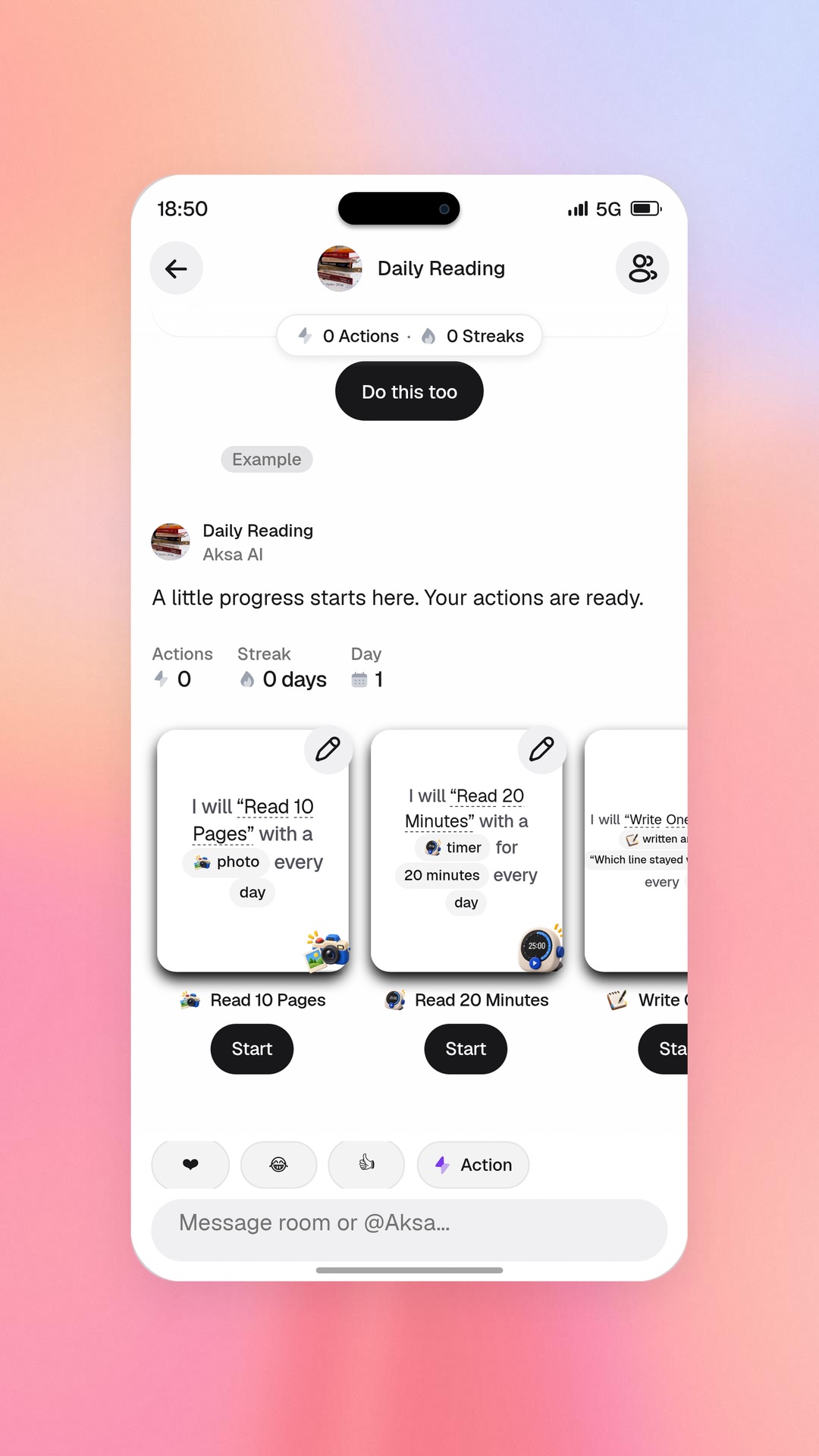
Aksa is a social platform with an AI agent built to hold that structure: daily actions with proof in six formats, rooms and partner visibility, streaks that count only proof-backed days - so the agreement has a machine to live in.
Why accountability works at all
The mechanism is not pressure - it is pricing. Alone, skipping a day costs nothing anyone will see. With a partner watching, the same skip costs a small piece of standing with someone whose opinion you care about. The decision math changes without anyone saying a word.
The second mechanism is externalization: a commitment said to another person becomes an object outside your head. Private intentions are infinitely renegotiable; a stated commitment to a witness is not - renegotiating it requires a conversation, and conversations are friction.
The third is calibration: watching a partner's ordinary consistent week recalibrates what 'normal effort' means. Most people have never seen consistency up close; once it is normal in your feed, it becomes normal in your life.
Why most partnerships fail by week two
Vague accountability: 'keep me accountable' with no defined action gives the partner nothing to check. There is no way to see a miss of an undefined promise, so both people quietly stop looking.
Proof-free reporting: 'did you work out?' 'yes.' Text-based honor systems collapse because they cost nothing to fake and feel awkward to doubt. Without artifacts, the partnership is a performance of accountability.
No miss protocol: the first missed check-in is the partnership's true test, and most pairs treat it with silence - the misser is embarrassed, the partner feels awkward, and the silence compounds into a dead arrangement neither person officially ended.
The four decisions that make it work
Decision one - the action: one specific, checkable action per person. Not 'get fit' but 'a photo of my workout, weekdays, by 8 PM.' Specific enough that a stranger could judge done from not-done in ten seconds.
Decision two - the proof: what artifact counts, agreed in advance. Photo, timer record, written answer, count against a target - Aksa's six formats cover the common cases and label their honesty. No artifact, no credit.
Decisions three and four - the rhythm and the miss protocol: daily or weekdays (daily check-ins outlast weekly calls by a wide margin), plus a written rule for misses: 'one miss = a message; two misses = a call; the misser always reports the miss themselves.' The self-reporting rule is what prevents the silence spiral.
Partner vs app vs room: what actually differs
A human partner is high-bandwidth: they notice your tone, ask the pointed question, adapt. The cost is fragility - the partnership rests on one other person's continued attention, and people get busy.
A room (small group) is low-bandwidth but durable: ambient witness, no scheduling, survives any one member's bad week. It cannot ask the pointed question, but it never forgets to watch.
The strongest setup combines both, plus a planning layer: Aksa AI decomposes the goal and nudges on stalls (the plan), the room provides the ambient witness (the daily pressure), and a partner provides the human conversation when the pattern looks wrong. Three failure modes, three covers.
Choosing the right partner
Reliability beats closeness. The consistent acquaintance outperforms the flaky best friend: you need someone whose own record proves they show up, because their reliability is the ceiling of yours.
Match cadence and seriousness before goal topic. A daily grinder paired with a casual three-times-a-week partner breeds contempt on one side and guilt on the other. Same-frequency beats same-goal.
Reciprocity is non-negotiable: both people must have a real goal with real stakes. A watcher-and-performer arrangement decays into resentment or theater; two witnesses works.
The day-one agreement, copy this
'My action: [specific, checkable, with floor version]. My proof: [format, submitted by time X]. Rhythm: [daily/weekdays]. If I miss: I tell you by [time], no explanation needed; you reply with one word and we move on. Two consecutive misses: we talk for ten minutes. Review: day 14, keep-adjust-end.'
Thirty seconds to read, ten minutes to fill in together, and it prevents the three failure modes: vagueness, honor-system drift and silence. Put it somewhere both can see - a pinned message, the room's description.
Notice what is not in it: encouragement duties, long check-in calls, guilt. The structure does the motivating; the humans just show up where they said they would.
A worked example: two founders, ninety days
The setup: both building side projects, both with four-abandoned-repo histories. The agreement: 'one hour of deep work weekdays, proof: timer session plus two-sentence answer, posted by 10 PM. Miss = self-report by 10:15. Two misses = call.'
Week three: the first double miss - and because the protocol existed, the call happened in ten minutes, cause identified (both traveling), floor activated ('thirty minutes counts when traveling'). The partnership survived precisely because the miss had a procedure.
Day ninety: 74 proof-backed weekdays each, one project launched, one in beta. Neither credits motivation; both credit the protocol - especially the rule that the misser reports the miss, which made silence impossible.
What the evidence pattern looks like
Formal research on accountability and goal progress is broadly consistent with the structural picture: commitments made to another person, with specific check-ins, outperform private intentions - and the specificity of the commitment matters as much as the audience. Vague public promises perform barely better than private ones.
The practitioner evidence points the same way: every community discussion of accountability eventually converges on the same three ingredients - a specific commitment, a regular rhythm, and someone who will actually notice. The details vary; the structure does not.
Aksa's own numbers fit the pattern: in a company database pull from late September 2026, 36% of proofs received a social response, and a company database count on October 1, 2026 recorded 375 proof posts from 40 contributors.
Setup checklist
- One checkable action each - judgeable by a stranger in ten seconds.
- One proof format each - artifact required, no honor-system reports.
- A fixed rhythm - daily beats weekly; weekday floors allowed.
- A written miss protocol - misser self-reports; two misses triggers a call.
- A day-14 review - keep, adjust or end cleanly.
- The agreement pinned where both see it - not buried in a chat.
FAQ
Do accountability partners actually work?
Yes, when structured: one checkable action each, an agreed proof format, a fixed rhythm and a written miss protocol. Most partnerships fail by week two because they run on vibes - no defined action to check, no artifacts, and silence at the first miss. Structure is the entire difference.
Why do accountability partnerships fail?
Three predictable causes: vague commitments ('keep me accountable' with nothing to check), proof-free reporting (honor-system texts that cost nothing to fake), and no miss protocol (the first miss is met with mutual silence, which compounds into a dead arrangement). All three are prevented by ten minutes of day-one structure.
How often should accountability partners check in?
Daily or weekday check-ins outlast weekly calls by a wide margin: the daily rhythm makes checking habitual and catches stalls at day two instead of day nine. The check-in itself should be cheap - a proof artifact, not a meeting - or it becomes the first thing dropped.
What should an accountability partner agreement include?
Four items: each person's specific checkable action, the proof format that counts, the rhythm (daily or weekdays, with a posting cutoff), and the miss protocol - who reports misses (the misser, always), and what happens at one miss (a one-word acknowledgment) versus two (a ten-minute call). Plus a day-14 keep-adjust-end review.
Is an accountability partner better than an app?
They cover different failure modes. A partner is high-bandwidth but fragile (rests on one person's attention); an app room is low-bandwidth but durable (ambient witness, never sleeps). The strongest setup combines them: the room for daily pressure, the partner for pointed questions, and Aksa's agent for planning and stall nudges.
How do I find a good accountability partner?
Recruit for reliability, not closeness: the consistent acquaintance beats the flaky best friend. Match cadence and seriousness before goal topic. Require reciprocity - both people need a real goal with real stakes. On Aksa, the Friend Tab supports peer discovery and partner invites.
What if my accountability partner keeps missing?
Follow the protocol, then the review: the misser self-reports; two consecutive misses trigger the ten-minute call. If the pattern holds to day 14, end cleanly - a dead partnership dragged on is worse than none, and ending well frees both people to find the fit that works.
Can a stranger be an accountability partner?
Yes - strangers trade warmth for structure: the partnership is the only relationship, so the agreement matters more and the day-14 review carries the weight. Friends go soft (excusing misses to preserve the relationship); strangers go cold (fading when it is not working). Guard the failure mode of whichever you pick.