Habit Tracker With Friends: Why Shared Tracking Wins (2026)
A habit tracker with friends makes your daily work visible to people who notice. Why shared tracking outlasts solo streaks, what to look for, and how Aksa's rooms, proof and weekly reset work.
Published October 23, 2026 · 7 min read
The short answer
A habit tracker with friends combines the daily record of a tracker with the visibility of a group: your check-ins, proofs and streaks are seen by people who notice - and whose habits you see back. That mutual witness is what solo trackers cannot manufacture.
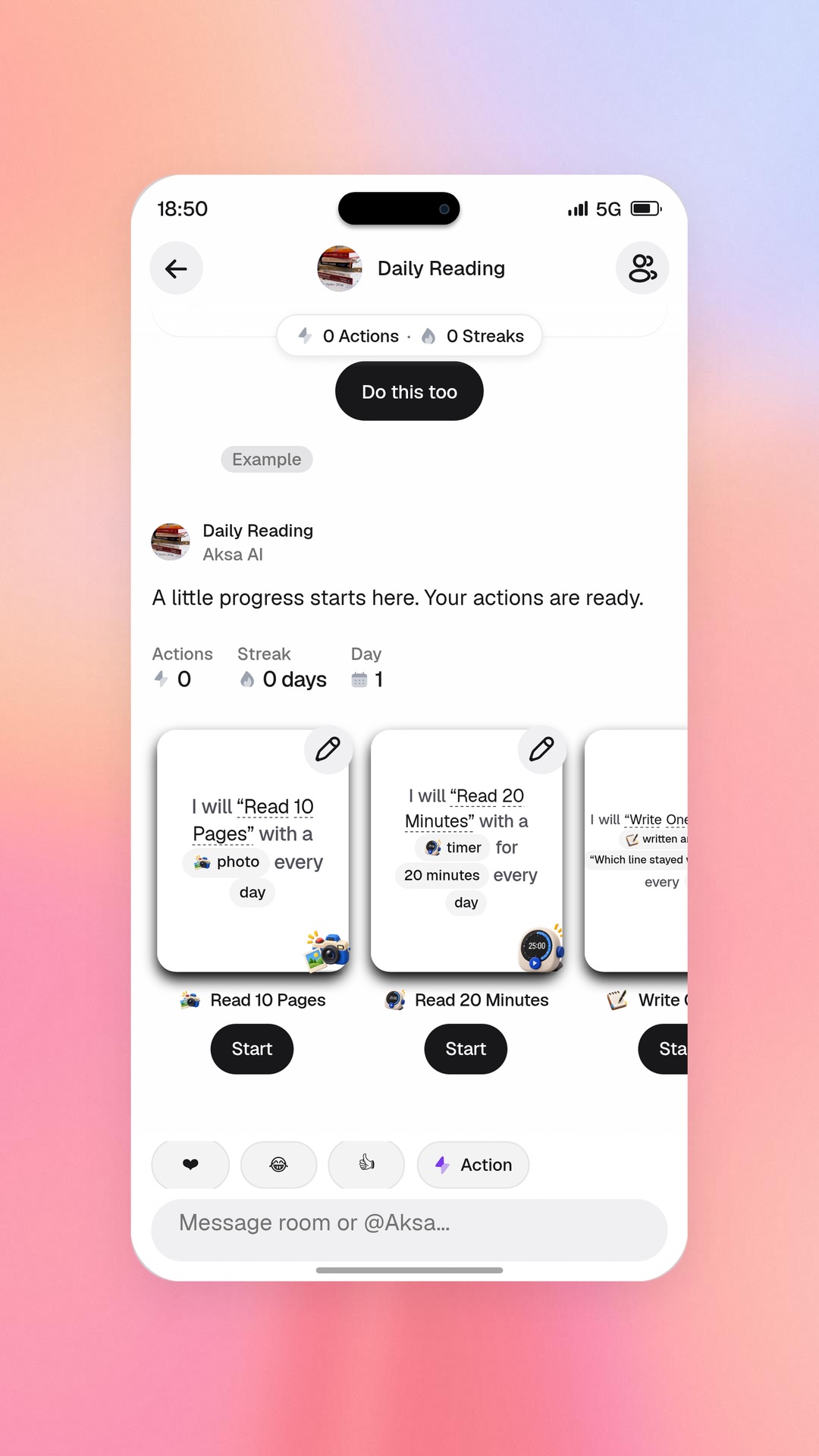
Aksa is a social platform with an AI agent built on this model: goals decomposed into daily actions, each finished action proven with one of six formats, and the proof visible in rooms where friends react, with a weekly leaderboard that resets every Monday.
The short version of the whole argument: habits tracked privately die privately. Habits tracked with friends have an audience - and audiences change what Tuesday night feels like.
Why solo trackers stop working
Every solo tracker follows the same arc: enthusiastic first week, solid second week, sporadic third, abandoned by the second month. The app did not change - the cost of skipping did. It started high (the streak was new and precious) and decayed to zero (the streak was broken anyway, and nobody knew).
The mechanism is not weakness; it is arithmetic. A private skip costs nothing anyone will ever see, so on hard days - the only days that matter - the rational choice is to skip. Motivation is not the scarce resource; witnesses are.
This is also why 'just be more disciplined' fails: discipline is what you need exactly when the structure gives you nothing. Shared tracking is structure that holds on the bad days, because the audience is still there when willpower is not.
What 'with friends' actually changes
Visibility reprices skipping: a gap on a shared heatmap is a fact your friends can see, so the skip decision carries a social cost - small, daily and automatic. No one has to say anything.
Reciprocity supplies the fuel: you react to their proofs, they react to yours. In in a company database pull from late September 2026, 36% of proofs received a social response - the encouragement loop runs on autopilot.
Comparison sets the pace: watching a friend's 20-day chain makes your day 20 feel normal instead of heroic. Shared tracking calibrates what 'consistent' means upward, quietly, without a single lecture.
The three designs, from weakest to strongest
Score-sharing: the app lets you post your streak to a chat. Weakest - it depends on you broadcasting, which you stop doing the week the streak breaks. Exactly when it should matter most.
Friend feeds: your activity appears in a feed friends can scroll. Stronger - the broadcast is automatic, but the audience is passive and the comparison is vague.
Rooms with shared structure: same task list, shared heatmap, a leaderboard that resets weekly. Strongest - the group has a common standard, everyone's record is visible side by side, and the game renews itself every Monday. Aksa's Action Rooms are this design.
What to look for in a shared tracker
- Proof, not taps - completion shown as evidence (photo, timer, count), not a checkbox.
- A shared heatmap - everyone's days visible side by side, not just yours.
- Reactions built in - the loop closes without anyone scheduling encouragement.
- A weekly reset - a bad week must be survivable, or the group bleeds members.
- Honest labels - self-reported counts marked as such; the record must stay believable.
- Small rooms - five to fifteen people; big groups dilute the witness effect.
- Async by default - no scheduling required; the room works across time zones.
How it works on Aksa
Each goal becomes daily actions; each action maps to one of six proof formats - photo, written answer, counter, timer, check-in or confirm. A finished action produces proof in under a minute, labeled honestly (hand counts unverified, device reads device-reported).
The proof lands in your Action Room: a shared task list, a member consistency heatmap, a feed of the day's work, chat and reactions. The host curates; everyone submits; nobody has to nag.
Weekly, the leaderboard resets every Monday at 00:00 UTC - Individual, School and City boards - and the podium produces shareable winner spotlight cards. The streak counts only proof-backed days, so the number always means work.
The AI agent: the fourth friend
Rooms supply witnesses; Aksa AI supplies the plan and the tap on the shoulder. It helps decompose the goal into provable daily actions at setup, and when you stall it nudges with one concrete next step sized to where you stopped.
The agent never marks work done - Verified Done requires your durable proof - so the social record stays honest. It plans, you prove, your friends see: three roles, one loop.
The practical effect: the system catches stalls at day two instead of week two, when a restart is still a small thing.
From tracking to identity: the long game
Three months of shared tracking produces something a solo streak never quite manages: evidence of who you are, witnessed by others. The heatmap is no longer a scoreboard; it is a track record your friends would vouch for without being asked.
That shift matters because identity is the only durable motivation. 'I am trying to run' needs willpower; 'I am a runner - the room has watched me run for ninety days' needs none. Shared proof accelerates the conversion from effort to identity because the identity is publicly earned.
The practical takeaway: pick room-mates you want to become like. The heatmap you stare at daily is a preview of your own habits in six months - choose the preview deliberately.
A worked example: five friends, one January
Five friends start 'January Moves': 30 minutes of movement daily, proof: photo or timer. The room takes ten minutes to set up; the host writes the three-sentence standard; everyone is in by New Year's Day.
Week two - the traditional death of January - arrives with travel and flu. Two members miss days; the heatmap shows it; nobody mentions it; both restart because the other three chains are still visibly running. Monday's reset wipes the board anyway.
February first: all five are still in. Not because five people found discipline - because five people built a structure where quitting would have been visible. Historically, four of the five had quit every previous January alone.
Common mistakes groups make
Too many people: a thirty-person room is a feed, not a witness. Split into pods of five to fifteen where every name is known.
Too many habits: three shared actions beat ten - depth is what the group can actually watch. Add habits monthly, not at launch.
Silent rooms: a room where nobody reacts dies of neglect. The fix is embarrassingly simple - react to every proof for the first two weeks, until the habit of reacting is itself a habit.
FAQ
What is a habit tracker with friends?
A tracker that combines the daily record with mutual visibility: your check-ins, proofs and streaks are seen by friends, and you see theirs. Aksa implements this with Action Rooms - shared task lists, member heatmaps, proof feeds, reactions, and a weekly leaderboard that resets Mondays 00:00 UTC.
Do shared habit trackers work better than solo ones?
For most people, yes - because they change the cost of skipping. A private skip is free and invisible; a witnessed skip is a gap your friends can see. Visible work draws reactions from people who know you, which keeps the loop alive.
How many friends should be in a shared tracker?
Five to fifteen. Below five the witness effect is thin and one dropout breaks the room; above fifteen it becomes a feed where nobody is individually missed. For bigger communities, split into pods by level - beginners together, advanced together.
What if my friends are not motivated?
Then the room inherits their drift - a room is only as alive as its least active member's last week. Two fixes: recruit for reliability, not closeness (the consistent acquaintance beats the flaky best friend), and post your own proofs daily for two weeks regardless - visible consistency is contagious.
Is my habit data public in a shared tracker?
It should be scoped, not public. On Aksa, proofs and heatmaps are visible to your room's members only; rooms can be private (invite-only) or public, and a room of one stays hidden everywhere. The audience is a tool you aim, not a floodlight.
What is the best habit tracker with friends?
Look for proof (not checkboxes), a shared heatmap, built-in reactions, a weekly reset and honest evidence labels. Aksa combines all five with an AI agent that plans daily actions and nudges on stalls - free to download on iOS and Android.
Can I track different habits than my friends?
Yes, with a caveat: the room works best when everyone shares one task list, because comparison needs a common standard. Different goals per person work in looser rooms, but the tightest version is 'same challenge, everyone's own proof.'
How do I start a shared tracker with friends tonight?
Twenty minutes: one shared habit with a clear standard ('30 minutes, proof: photo'), one room, invite links sent, and the first proofs posted tonight. Do not wait for Monday - the room that starts midweek has already beaten the planning stage that kills most group challenges.
Does sharing habits with friends create unhealthy pressure?
It can, if the room runs on shame. Healthy rooms run on the opposite: misses are recorded honestly without commentary, restarts get the loudest reactions, and the weekly reset guarantees nobody is defined by a bad week. Choose rooms where the culture cheers comebacks louder than streaks.