The 30-Day Challenge App: Design One That Survives (2026)
A 30-day challenge app should give you one daily action, cheap proof, visible progress and a weekly reset. How to design a 30-day challenge that survives week two - solo or with friends - with Aksa's rooms and streaks.
Published October 23, 2026 · 7 min read
The short answer
A 30-day challenge works when it has five parts: one daily action with a bad-day floor, proof that takes under a minute, a visible chain (streak and heatmap), at least one witness, and a weekly reset so a bad week does not end the month. Thirty days is long enough to build the chain and short enough to see the finish.
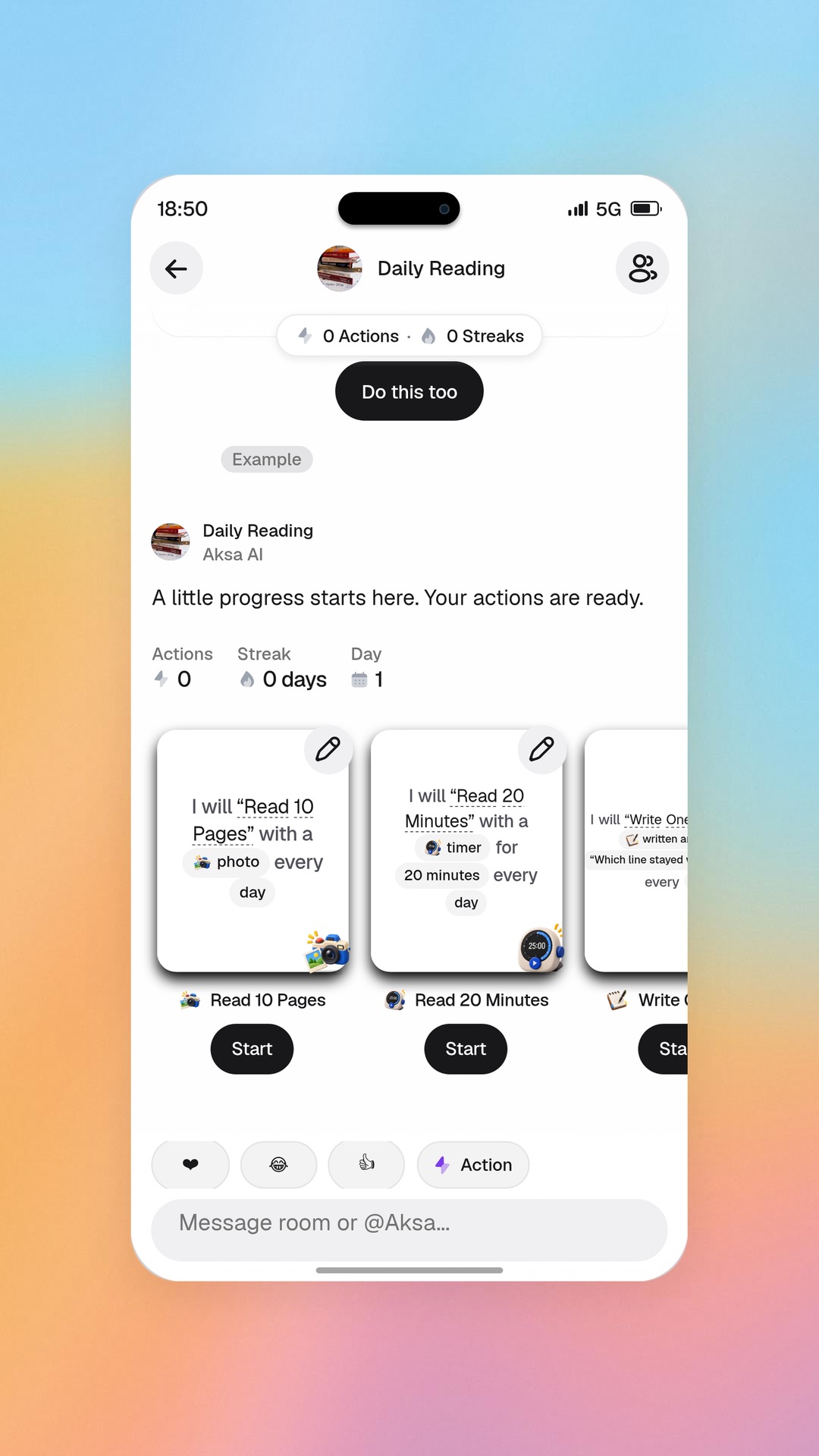
Aksa is a social platform with an AI agent built for exactly this container: daily actions in six proof formats, streaks that count only proof-backed days, rooms for witnesses, an agent that nudges on stalls, and leaderboards that reset Mondays 00:00 UTC.
This guide is the complete design: why thirty days, the five parts, a day-by-day arc of what to expect, and the mistakes that end most challenges around day twelve.
Why thirty days works
Long enough: thirty days of a daily action is a real chain - enough repetitions for the behavior to start feeling like identity ('I am someone who writes daily') rather than effort. Seven-day challenges end before the shift; ninety-day ones feel endless at the start.
Short enough: the finish line stays visible from day one. 'I can do anything for thirty days' is true for almost any reasonable action, and that belief is the engine - a challenge you believe you can finish is one you start properly.
And stackable: the month is the right unit for sequencing. January's movement challenge becomes February's writing challenge, with the January habit now running on its established floor. Year-long change, assembled in monthly pieces.
Part 1: One action, with a floor
The challenge is one action - not three, not a morning routine stack, one. 'Write daily,' 'move thirty minutes,' 'no sugar.' Multi-action challenges multiply dropout risk; the month is long enough that every additional action finds a day to break.
The floor is the minimum version that always counts: one paragraph, ten minutes, the binary kept. Size it for the worst day of the month - the sick, traveling, twelve-hour-workday day - because that day is in the thirty somewhere.
Write both numbers down: the floor (always counts) and the standard (what a normal day looks like). The floor saves the chain on day nineteen; the standard makes normal days meaningful.
Part 2: Proof under a minute
Every day of the thirty must end with an artifact: the photo of the finished page, the timer session, the counter at target, the written answer, the confirmation. Aksa's six formats cover every challenge shape - pick one and hold it for the month.
The budget is one minute. A proof ritual that takes longer dies on the first exhausting day, and an unproven day breaks the chain even when the work happened - the record is the challenge.
Accept the honest labels: hand counts are unverified, device totals are device-reported and never tamper-proof, and weak evidence is never upgraded into verified proof. A thirty-day record you believe is the actual prize.
Part 3: The visible chain
The chain is the challenge's spine: Aksa streaks move only on proof-backed days, so the number always measures real days. Protecting the chain and doing the work become the same action - the alignment that makes streaks useful instead of corruptible.
Watch the heatmap, not the day: the consistency heatmap shows the month's pattern at a glance - the green wall you are building, the weekends that keep failing, the drift before the collapse.
The three-month Photo Calendar on the profile is the long-game surface: your daily proof photos as a gallery. Thirty days of visible artifacts is the rare productivity artifact that is also genuinely satisfying to look at.
Part 4: Witnesses
Solo thirty-day challenges fail at the same place private trackers do: nobody sees the skip. One witness changes the month - a friend, a partner, or a room running the same challenge.
An Aksa Action Room is the strongest version: shared task list, everyone's proofs in the feed, a member heatmap, reactions built in. In in a company database pull from late September 2026, 36% of proofs received a social response - visible work draws reactions often enough to keep every day warm.
Same-challenge beats mixed-goals for rooms: when everyone posts the same daily proof, comparison is fair and the standard is shared. Five to fifteen people; bigger groups split by level.
Part 5: The weekly reset
Thirty days contains four or five weeks, and one of them will be bad - illness, travel, a work crunch. The design question is whether a bad week ends the challenge or just ends the week.
Aksa's Weekly Arena resets leaderboards every Monday at 00:00 UTC: the week you missed four days closes, and Monday starts everyone at zero. The chain's streak stays honest (a break is recorded), while the competitive board forgives - both, deliberately.
Use the reset ritually: Sunday evening, ten minutes, heatmap open. What failed, what is the floor adjustment, what does next week need. The challenge is won in these reviews, not in the heroic days.
The month, day by day: what to expect
Days 1-3: novelty carries everything. Proof feels fun, the room is loud, the chain is easy. Enjoy it, but do not mistake it for the system - it ends.
Days 4-14: the dip. Novelty is gone, identity has not arrived, and the first miss usually lands here. This is where the floor and the witnesses earn their keep: floor action on the bad day, room reactions on the comeback proof. Most challenges die in this window; yours will not, because you expect it.
Days 15-25: the groove. The action starts feeling like 'just what I do.' The streak has mass; the heatmap is mostly green; the risk shifts to complacency - hold the standard at reviews.
Days 26-30: the finish. Decide the verdict in advance: what counts as completing the challenge, and what the next month's challenge is. Ending well - with a review and a sequel - is what turns one good month into a system.
Mistakes that end challenges around day twelve
No floor: the all-or-nothing day arrives, the full version is impossible, and 'zero' feels closer to 'all' than a humble floor would have. One floor-sized day saves the chain.
Mourning the first miss: the streak breaks, and the misser takes three days 'to recover' - converting one gap into four. The rule: a miss ends the count, never the practice; restart at the floor the next morning.
Quiet quitting: stopping without saying anything, in a room that notices but says nothing. The room's job is one message ('everything okay?'); your job is answering honestly. Silence is the only unrecoverable failure.
Setup checklist
- One action for the month - with the floor and the standard both written down.
- One proof format, under a minute, chosen before day one.
- Streak and heatmap visible - the chain is the spine.
- One witness minimum; a same-challenge room of five to fifteen is best.
- Sunday review ritual: ten minutes, heatmap open, floor adjustment.
- The day-30 verdict and sequel decided before the finish arrives.
FAQ
How do I do a 30-day challenge?
Five parts: one daily action with a bad-day floor, proof under a minute (photo, timer, counter, answer or confirm), a visible chain (streak and heatmap), at least one witness, and a weekly reset. Expect the day 4-14 dip - that is where the floor and the room earn their keep.
What is the best app for a 30-day challenge?
Look for: proof-backed streaks (not checkboxes), six evidence formats, rooms with a shared heatmap and reactions, an agent that nudges on stalls, and a weekly leaderboard reset. Aksa combines all five - a social platform with an AI agent, free on iOS and Android.
Are 30-day challenges effective?
As containers, yes: thirty days is long enough to build a real chain and short enough to see the finish. The design decides the outcome - challenges with a floor, cheap proof and witnesses survive the day 4-14 dip; willpower-only ones die there. End with a review and a sequel to convert the month into a system.
What happens if I miss a day in a 30-day challenge?
Record it honestly and restart at the floor the next morning. The streak breaks by the rules - that honesty is what keeps the record valuable - while the weekly leaderboard reset (Mondays 00:00 UTC) forgives the week structurally. The rule: a miss ends the count, never the practice.
What are good 30-day challenge ideas?
Anything daily and provable: thirty minutes of movement (photo or timer), one page of writing (photo), twenty minutes of language practice (timer plus answer), fifty push-ups (counter), no sugar (confirm), one chapter read (photo plus two-sentence answer). One challenge, one action - always.
Should I do a 30-day challenge solo or with friends?
With witnesses if you can: solo challenges fail where private trackers fail - nobody sees the skip. A same-challenge room of five to fifteen keeps the standard shared and comparison fair. If solo, make the record visible to at least one person - the audience is the mechanism.
How do I stay motivated for 30 days?
Do not rely on motivation - rely on the structure: the floor for bad days, the streak for daily pressure, the room for witnesses, the Sunday review for adjustments, and the Monday reset for bad weeks. Motivation shows up for the first three days; the system covers the other twenty-seven.
What should I do after the 30 days end?
Run the day-30 review: count proof-backed days, read the heatmap's pattern, decide keep-adjust-stop. Then either lock the habit at its floor (it now runs cheaply) and start the next month's challenge, or raise the standard and rerun. Ending deliberately is what turns one good month into a year that looks different.