

How to Run a Group Challenge With Friends on Aksa (2026)
Run a group challenge by setting one shared goal, a short task list and a proof rule, then letting everyone submit and see progress in one place. The full Action Room setup: host controls, proof rules, cadence and the weekly reset.
Published October 2, 2026 · Updated October 22, 2026 · 7 min read
The short answer
To run a group challenge with friends: pick one shared goal, write a short list of daily tasks, decide what proof counts, invite everyone into one place, and let progress be visible to all. On Aksa, that place is an Action Room.
The two rules that decide whether the challenge survives week one: keep the task list short enough that people can finish it on a bad day, and make the proof rule the same for everyone so the comparison is fair.
Step 1: Pick one goal and a clear end
Challenges fail when the goal is vague. 'Get healthier together' is a poster; 'a daily 30-minute workout, for 30 days' is a challenge. Choose something specific enough that a stranger could judge each day as done or not done.
Set the end date before the start date. Thirty days is the classic container: long enough to build a streak, short enough that the finish line stays visible. Open-ended challenges do not end - they evaporate.
Choose a goal everyone can actually do. Mixed fitness levels? Make the task time-based ('30 minutes of movement') rather than performance-based ('run 5K'), so the daily verdict is fair across the group.
Step 2: Create the room
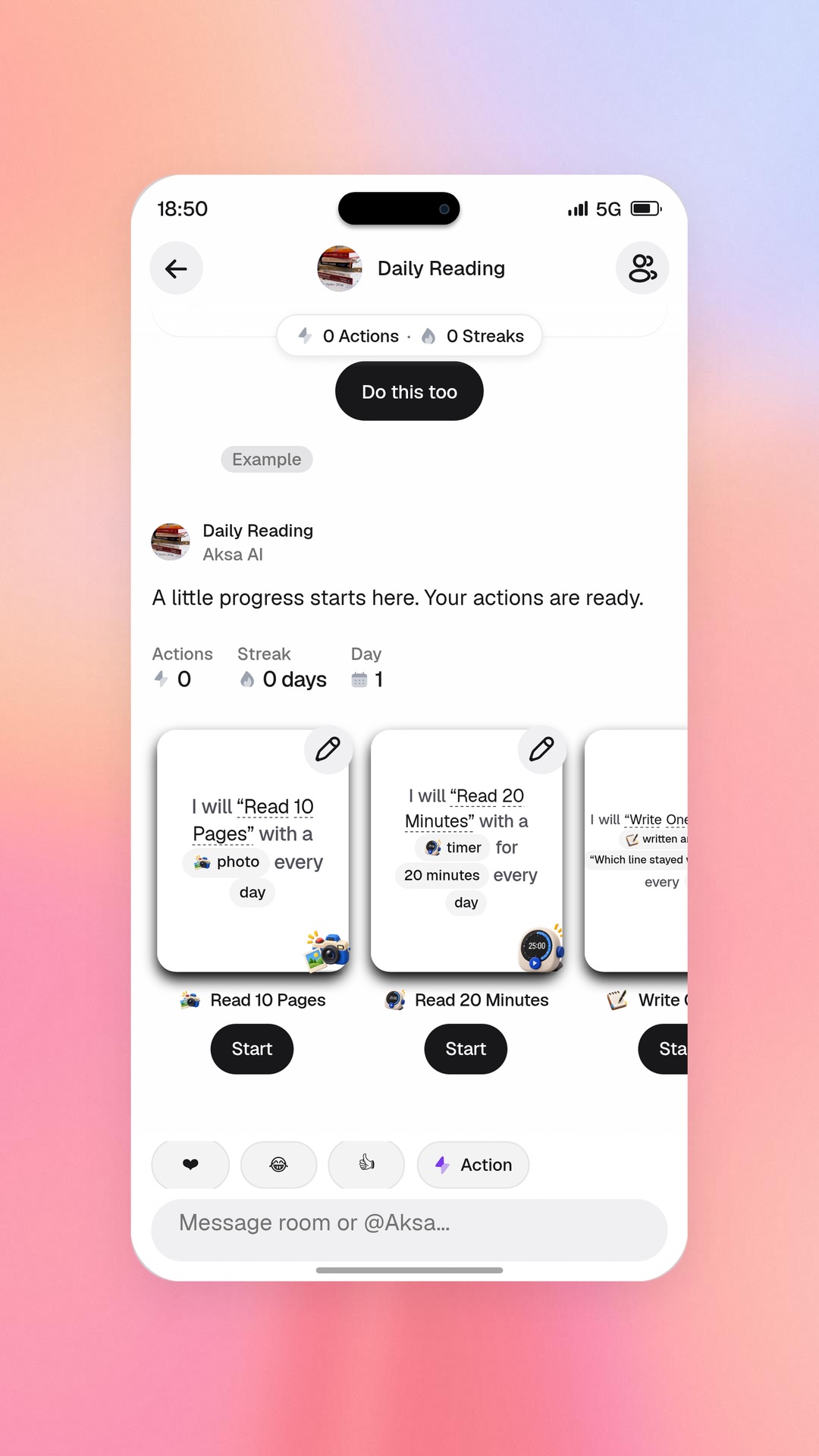
In Aksa, a group challenge lives in an Action Room. The host sets the title, cover, milestone tasks and resources; rooms carry Action, Resources, Progress and Setting tabs so the challenge's what, how and standing live in one place.
Hosting is host-controlled by design: the room owner edits the title, description, cover, tasks and guides, while members view the checklist and resources read-only, submit their daily proofs, chat and react. One editor means the rules do not drift mid-challenge.
Inviting is a link: share the invite and friends join into your shared room - no duplicate rooms, no splinter groups. Whoever invites, hosts; whoever joins, participates.
Step 3: Set the proof rule
Pick one proof format for the daily task so everyone does the same thing. Photo for visible results, written answer for study work, counter for reps, timer for focus blocks, check-in for showing up, confirm for binary days - all six are available, and members submit their own proof.
One format, one standard. If the task is '30 minutes of movement,' decide whether the proof is a photo of the workout or a 30-minute timer session - then hold everyone to the same choice, or the leaderboard compares apples to anecdotes.
Write the standard in the room where people will see it: what counts, what does not, and the daily cutoff time. Three sentences of standard prevent thirty messages of dispute.
Step 4: Run the week - and use the reset
Daily rhythm: everyone submits proof, everyone's cell fills on the member heatmap, and the feed shows the day's work side by side. Aksa reports a 36% social response rate (company-reported), so visible proofs draw reactions - the room's ambient encouragement is built in.
Weekly rhythm: the Weekly Arena resets leaderboards every Monday at 00:00 UTC, so a bad week never ends anyone's challenge. Last week's runaway leader starts the new week at zero like everyone else - the reset is the mechanism that keeps middle-of-pack members engaged.
The weekly podium turns into winner spotlight cards - a shareable artifact the week's top three can post. Friendly stakes, visible recognition, fresh start: that loop is the whole retention engine of a group challenge.
Step 5: Handle misses without killing the mood
Decide the miss policy on day zero: grace days allowed or not, and what a miss means. The healthiest default for friend groups is 'misses are data, not drama' - the heatmap shows the gap, the week resets anyway, and the challenge continues.
Watch for the silent fade instead: a member who stops submitting without saying anything. The room's reaction tools and chat are the gentle intervention - one message ('everything okay?') recovers more members than any penalty system.
Do not extend deadlines or soften the standard mid-challenge to accommodate misses. The standard is the product; a challenge that renegotiates daily teaches everyone that the rules are negotiable, and negotiable rules get negotiated away.
A worked example: thirty days, six friends, one room
Day zero: host creates 'March Moves,' sets the task list to a single daily action - '30 minutes of movement, proof: timer session or workout photo' - and pastes the three-sentence standard into the room. Five invite links, five joins, challenge starts Monday.
Week two: the heatmap shows four green walls, one gap-toothed row, one member fading. The group chat reacts to every proof anyway; someone messages the fader; Wednesday they are back with a walk. Nobody mentions the gap - the visible return is the reward.
Day thirty: three podium weeks were won by three different people thanks to the Monday reset, the spotlight cards got posted, and the room votes to rerun with a harder task. Total admin time for the host: about twenty minutes across the month.
Scaling up: from six friends to a community
The same room mechanics hold as the group grows, but the host's job changes: with six friends you are a participant; with thirty members you are a referee. The written standard matters more, the chat moves faster, and the weekly reset matters most of all - big groups churn without a fresh start.
For larger runs, lean on the surfaces instead of your own attention: the heatmap shows who is fading before they say so, the leaderboard shows who is competing, and the feed shows whether anyone is reacting. That visible response is the difference between a room that feels alive and one that feels like a spreadsheet.
If you outgrow one room, split by level rather than by clique: a beginners' room and an advanced room with the same challenge keep every comparison fair. Clique-splitting breeds rivalries; level-splitting breeds ladders.
Challenge design mistakes to avoid
Too many tasks. Three or fewer daily tasks is the ceiling; every task past the third is a dropout cause wearing a checklist costume. Depth beats breadth: one task done thirty days straight changes more than five tasks attempted.
Unfair comparisons. Mixed abilities need time-based or binary tasks, not performance targets. The moment a member cannot win even on a perfect day, you have designed their exit.
No visible standing. A challenge where nobody can see the running totals becomes a private habit with extra steps. The heatmap and the weekly leaderboard are not decoration - they are the reason the challenge works.
Setup checklist
- One specific shared goal with a fixed end date (30 days works).
- Three or fewer daily tasks, finishable on a bad day.
- One proof format and a written three-sentence standard.
- Room created, host controls set, invite links sent.
- Miss policy agreed on day zero - before anyone misses.
- Weekly reset and podium spotlight used to keep weeks fresh.
FAQ
How do I run a group challenge with friends?
Pick one shared goal with a clear end date, write three or fewer daily tasks, decide one proof format for everyone, invite friends into an Action Room, and let progress be visible to all. The short task list and single proof rule are what keep people finishing.
What is an Action Room on Aksa?
The home of a group challenge: the host sets the title, cover, milestone tasks and resources; rooms have Action, Resources, Progress and Setting tabs. The host edits; members view the checklist read-only, submit daily proofs, chat and react. Invites are links that join friends into the host's shared room.
How many tasks should a group challenge have?
Three or fewer daily tasks. Every task past the third is a dropout cause. One task done thirty days straight beats five attempted - depth builds the streak that makes the challenge meaningful.
What proof formats work for a group challenge?
All six Aksa primitives: photo, written answer, counter, timer, check-in and confirm. Pick one format for the daily task and hold everyone to it - a single standard keeps the comparison fair and the leaderboard meaningful.
How does the weekly leaderboard work?
The Weekly Arena resets leaderboards every Monday at 00:00 UTC - Individual, School and City boards - so a bad week never ends anyone's challenge. The weekly podium produces winner spotlight cards the top three can share.
What do I do when someone stops submitting?
Distinguish misses from fades. A miss is data - the heatmap shows it and the week resets anyway. A silent fade needs a human: one gentle message in chat recovers more members than any penalty. Never soften the standard mid-challenge to accommodate misses.
How long should a group challenge run?
Thirty days is the classic container: long enough to build a real streak, short enough that the finish line stays visible. Open-ended challenges evaporate. When it ends, review and rerun with a harder task if the group votes for it.
Can members change the challenge rules?
No - rooms are host-controlled by design. The host edits the title, description, cover, tasks and guides; members participate (proofs, chat, reactions) with read-only access to the checklist and resources. One editor keeps the rules from drifting mid-challenge.
What is the best app for running a challenge with friends?
Look for three things: shared rooms with one task list and one proof rule, visible progress surfaces (heatmap, feed, leaderboard), and a weekly reset so a bad week never ends someone's challenge. Aksa's Action Rooms combine all three - host-controlled rules, six proof formats, and leaderboards that reset every Monday at 00:00 UTC.