

How to Turn a Goal Into Daily Actions (2026 Method)
A goal becomes doable when you split it into small daily actions with clear proof. The four-step method - outcome, action, proof, repeat - with real examples and how Aksa's six action formats map to any goal.
Published October 2, 2026 · Updated October 22, 2026 · 7 min read
The method in one line
To turn a goal into daily actions: write the result you want, pick one small action that moves toward it, decide how you will show it is done, and repeat it every day. The action should be small enough to finish today.
That is the entire method - four moves. Everything else in this guide is about doing the four moves well, because each has one classic failure: vague outcomes, oversized actions, after-the-fact proof, and broken repetition.
Step 1: Write the outcome so a stranger could judge it
State what will be true when the goal is done, specifically enough that someone else could tell whether it happened. 'Get fit' fails the test; 'run 10K without stopping' passes. 'Learn Spanish' fails; 'hold a ten-minute conversation with a native speaker' passes.
The stranger test is not pedantry - it is the foundation of every later step. A provable outcome decomposes into provable actions; a vague outcome decomposes into vibes, and vibes do not survive February.
If you cannot write the outcome provably, you do not have a goal yet - you have a direction. Directions are fine for orientation; goals are what get daily actions. Convert first: 'get fit' plus a deadline plus a measurement equals 'run 10K by June 1.'
Step 2: Pick the daily action - the smallest one that moves it
Choose the smallest action that clearly moves the goal forward, done daily. Small is a feature: the daily action must survive your worst day - tired, traveling, busy - because the chain of days is the actual product you are building.
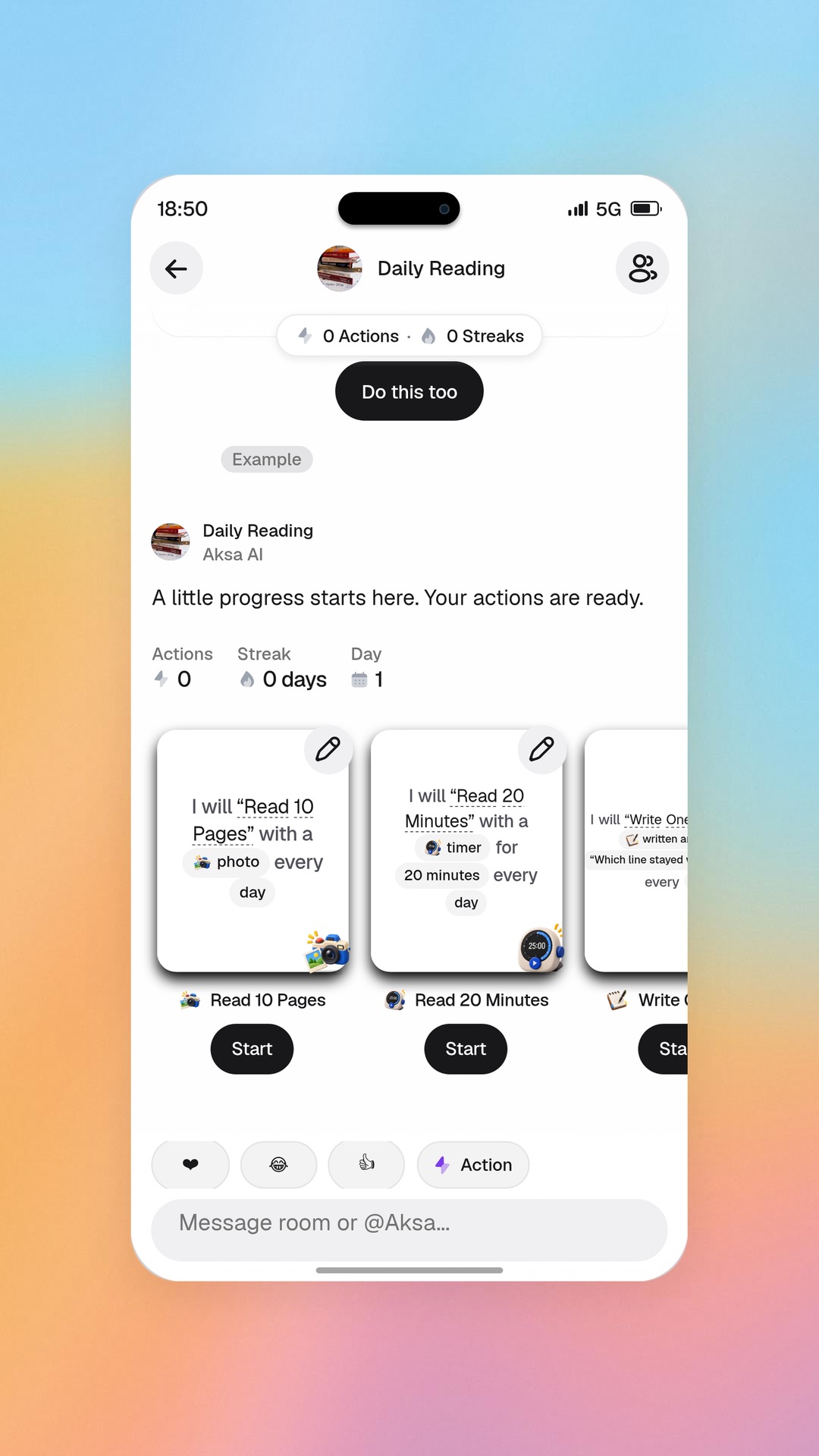
In Aksa, a daily action maps to one of six formats, which forces the action to be concrete. The mapping is the discipline: if you cannot say which format the action uses, the action is not specific enough yet.
One action per goal to start. Multi-action days are where ambitious plans go to die; earn the second action with thirty days of the first. Depth compounds; breadth evaporates.
The six formats - and what a good action looks like in each
Every daily action on Aksa uses one of six proof formats. The chooser:
- Submit (photo) - 'a photo of today's finished page' - show a visible result.
- Answer (written) - 'three sentences summarizing the chapter' - show thinking.
- Counter - '50 push-ups, target set' - show a repeatable quantity.
- Timer - 'one 25-minute study block' - show bounded focus time.
- Check-in - 'arrived at the gym' - show presence, no location tracking.
- Confirm - 'no sugar today, yes or no' - show a binary day, including avoidance.
Step 3: Decide the proof before the day starts
Pick the evidence in advance so you do not negotiate with yourself at 11 PM. 'Photo of the page' decided at 8 AM is a standard; 'I will know if I did it' decided at 11 PM is a loophole.
Match the proof to the action's shape, and accept the honest label that comes with it. A hand-entered count is labeled unverified; device-read totals are device-reported, never tamper-proof; a confirmation is your word. The label is information, not insult - it keeps the record believable.
Keep the proof cheap: under a minute, or it will be skipped on exactly the days the streak most needs it. The best proof is the one you will actually give on day 47 in the rain.
Step 4: Repeat - and manage the chain, not the mood
Repetition is where goals actually happen, and the management target is the chain of days, not your daily enthusiasm. Moods fluctuate; the chain just needs one proof per day.
Use the surfaces: the heatmap shows the chain's health at a glance, the streak counts the proof-backed days, and a room adds witnesses who make skipping visible. Aksa reports a 36% social response rate, so visible work draws reactions that keep the loop warm.
Review weekly, adjust monthly. The weekly question is 'did the action happen?' - if not, shrink it. The monthly question is 'is the outcome closer?' - if not, change the action. Never confuse the two questions; shrinking and changing are different surgeries.
Worked example: 'run 10K by June 1' becomes a Tuesday
Outcome: run 10K without stopping by June 1 - provable, dated, stranger-judgeable. Daily action: 'run, minimum ten minutes, proof: photo of the watch or treadmill display.' Floor sized for the worst day; normal days run long.
Weekly review in week three: action happened six of seven days - good; outcome check says pace is behind plan - so the action changes shape, not size: 'ten minutes minimum, one tempo interval on weekdays.' Same floor, better direction.
By June: the chain is 100+ days, the 10K happens on a random Thursday morning, and the proof is one more photo in a feed full of them. That is the method's signature ending - the goal arrives as a routine day, not a dramatic finale.
From one chain to a system
After the first chain holds for a month, the method scales by addition, not multiplication. Add the second goal with its own floor and its own proof - but stagger the start so the new chain's fragile first weeks do not coincide with a hard patch in the old one.
Two chains is the practical ceiling for most people; three is a part-time job. The constraint is not time but attention: every chain needs its daily proof, its weekly review and its place in your head. Better two chains at 300 days than four that died in March.
The endgame is a portfolio: a health chain, a craft chain, maybe a relationship chain - each with a floor so small that even your worst day satisfies all three. At that point the goals stop being projects and start being identity, which is where decomposition was always headed.
The four classic failures and their fixes
Vague outcome: 'get healthier.' Fix: add a measurement and a date until a stranger could judge it. No provable outcome, no daily actions worth the name.
Oversized action: 'study two hours daily' from a standing start. Fix: shrink to the bad-day floor - 25 minutes, one block - and earn size with the chain.
After-the-fact proof: deciding at night whether the day 'counted.' Fix: name the evidence in the morning; the day is judged by the standard, not the mood.
Broken repetition: three misses and quiet abandonment. Fix: witnesses - a room, a partner - plus a weekly review that shrinks the action instead of mourning the miss.
FAQ
How do I turn a goal into daily actions?
Four steps: write the outcome specifically enough that a stranger could judge it; pick the smallest daily action that clearly moves it; decide the proof before the day starts; repeat daily and manage the chain. The action must be small enough to finish on your worst day.
What makes a good daily action?
Small, provable and singular. Small enough to survive a bad day; provable with one of the six formats (photo, answer, counter, timer, check-in, confirm); one action per goal to start. If you cannot name the proof format, the action is not specific enough yet.
How small should the daily action be?
Sized for your worst day, not your best: ten minutes, one page, one block. The chain of unbroken days is the product - size is earned at weekly reviews after the routine stabilizes, typically after three to four weeks of not missing.
How do I choose the proof for a daily action?
Match the action's shape: photo for visible results, written answer for thinking, counter for repetitions, timer for focus blocks, check-in for presence, confirm for binary days. Decide the evidence in the morning, keep it under a minute, and accept the honest strength label it carries.
What if my daily action keeps failing?
Shrink it - a failing action is too big, full stop. Halve it until the chain holds, then grow at reviews. Also check the witness layer: a solo failing action often stabilizes the week it moves into a room where misses are visible. Do not redesign the goal at the same time - one variable per week, or you will not know which change worked.
How many goals should I decompose at once?
One, with one daily action. Every parallel goal halves the chance either survives month one. Sequence them: install the first chain, stabilize it at the floor, then add the second. People who run three chains started them three months apart.
How is this different from a to-do list?
A to-do list holds tasks; this method builds a chain. The daily action repeats with proof, the streak counts proof-backed days, and the heatmap shows the pattern - the unit is not the task but the unbroken series of evidenced days moving one outcome closer.
Does the AI agent help with decomposition?
Yes - Aksa is a social platform with an AI agent, and the agent helps decompose a goal into daily actions at setup, then notices stalls later and nudges with one concrete next step. The four-step method here is exactly what the agent walks you through.
What do I do at the weekly review?
Two questions, kept separate: 'Did the action happen?' - if not, shrink it. 'Is the outcome closer?' - if not, change the action's direction, not its size. Ten minutes, same time each week, decisions written down. The review is where the method's intelligence lives; the days are just execution.