

How to Prove You Did a Task: 6 Proof Types That Work (2026)
Prove a task with a photo, a written answer, a count, a timer, a presence check or a confirmation. Which proof fits which task, what each one actually shows, and how Aksa's six proof primitives keep the record honest.
Published October 2, 2026 · Updated October 22, 2026 · 7 min read
The short answer
You prove a task by leaving evidence someone else could check: a photo, a written answer, a count, a timed session, a presence check, or a simple yes-or-no confirmation. The best proof fits the task and is cheap enough to give every single time.
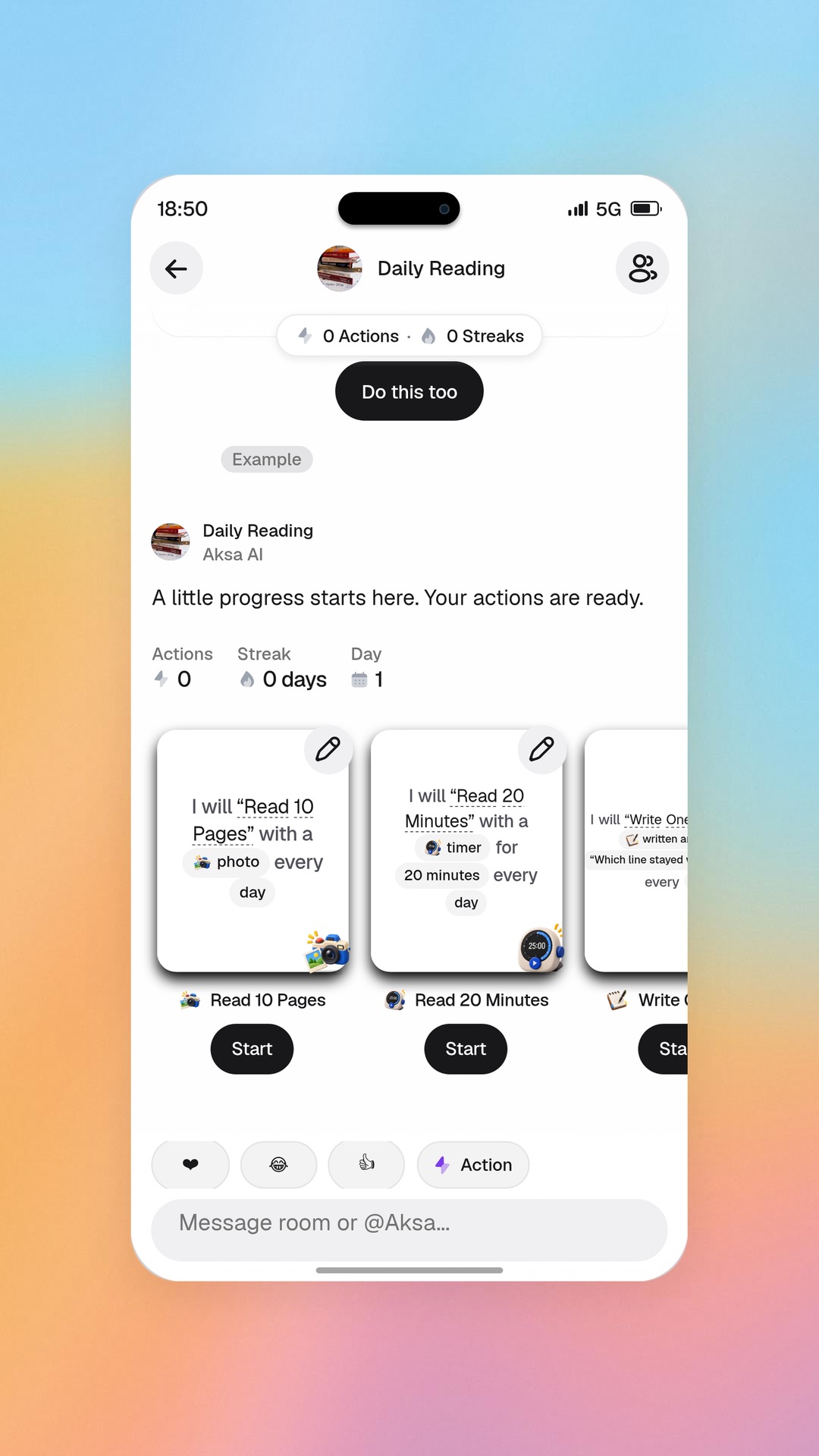
Aksa builds these six in as proof primitives: camera or gallery photo, text answer, counter, countdown or stopwatch timer, check-in without location, and confirm - including peer confirmation. Each carries an honest label about its strength, because a record that admits its limits is a record you can trust.
Photo proof: when the result can be seen
Use a photo when the work leaves something visible: a cooked meal, a tidy desk, a finished page, the run route on your watch. The rule of thumb is simple - if another person could glance at the result and nod, a photo is your proof.
In Aksa, Submit takes a live camera photo or a gallery upload. The live capture matters for strength: a photo taken in the moment is harder to fake than a curated upload, and the record says which it was.
Keep the photo informative, not pretty. The finished page with your handwriting, the pan with the actual food - proof is evidence, not content. One clear frame beats five flattering ones.
Written proof: for thinking and learning
Use a written answer when the work happened in your head: a summary of the chapter, the decision you made and why, tomorrow's plan. Aksa's Answer format takes a text response to a prompt or a daily reflection.
Written proof has a hidden second benefit: writing the answer is itself part of the work. Summarizing chapter 4 in three sentences forces the understanding that passive reading skips - the proof doubles as the study method.
Keep it concrete and short. 'Outlined the argument's three premises and flagged the weak second one' is evidence. 'Good session, feeling motivated' is weather.
Count proof: for anything repeatable
Use a count when the day reduces to a number: 50 push-ups, 8 glasses of water, 20 sales calls. A count without a target is trivia, so set the target first - at or past it, the day counts.
Hand counting is labeled unverified - an honesty marker, not an accusation. Where manual counting is weak, like steps, the counter can work with a consented, read-only daily total from Apple Health or Health Connect (arriving with the 1.2 update behind a feature flag), labeled device-reported and never tamper-proof.
Counts shine over weeks: the number itself is forgettable, but the trend on the heatmap - fifty days at target - is the kind of record that ends arguments with yourself.
Timer proof: for bounded focus
Use the timer when the work is time-in-seat: a 25-minute study block, an hour of practice, a writing session. Aksa's Timer runs countdown and stopwatch sessions, with a screen rule you choose - keep the screen awake, or background and hide the clock.
The record shows a bounded session that started and ended properly - with a deliberate confirm step if you finish early. What it does not claim: that you were brilliant inside the block. That is what the written answer afterward is for.
Optional consented app-usage totals from the operating system can add device-reported evidence (1.2, flag-gated) - labeled, never tamper-proof. App blocking is a separate focus aid under exploration, and Aksa is explicit: enforcement is not evidence.
Check-in and confirm: presence and binaries
Use check-in when the task is showing up: arrived at the gym, attended the lecture, made the meeting. Aksa's check-in confirms presence without location tracking - the act of checking in is the record, not a GPS trail.
Use confirm for binary days: did the rule hold, yes or no. It covers positive binaries ('did I meditate?') and avoidance ones ('no sugar today') - and a confirm can be done as a peer confirmation, where a partner attests to the day.
Both are self-reports at base, labeled as such. Their strength comes from consistency plus witnesses: a ninety-day chain of daily confirmations in a room people actually watch is worth more than any single strong artifact.
A worked example: one goal, three proof types in a day
The goal is 'train for the 10K in ten weeks,' and Tuesday's plan has three actions. Morning: the run - proved with a photo of the watch face, live-captured at the park, distance and time visible. Midday: the strength work - 40 lunges and 30 squats on the counter, target set, hand-counted and labeled unverified because that is what it was.
Evening: the recovery routine nobody sees - ten minutes of stretching on the timer, countdown mode, screen backgrounded so the phone cannot interrupt. A one-line answer closes the day: 'legs heavy, pace steady, Thursday is rest.'
None of the three proofs is elaborate, and that is the point. Each was made in the moment, in under thirty seconds, labeled for exactly what it is - and ten weeks of Tuesdays like this one add up to a record that makes race day feel inevitable instead of hopeful.
Match the proof to the task: a chooser
Work backward from the task's shape - what exists when the work is done?
- Visible result (meal, page, workspace) - Photo, live camera for strength.
- Thinking or learning (chapter, decision, plan) - Written Answer, concrete and short.
- Repeatable quantity (reps, glasses, calls) - Counter with a target set first.
- Bounded focus block (study, practice, writing) - Timer, plus an answer after.
- Showing up somewhere (gym, class, meeting) - Check-in, no location tracking.
- Binary day (habit kept, avoidance held) - Confirm, peer confirmation for stakes.
- Mix across types? - One primary proof per action; add an answer for texture.
What makes proof strong - the four properties
Fitting: the proof matches the task's shape. A photo of an absence proves nothing; a confirmation of a quantity proves little. Mismatched proof is where fake progress hides.
Cheap: you can give it on your worst day. A proof ritual that takes ten minutes gets skipped exactly when the habit is most at risk. Thirty seconds is the right budget.
Honest: the record says how the evidence was made - live or uploaded, hand-counted or device-reported, self-confirmed or peer-confirmed. Aksa's boundary is that weak evidence is never upgraded into verified proof.
Witnessed: proof someone sees beats proof no one does. In a room, every proof lands on a feed and a heatmap - and the company reports a 36% social response rate, so visible work draws reactions.
Common mistakes that weaken proof
Proving the intention instead of the task. A photo of your running shoes is not a run; a photo of the treadmill display after is. Proof describes the world after the work, never before.
Batching proofs at night. Evening reconstruction rounds up and blurs - record in the moment or accept that you are writing fiction. The whole value of the record is that it was made when the work was.
Over-proving easy days and under-proving hard ones. The hard days are the record's spine: a photo taken when you almost skipped is worth ten from a motivated Monday. Prove the days you did not want to.
FAQ
How do I prove I did a task?
Leave evidence someone else could check, matched to the task's shape: a photo for visible results, a written answer for thinking work, a count for repetitions, a timer for focus blocks, a check-in for showing up, or a confirmation for binary days. The best proof is the one cheap enough to give every time.
What are Aksa's six proof types?
Camera or gallery photo, text answer, counter, countdown or stopwatch timer, check-in without location, and confirm - including peer confirmation. Each proof carries an honest label: hand counts are unverified, device-read totals are device-reported, and no consumer signal is called tamper-proof.
Which proof type is the strongest?
The one that fits the task - strength comes from fit, honesty and witnesses, not from format. A live-captured photo of a visible result is strong; a ninety-day chain of witnessed confirmations is strong; a mismatched 'strong' format (photographing an absence) is weak. Aksa never upgrades weak evidence into verified proof.
Is a photo enough proof that I did the work?
For visible results, usually - especially live-captured in the moment. For time-based or thinking work, a photo alone under-proves: pair a timer session with a one-paragraph written answer and the record shows both the block and what it produced.
Can proof be faked, and how does Aksa handle that?
Any consumer proof can be gamed, which is why Aksa labels evidence strength instead of pretending otherwise: unverified hand counts, device-reported (never tamper-proof) health reads, live versus uploaded photos, self versus peer confirmations. The design goal is a record that admits its limits - those are the records people trust.
How do I prove an avoidance goal, like no sugar?
With a daily yes-or-no confirmation - absences cannot be photographed. Confirm each day honestly, add a one-line written note on hard days, and put the goal where a room or a peer can see the streak. The witness, not an artifact, is what strengthens absence-based proof.
What is peer confirmation?
A confirm done with a specific partner who attests to your day - two people's words instead of one. It is the strongest option for high-stakes quits and commitments, and the daily contact with the partner is often the real intervention.
Why not just use a regular habit checklist?
A checklist records what you intended to report; proof records what someone could check. The difference compounds: weeks of checkable evidence build a record you can review, share and compete on - weeks of taps build a streak even you quietly doubt.