Fitness Challenge App for Friends: Run One That Lasts (2026)
A fitness challenge app for friends needs one shared goal, one proof rule, a visible leaderboard and a weekly reset. How to run a 30-day challenge that survives week two - setup, proof formats and fair design.
Published October 23, 2026 · 7 min read
The short answer
To run a fitness challenge with friends that lasts: pick one goal everyone can do daily, set one proof format so comparison is fair, put everyone in one room where progress is visible, and use a weekly reset so a bad week never eliminates anyone. Thirty days is the right container.
Aksa is a social platform with an AI agent built for exactly this: Action Rooms with a shared task list, six proof formats, a member heatmap, reactions, and leaderboards that reset every Monday at 00:00 UTC.
This guide is the full playbook: design, setup, the week-two survival plan, and the mistakes that kill most challenges.
The recipe below comes from the mechanics that actually keep groups alive: fairness across fitness levels, proof cheap enough for bad days, and a scoreboard that restarts before the bottom third quits. Every step is doable in under an hour of total setup.
Why most friend challenges die in week two
Week one runs on novelty; week two runs on design. The classic killers: a goal only the fittest member can sustain ('run 5K daily' when two members are beginners), proof that is too annoying to submit, and a scoreboard where the leader is already uncatchable.
The dropout pattern is always the same: the bottom third realizes they cannot win, the middle realizes nobody would notice, and the top gets bored. Good challenge design defends all three groups at once.
The defenses: time-based or binary goals (fair across fitness levels), cheap proof (under a minute), and a weekly reset (the leaderboard restarts before the bottom third quits).
Step 1: Pick the goal - fair beats impressive
Choose something everyone in the group can do on their worst day: '30 minutes of movement daily' works for the marathoner and the beginner; 'run 5K daily' works for exactly one of them. Time-based and binary goals equalize; performance goals eliminate.
One goal, not five. A challenge with a workout goal, a water goal, a steps goal and a sleep goal is four dropout opportunities wearing a checklist costume. Depth beats breadth: one habit for thirty days changes more than five attempted for nine.
Set the container: thirty days, fixed end date, named at launch. Open-ended challenges do not end - they evaporate. The finish line is a feature.
Step 2: Set the proof rule - one format, one standard
Pick one proof format for the daily task and hold everyone to it. For movement challenges the practical choice is a photo (the watch face, the gym floor, the post-run view) or a timer session - both cheap, both hard to argue with.
Aksa's six formats cover the variants: counter for rep challenges (50 push-ups, target set), timer for time-based goals, photo for visible effort, confirm for binary days ('no rest day skipped'), check-in for showing up at the gym.
Write the three-sentence standard at launch: what counts, what does not, and the daily cutoff time. '30 minutes counts; stretching counts; the day ends at midnight local.' Three sentences prevent thirty messages of dispute.
Step 3: Set up the room
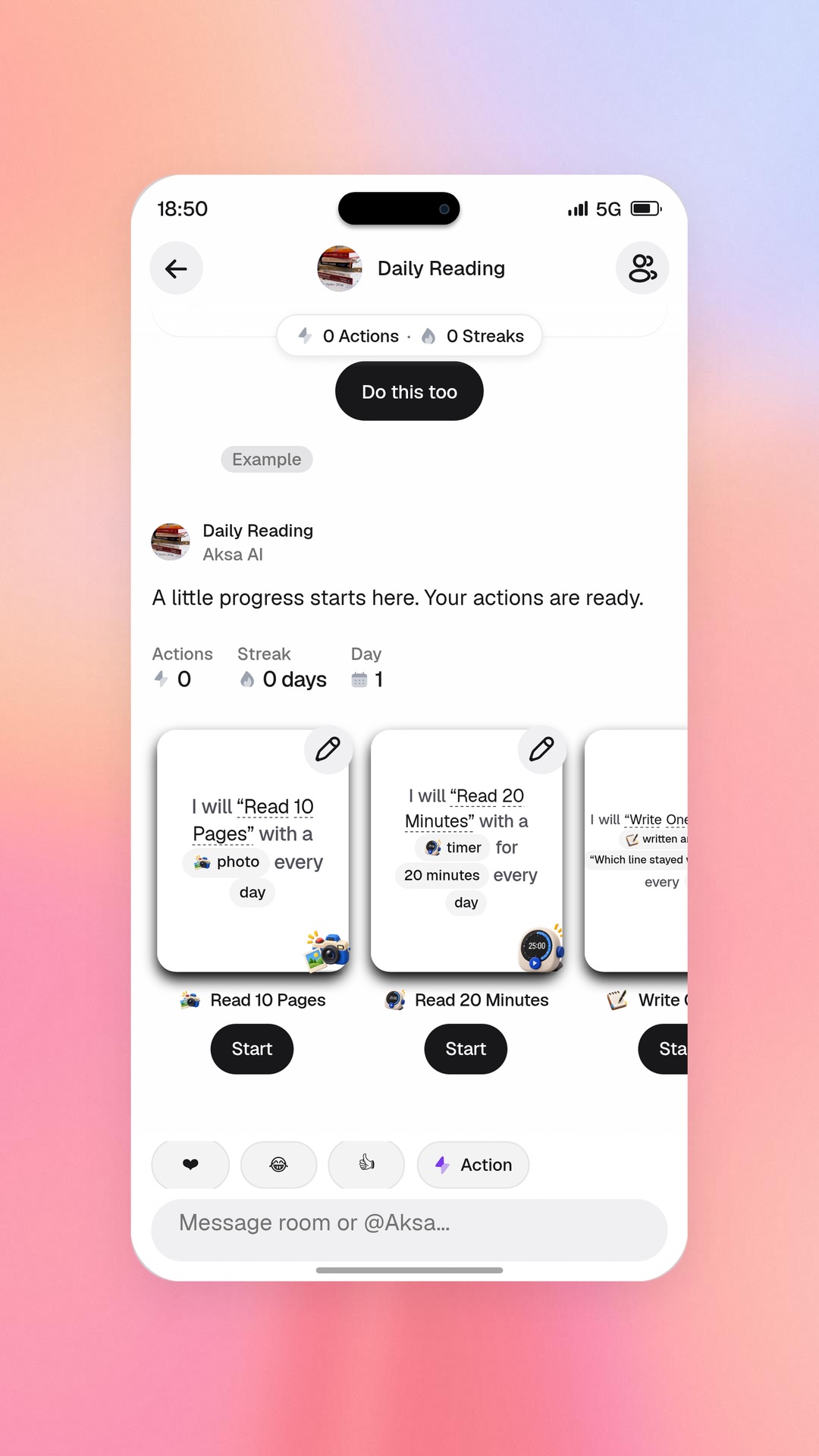
On Aksa, the challenge lives in an Action Room: the host sets the title, cover, milestone tasks and resources; members view the checklist, submit proofs, chat and react. Joining is an invite link - no duplicate rooms, no splinter groups.
Keep the room five to fifteen people. Below five the witness effect is thin; above fifteen it becomes a feed where nobody is individually missed. For a big friend group, split by level: beginners' room and advanced room, same challenge.
The host's job is ten minutes at launch and five minutes on Sundays: set the standard, watch the heatmap, welcome the Monday reset. Rooms are host-controlled by design, so the rules do not drift mid-challenge.
Step 4: Run the weekly rhythm
Daily: proofs land in the feed, cells fill on the member heatmap, reactions close the loop. In in a company database pull from late September 2026, 36% of proofs received a social response - visible workouts draw reactions, and that ambient noise is the challenge's heartbeat.
Weekly: the leaderboard resets every Monday at 00:00 UTC - the runner-up from last week starts level with the person who missed four days. The reset is the retention engine: it gives the bottom third a reason to show up on Monday.
The weekly podium produces winner spotlight cards the top three can share - friendly stakes, visible recognition, zero cost. Rotate wins across members and the challenge sells itself for month two.
Step 5: Handle misses, fades and sandbagging
Misses are data: the heatmap shows the gap, the streak ends by the rules, and the week resets anyway. The healthy room culture cheers comebacks louder than streaks - the return proof deserves the loudest reaction.
Fades need a human: a member who stops submitting without explanation gets one message ('everything okay?'), not a penalty. The room's chat is the recovery channel; most fades are one bad week plus embarrassment.
Sandbagging (suspiciously easy proofs) is handled by the standard, not the vote: if the proof rule is 'photo of the watch,' a photo of the couch does not count, and the host says so once, kindly, in week one - before it becomes a precedent.
A worked example: 'March Moves,' eight friends
Day zero: the host creates the room - '30 minutes of movement, proof: photo or timer, days end at midnight.' Eight invite links, eight joins, three-sentence standard posted. Two members are gym regulars; three have not trained since school.
Week two: the beginner who missed four days restarts after the Monday reset zeroes the board - because the reset made restarting rational. The regulars compete for the podium; the middle competes with their own heatmaps. Everyone has a game to win.
Day thirty: seven of eight finished. Three different members took podium weeks. The room votes to rerun at 40 minutes - the classic sign a challenge worked: it ends with a harder version of itself.
Design mistakes that kill challenges
Performance goals across mixed fitness levels: the beginner cannot win a perfect day, so they leave. Time-based or binary only.
No visible standing: if the running totals are not on a shared surface, the challenge is a private habit with extra steps. The heatmap and leaderboard are the point.
No reset: a 30-day cumulative board is decided by day ten. Weekly resets keep eight people racing instead of one person winning and seven people watching.
Too many habits: every added daily task multiplies dropout risk. One challenge, one habit, thirty days.
Setup checklist
- One fair goal: time-based or binary, doable on everyone's worst day.
- Thirty-day container with a fixed end date, named at launch.
- One proof format and a written three-sentence standard.
- Room of five to fifteen; split by level if the group is big.
- Host's Sunday five minutes: heatmap check, welcome the reset.
- Culture set early: comebacks cheered louder than streaks.
FAQ
What is the best fitness challenge app for friends?
Look for: shared rooms with one task list and one proof rule, a member heatmap, built-in reactions, a weekly leaderboard reset, and honest proof formats. Aksa's Action Rooms combine all five with an AI agent that plans daily actions - free to download on iOS and Android.
How do I run a 30-day fitness challenge with friends?
Five steps: pick one fair goal ('30 minutes of movement daily'), set one proof format with a written standard, create one room and send invite links, run the daily proof-and-reaction rhythm, and use the Monday 00:00 UTC leaderboard reset to keep the bottom third racing. End at thirty days and vote on a harder rerun.
What is a fair fitness challenge for mixed levels?
Time-based or binary goals: '30 minutes of movement' lets the marathoner and the beginner both win their day. Performance goals ('run 5K daily', '100 push-ups') eliminate the bottom third by design - save them for groups of matched athletes.
What proof works for a fitness challenge?
Photo of the watch face or gym floor, or a timer session - both cheap and hard to fake. For rep challenges use a counter with a target (hand counts are honestly labeled unverified on Aksa). One format for everyone: a single standard keeps the leaderboard meaningful.
How many people should join a fitness challenge?
Five to fifteen per room. Below five the witness effect is thin; above fifteen nobody is individually missed. For big groups, split by level into parallel rooms running the same challenge - ladders, not rivalries.
What do I do when someone stops posting?
Distinguish misses from fades: a miss is data (heatmap shows it, week resets); a fade needs one human message - 'everything okay?' - not a penalty. Most fades are one bad week plus embarrassment; a kind message and the Monday reset recover most members.
How do weekly resets work in fitness challenges?
On Aksa, leaderboards (Individual, School, City) reset every Monday at 00:00 UTC. Last week's runaway leader starts Monday at zero like everyone else - the reset keeps the middle and bottom racing instead of watching, and each week's podium earns shareable winner spotlight cards.
Can the challenge track steps or workouts automatically?
Aksa's counter can work with consented, read-only step totals from Apple Health or Health Connect (arriving with the 1.2 update behind a feature flag), labeled device-reported, never tamper-proof. For challenge purposes, the photo or timer proof remains the standard - simple and comparable across devices.
Is there a free fitness challenge app?
Aksa is free to download on iOS and Android with an optional Premium tier - rooms, heatmaps, proofs, reactions and the weekly reset are the core product. Each friend who joins through your invite and finishes onboarding earns one month of Premium for both of you, up to five friends.