

How to Do a Focus Session With Proof on Aksa (2026)
Run a focused work session on Aksa with the countdown or stopwatch Timer and leave proof it happened. Preset durations, screen rules, what the timer does and does not prove, and how to strengthen the record with a written answer.
Published October 2, 2026 · Updated October 22, 2026 · 7 min read
The short answer
To do a focus session with proof on Aksa: name one task, set the Timer for a fixed block, work without switching tasks, and record the finished session. The countdown and stopwatch are live today as one of Aksa's six proof primitives.
The strength of the record is stated honestly: elapsed time is tracked and early finishes are asked to be confirmed; optional device-usage evidence is labeled device-reported, never tamper-proof; manual completion stays available and unverified. A recorded session is a fact - that is the whole point.
This guide covers the full loop: choosing the task and block, running the session with the screen rule that fits, understanding exactly what the proof claims, and chaining sessions into a practice you can see on a chart weeks later.
Step 1: Pick one task and one block
Name the task before you start the clock. 'Study chapter 4' or 'draft the proposal section' - one task per block keeps the session honest, because a timer covering five tasks proves nothing about any of them.
Choose a block you can finish. Twenty-five minutes is the classic study block; Aksa's timer supports fixed countdowns and open-ended stopwatch sessions. The right length is the longest stretch you can genuinely hold - for most people starting out, that is shorter than they think, and it grows with practice.
Decide the finish condition too: 'session ends when the timer ends' is cleaner than 'session ends when I feel done.' Feelings end early; timers end on time.
Step 2: Run the session with the Aksa Timer
Start the timer before the work begins - not after you have settled in, before. During a session you choose a screen rule: keep the screen awake so the countdown is visible, or allow the app to go to the background and hide the timer so the clock stops being a distraction itself.
The timer tracks elapsed time through the session, and if you try to finish early it asks you to confirm. That confirm step matters more than it looks: it turns 'I stopped' into a deliberate decision instead of a drift, which is the difference between a session that ended and a session that evaporated.
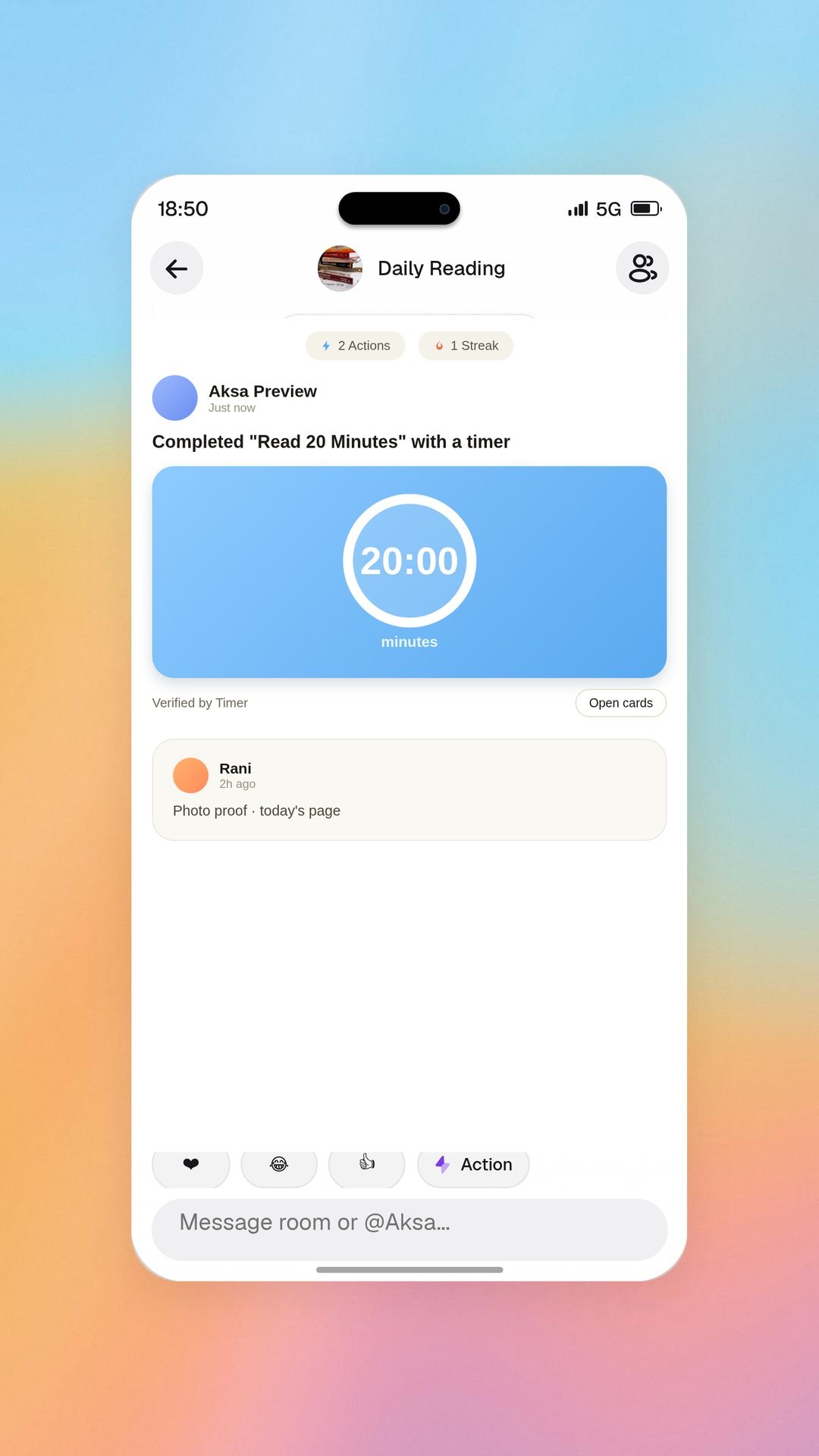
When the block completes, the session is recorded as proof for that action - duration, finish, timestamp - and lands in your room feed if you have one, or on your own record if the goal is solo.
Step 3: Know what the timer proves - and what it does not
Be clear about proof strength, because Aksa is. A finished timer session proves a bounded block of elapsed time with a declared task. It does not prove you were brilliant during it, and Aksa does not pretend otherwise - the record shows the session happened and ended properly.
For stronger evidence, the timer can optionally work with consented, privacy-minimal app-usage totals from the operating system - device-reported evidence that arrives with the app's 1.2 update behind a feature flag. Aksa states plainly that this is not tamper-proof: it is a signal with a label, not a surveillance guarantee.
App shielding - blocking distracting apps during a block - is a separate, platform-dependent focus aid that Aksa lists as under exploration, not a shipped feature. Observation and enforcement are different things: a measured rule can be evidence; a blocked app is just a blocked app, and never becomes proof merely because enforcement was requested.
Step 4: Strengthen the record with a written answer
A short written answer after the session turns a time record into a work record. Aksa's Answer format takes a one-paragraph written response - 'summarized chapter 4 in three bullet points' or 'drafted 400 words of the methods section' - and attaches it to the session.
The combination is the point: the timer proves the block happened; the answer shows what the block produced. Together they read as real work to anyone reviewing the goal later - including future you, who is the most important reviewer.
Keep the answer concrete and short. Two sentences of specifics beat a paragraph of mood. 'Finished the intro and outlined section two' is evidence; 'felt productive today' is weather.
A worked example: the 25-minute study block
9:00 PM: goal says 'study for the certification exam,' tonight's action says 'chapter 4, one block.' Timer set to 25 minutes, screen rule set to background-and-hide so the clock cannot become a second distraction. Phone face down; textbook open. The session starts before the reading does.
9:19: the urge to check messages arrives on schedule, six minutes from the end. The block holds because the end is visible - six minutes is survivable, and the confirm-on-early-finish step means quitting would be a decision you have to make out loud to yourself.
9:25: timer ends, session recorded. One-paragraph answer attached: 'Read chapter 4 sections 1-3; flagged the three formulas to drill tomorrow.' In the room, the session lands in the feed next to a friend's finished run. Tomorrow's block is easier to start because today's is already a fact.
Step 5: Chain sessions into a visible practice
One recorded session is a fact; a chain of them is a practice. Attach the focus block to a daily goal and each finished session feeds the same surfaces as every other proof: the streak, the heatmap, the momentum chart, and your room's shared visibility.
In a room, focus becomes social without becoming noisy: your finished sessions appear next to everyone else's finished work. No chat obligation, no performance - just visible, parallel effort, which is the specific kind of peer pressure that helps.
Over weeks the record answers the question calendars never can: not 'was I busy?' but 'did the deep work actually happen, how often, and how long?' That is the number that predicts whether the project ships.
Common mistakes that waste sessions
Vague tasks. 'Work on thesis' invites drifting; 'draft the literature-review paragraph on method X' does not. The timer cannot rescue a task you never named.
Blocks sized for the ideal self. Start with what you can hold on a bad day - often 15 or 25 minutes - and let the record earn longer blocks. A finished 25 is worth more than an abandoned 90.
Treating the timer as the achievement. The session is the container; the answer is the content. Always attach the one-paragraph outcome, or all you have proven is that a clock ran.
The fix for all three is the same loop: smaller, sharper, recorded. A named task you can finish, a block you can hold, a proof that exists afterward. Do that daily and the question 'do I actually do deep work?' stops being a vibe and becomes a chart.
Setup checklist
- Name one task per block before starting the clock.
- Pick a block length you can finish on a bad day; grow it from the record.
- Start the timer before the work; choose your screen rule (awake or background).
- Treat early finish as a decision, not a drift - the app asks you to confirm it.
- Attach a one-paragraph written answer after each session.
- Review the week on the heatmap: sessions done, not sessions intended.
FAQ
How do I do a focus session with proof on Aksa?
Name one task, set the Timer for a fixed block, work without switching tasks, and record the finished session. Optionally add a one-paragraph written answer describing what the block produced. The recorded session is your proof; an intended session is just a plan.
Does Aksa have a pomodoro timer?
Aksa's Timer runs countdown and stopwatch focus sessions - a 25-minute countdown is the classic pomodoro block and works directly. During a session you choose a screen rule: keep the screen awake, or background the app and hide the timer.
Can the timer prove I was not on my phone?
Partially, with honest labels. The timer can optionally use consented, privacy-minimal app-usage totals from the operating system as device-reported evidence (arriving with the 1.2 update behind a flag). Aksa states this is never tamper-proof. Manual completion stays available and unverified.
Does Aksa block distracting apps during a focus session?
App shielding is listed by Aksa as under exploration - a separate, platform-dependent focus aid, not a shipped feature. Aksa is explicit that enforcement is not evidence: a blocked app never becomes proof merely because enforcement was requested.
What makes a recorded session stronger proof?
Attach a one-paragraph written answer after the block. The timer proves a bounded session happened and ended properly; the answer shows what it produced. Concrete and short wins: 'drafted 400 words of the methods section,' not 'felt productive.'
Can I run focus sessions with friends?
Your finished sessions appear in your Action Room's feed and member heatmap alongside everyone else's finished work - parallel, visible effort without chat obligation. Shared or room timers are on Aksa's exploration list, not live today.
How long should a focus block be?
As long as you can genuinely hold on a bad day - often 15 to 25 minutes at first. The right length grows with the record: when the heatmap shows weeks of finished blocks, extend by small steps. A finished 25 beats an abandoned 90 every time.
Does a focus session count toward my streak?
Yes - a recorded session is proof, and proof-backed days are what streaks and weekly rank are built from. The streak boundary applies as always: it moves only on recorded proof, never on intention.