How to Stop Procrastinating and Get Things Done (2026 System)
Procrastination is a structure problem, not a character flaw. The five-part system: shrink the start, make proof immediate, add witnesses, install a stall alarm, and reset weekly. How to set it up with Aksa.
Published October 23, 2026 · 7 min read
The short answer
To stop procrastinating: shrink the first step until it is trivial, make finishing it produce immediate visible proof, put the proof where other people see it, and review the record weekly. Procrastination is a structure problem - starting is expensive and skipping is free - so fix the prices, not your character.
Aksa is a social platform with an AI agent built around this fix: goals decomposed into tiny daily actions, each finished action proven in under a minute, proofs witnessed in rooms, an agent that nudges when you stall, and a weekly reset that forgives the bad week.
The rest of this guide is the five-part system in detail, with the worked setups for the three procrastination patterns nearly everyone recognizes.
Why willpower advice fails
'Just start.' 'Discipline over motivation.' 'Eat the frog.' The advice is not wrong - it is useless at the moment it matters, because the moment it matters is exactly when willpower is absent. Advice that requires the thing you lack is not a system; it is a slogan.
Procrastination is better understood as arithmetic: the immediate cost of starting (boredom, ambiguity, fear of doing it badly) exceeds the immediate cost of skipping (zero, invisible, deferred). Every night the arithmetic runs, and every night it wins.
So the engineering target is the two prices. Lower the cost of starting below the dread threshold, and raise the cost of skipping above zero. Both moves are structural - they work on the days you feel nothing.
Part 1: Shrink the start below the dread threshold
The brain resists 'write the report' and accepts 'open the document and write one ugly sentence.' The first version triggers evaluation anxiety; the second is beneath it. Procrastination research and common experience agree: initiation is the bottleneck, and size controls initiation.
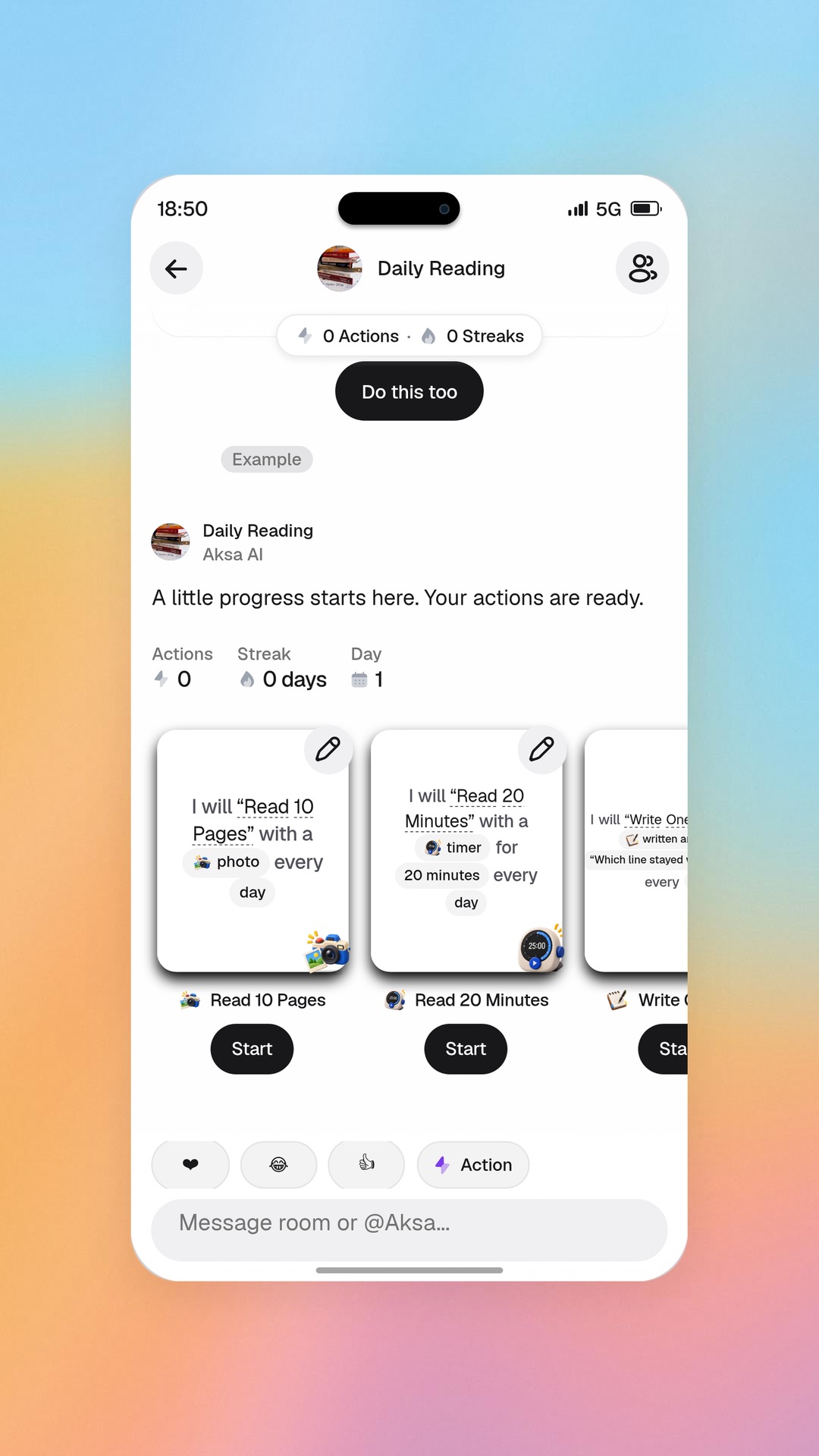
Operationalize it with a floor: the two-minute version of your daily action, written down, that always counts. On Aksa, the daily action carries exactly this floor - 'one timer block,' 'one page, proof: photo' - sized for your worst day, not your best.
The floor works because starting compounds: the ugly sentence becomes a paragraph, the ten-minute run becomes thirty. But even when it does not, the floor preserved the chain - and the chain is the asset.
Part 2: Make finishing produce immediate proof
Procrastination thrives on delayed feedback: the report matters in March, so tonight it does not. The fix is to manufacture an immediate consequence: a visible artifact the moment the work is done.
Aksa's proof ritual is exactly this: photograph the finished page, submit the timer session, write the two-sentence answer. Under a minute, and the day has a receipt. The streak counts only proof-backed days, so the receipt is the currency.
The psychological effect is disproportionate to the effort: the tiny ceremony converts 'I should have worked today' into 'today produced this' - and days that produce things are addictive in the good way.
Part 3: Add witnesses - the strongest lever
Private procrastination is invisible procrastination. The single strongest structural change is making the daily record visible to people you respect: the heatmap shows the gap, the feed shows the proof, and the room notices without anyone scheduling a check-in.
On Aksa this is the Action Room: a shared task list, a member consistency heatmap, a feed of the day's proofs, reactions built in. In in a company database pull from late September 2026, 36% of proofs received a social response - visible work draws a response, which closes the encouragement loop daily.
Choose witnesses deliberately: two to fifteen people, ideally working on something themselves. The audience does not need expertise in your goal; it needs to see the record.
Part 4: Install a stall alarm that is not you
Procrastination's kill shot is not the missed day - it is the missed week, when returning feels too heavy to attempt. A system that catches the stall at day two, while the restart is still small, is the difference between a wobble and an abandonment.
Aksa AI watches for stalls and nudges with one concrete next step sized to where you stopped: 'one ten-minute block, proof: photo of the page.' The restart is made smaller than the dread of restarting - which is the whole battle.
The agent cannot forgive or fake: Verified Done requires your proof. It is an alarm and a map, not a judge - which is why its nudges land as help rather than guilt.
Part 5: Reset weekly - forgive the bad week structurally
Every anti-procrastination system eventually meets the catastrophic week: illness, deadline crunch, family crisis. What happens next decides whether the system survives - a permanent hole in the record gets abandoned; a clean restart gets used.
Aksa's Weekly Arena resets leaderboards every Monday at 00:00 UTC. The bad week is archived as data; Monday starts everyone at zero. The forgiveness is structural - you do not have to grant it to yourself, which is good, because procrastinators are terrible at self-forgiveness.
The streak tells the truth (a break is a break), while the board offers the fresh start. Honesty about the past plus optimism about the week: both, deliberately.
Setups for the three classic patterns
- The big scary project - Floor: one ugly sentence or fifteen minutes; proof: photo; witness: one room.
- The boring admin pile - Floor: one item, not the inbox; proof: photo of the finished thing; cadence: daily confirm.
- The health habit - Floor: ten minutes; proof: timer or photo; witness: a room doing the same challenge.
- The study goal - Timer blocks plus a two-sentence answer; the explanation doubles as review.
- The avoidance loop (doomscrolling) - Confirm the binary day honestly; peer confirmation for stakes.
A worked example: the thesis that got unstuck
The pattern: eight weeks of 'work on thesis tomorrow.' The conversion: 'fifteen minutes, floor, proof: photo of the paragraph count.' Room: two other stalled thesis-writers, mutual visibility, zero commentary agreement.
Day one produced one ugly paragraph. Day four produced a real page. Day nine - the crash - produced nothing, and the room saw it, and said nothing, and day ten restarted at the floor because the restart was smaller than the shame.
Week twelve: 61 proof-backed days, three chapters drafted. The thesis was never the problem - the unpriced start and the free skip were. Both prices moved, and the work followed.
Setup checklist
- One goal - the one that embarrasses you most.
- Floor action: two to fifteen minutes, always counts, written down.
- Proof ritual: under a minute, attached to the action.
- Witnesses: one room, two to fifteen people, posting tonight.
- Stall protocol: after any miss, floor action the same day.
- Weekly review: ten minutes Sunday, heatmap open, adjust the floor.
FAQ
How do I stop procrastinating and get things done?
Fix the two prices: shrink the first step until it is trivial (a two-minute floor that always counts), make finishing produce immediate visible proof, put the proof where friends see it, and review weekly. Procrastination is expensive starts plus free skips - move both prices and the behavior follows.
Why do I procrastinate even on things I care about?
Because caring raises the stakes, and high stakes raise the cost of starting - fear of doing it badly. The fix is a floor so small it is beneath the fear: one ugly sentence, ten minutes. Caring is the fuel; the oversized first step is the wall.
Do apps help with procrastination?
The right kind: apps that lower initiation cost (tiny actions), create immediate feedback (proof), add witnesses (rooms) and catch stalls early (an agent's nudge). The wrong kind - another private list - adds a second task to avoid. Aksa is built around the first set, free on iOS and Android.
What is the two-minute rule for procrastination?
Scale the task down to a two-minute version - open the document, put on running shoes - and do only that. Starting compounds: the tiny version usually becomes the real session, and when it does not, you kept the chain. On Aksa, the floor action formalizes exactly this.
How do I restart after weeks of procrastinating?
At the floor, today, not Monday: the smallest provable version, witnessed by someone. Aksa's agent nudges with one sized step when you stall, and the weekly leaderboard reset (Mondays 00:00 UTC) forgives the bad stretch structurally. Restart tiny and immediately - the mourning gap is procrastination's second act.
Is procrastination laziness?
No - procrastination is avoidance driven by the immediate costs: ambiguity, boredom, fear of a bad result. Lazy people do not feel bad about skipping; procrastinators suffer through it. The distinction matters because the fix is structural (cheaper starts, visible work), not moral.
Can friends help me stop procrastinating?
Witnesses are the strongest external lever: when your daily record is visible - a shared heatmap, a proof feed - skipping carries a small daily social cost. Pick two to fifteen people who post their own work; their consistency calibrates yours upward without a single lecture.
How long until the anti-procrastination system sticks?
Expect two deliberate weeks, a fragile middle (weeks three to six) where the room and the streak carry you, and a shift around weeks six to ten where starting becomes the default. The floor must survive the fragile phase - that is what it is for.
What should I do in the first hour of starting this system?
Twenty minutes of setup, then one floor action today: pick the goal, write the floor (two to fifteen minutes), choose the proof format, create or join a room, and post tonight's proof before bed. Starting tonight beats starting perfectly - the chain begins with one ugly, witnessed day.