

What Is a Social Platform for Goals? (2026 Explainer)
A social platform for goals lets you work on a goal in view of other people, with proof, feedback and shared progress. The definition, how it differs from private trackers and social media, and how Aksa implements the model.
Published October 2, 2026 · Updated October 22, 2026 · 7 min read
The definition
A social platform for goals is an app where people work on goals in view of other people. It combines a way to do and record the work with a way for others to see it, respond to it and join in - the social layer is part of the product, not an add-on.
The category sits between two familiar things: private habit trackers, which record work nobody sees, and social media, which shows life without requiring any work. A social platform for goals borrows the record from the first and the audience from the second, and welds them: what you share is what you did.
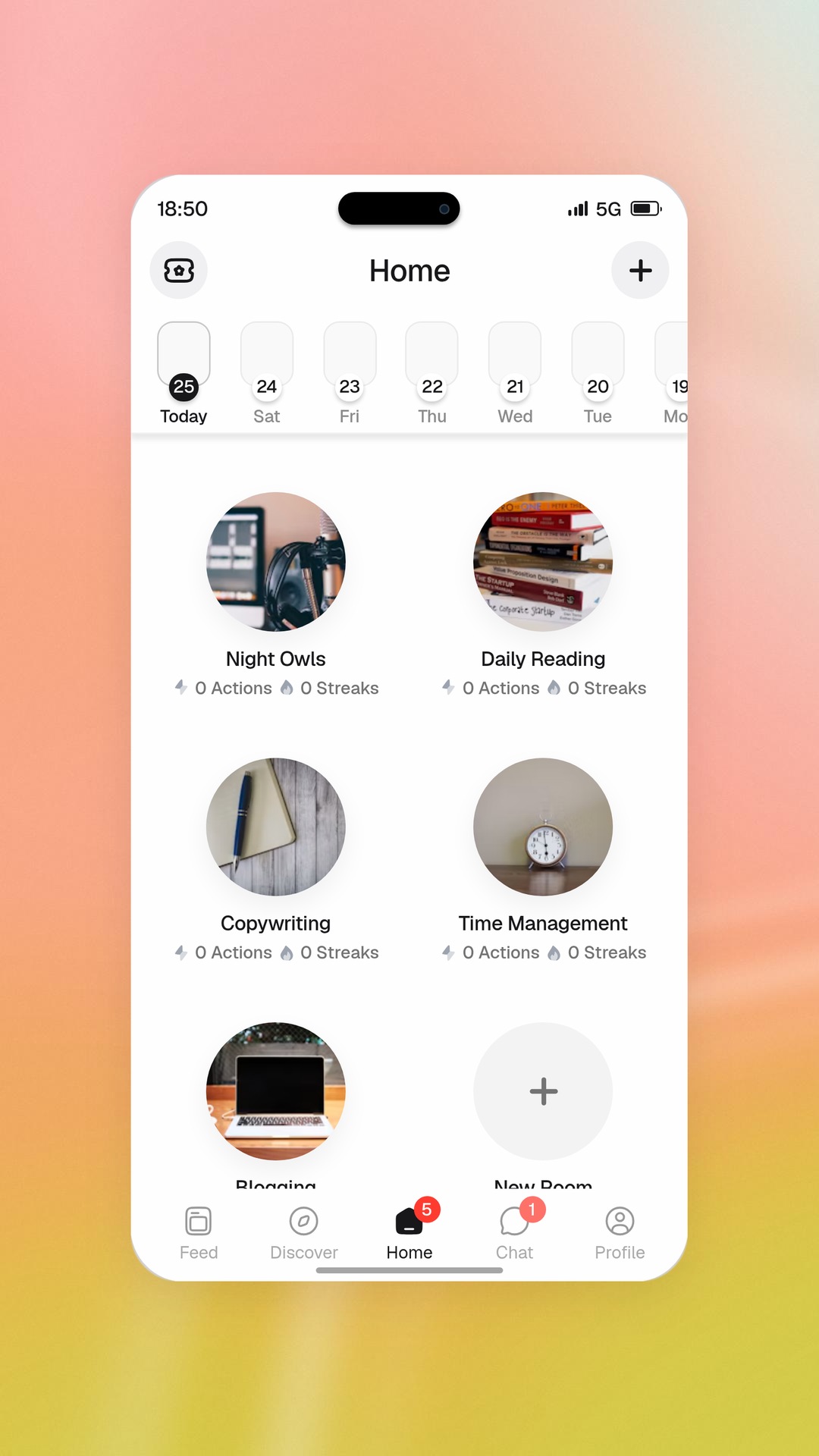
Aksa is a social platform with an AI agent built on exactly this model - goals decomposed into daily actions, actions finished with proof, proofs visible in rooms and feeds where other people respond.
How it differs from a private tracker
A private tracker is seen only by you. It records honestly and motivates nobody but you - which is precisely its failure mode: when motivation dips, there is no external reason to open the app, and the streak dies in private the way it lived.
A social platform adds the feed, the rooms, the relationships and the shared sense of who is showing up. In Aksa, the Social surface covers the feed, the inbox, action rooms, interactions, relationships, discovery and the weekly podium - the infrastructure of being seen.
The difference is not cosmetic. Visibility changes the cost of skipping: a private skip costs nothing anyone will ever know; a visible skip is a gap on a heatmap your room can see. That asymmetry - not willpower - is what keeps streaks alive.
How it differs from social media
Social media distributes attention; a social platform for goals distributes accountability. The feed on social media rewards what is interesting; the feed here rewards what is done. The unit of content is not a post but a proof.
The incentives point the opposite way, too. Social media profits from your scrolling; a goals platform succeeds when you close the app and go do the thing. The product's center of gravity is the action, with the social layer wrapped around it as support.
And the honesty rules differ. A highlight reel is the norm on social media; on a goals platform, the record's value depends on it being complete - misses included - because the people watching are using your record to calibrate their own.
What the social layer does in Aksa
The social layer makes action visible, supported and repeatable. Members follow a For You feed or a Following feed, join public or private rooms, chat, react to each other's claims and see rankings on the weekly boards.
The moments are designed around work, not noise: a notification goes out when a member completes a milestone so others can cheer - recognition arrives attached to an achievement, not to engagement bait. The company reports a 36% social response rate among active users, meaning visible work draws reactions often enough to keep the loop warm.
Rooms are the social unit: a shared goal, a member heatmap, a feed of the day's proofs, and a weekly leaderboard that resets every Monday at 00:00 UTC. The podium each week becomes winner spotlight cards - recognition you can post outside the app.
Where the AI agent fits
A social platform for goals has two kinds of support: people who see you, and a system that knows your plan. Aksa's AI agent is the second kind - it helps decompose a goal into daily actions at the start, and notices when you stall.
The agent's check-in is concrete: not 'how are you feeling about your journey' but one next step sized to where you stopped. The social layer supplies the witnesses; the agent supplies the nudge - the two cover different failure modes.
This pairing is what separates the category from both pure trackers (record without support) and pure communities (support without record). The work, the witness and the nudge live in one place.
None of the three mechanisms requires willpower from you or effort from your friends. That is the design bet: motivation fluctuates, but architecture persists - a platform that prices skipping correctly, closes the reciprocity loop, and resets weekly keeps working on the days you do not feel like it.
Who it is for - and who it is not for
It is for people whose goals die in private: the runner who quits every February, the student whose notes stop after week two, the side-project builder with four abandoned repos. The common thread is not laziness - it is that nothing outside their own head noticed the stopping.
It is also for groups who want structure around a shared push: friends running a 30-day challenge, a class building a study habit, a team shipping weekly. The room gives the group a home with rules, a record and a scoreboard.
It is not for goals that need privacy above all - some work should stay solo, and Aksa supports private solo goals for exactly that. And it is not for people who want an audience without the work: the proof requirement filters that out by design.
A day on a social platform for goals
Morning: the room's heatmap already shows two finished workouts from friends in earlier timezones - the day's ambient pressure arrives before your alarm-snooze debate ends. Your own task list is short: three actions, each with a proof format attached.
Evening: the run becomes a photo, the study block becomes a timer session with a one-line answer, the avoidance rule becomes a confirmation. Each proof lands in the room feed; two reactions arrive before dinner; someone's milestone notification pings the room and you cheer back.
Week's end: the leaderboard resets Monday, last week's podium posted their spotlight cards, and your own heatmap shows six green cells out of seven - with the gap visible, dated and already scheduled for redemption. That loop - work, witness, reset - is the entire product category in one week.
Why the model works: the three mechanisms
Witness: behavior changes when it is observed. The heatmap and feed make skipping visible, which prices it correctly - the mechanism costs nobody any effort.
Reciprocity: you cheer because you were cheered. Reactions to proofs close a loop that private tracking never opens.
Renewal: weekly resets mean a bad week is an event, not an identity. Platforms without a reset let one failure compound into abandonment; with one, every Monday is a fresh leaderboard and a legitimate reason to restart.
FAQ
What is a social platform for goals?
An app where people work on goals in view of other people - combining a way to do and record the work with a way for others to see it, respond to it and join in. The social layer is part of the product, not an add-on. Aksa is a social platform with an AI agent built on this model.
How is a goals platform different from a habit tracker?
A private tracker is seen only by you; a social platform adds feeds, rooms, relationships and a shared sense of who is showing up. Visibility changes the cost of skipping - a private skip is free, a visible skip is a gap on a heatmap your room can see. That asymmetry keeps streaks alive.
How is it different from social media?
Social media distributes attention; a goals platform distributes accountability. The unit of content is proof, not posts - the feed rewards what is done, not what is interesting. The product succeeds when you close the app and go do the work, the opposite of engagement-driven design.
What does Aksa's social layer include?
The feed (For You and Following), the inbox, action rooms, interactions, relationships, discovery and the weekly podium. Members join public or private rooms, chat, react to each other's claims, and get notified when a member completes a milestone.
What does the AI agent do on a goals platform?
It is the second kind of support: people witness you; the agent knows your plan. It helps decompose goals into daily actions and notices stalls, nudging with one concrete next step. The social layer supplies witnesses, the agent supplies the nudge - different failure modes, one place.
Who should use a social platform for goals?
People whose goals die in private, and groups running shared pushes - 30-day challenges, study habits, team shipping. Not for goals needing full privacy (Aksa supports solo goals for that) and not for audiences without work - the proof requirement filters that out.
Why do weekly resets matter?
They turn a bad week into an event instead of an identity. Without a reset, one failure compounds into abandonment; with one - Aksa's leaderboards reset Mondays at 00:00 UTC - every Monday is a fresh board and a legitimate restart. Renewal is one of the three mechanisms (witness, reciprocity, renewal) that make the model work.
Is my goal public on a social platform for goals?
No - visibility is scoped. Rooms can be public or private, and solo goals stay private to you alone. The social layer is a tool you point at the goals that benefit from witnesses, not a floodlight over everything you do.