

What Is Verified Done? Why a Checkbox Is Not Proof (2026)
Verified Done means a task has durable proof and has passed its verification rule - never inferred from an AI reply or a ticked box. The definition, the action lifecycle, and why honest completion states matter.
Published October 2, 2026 · Updated October 22, 2026 · 7 min read
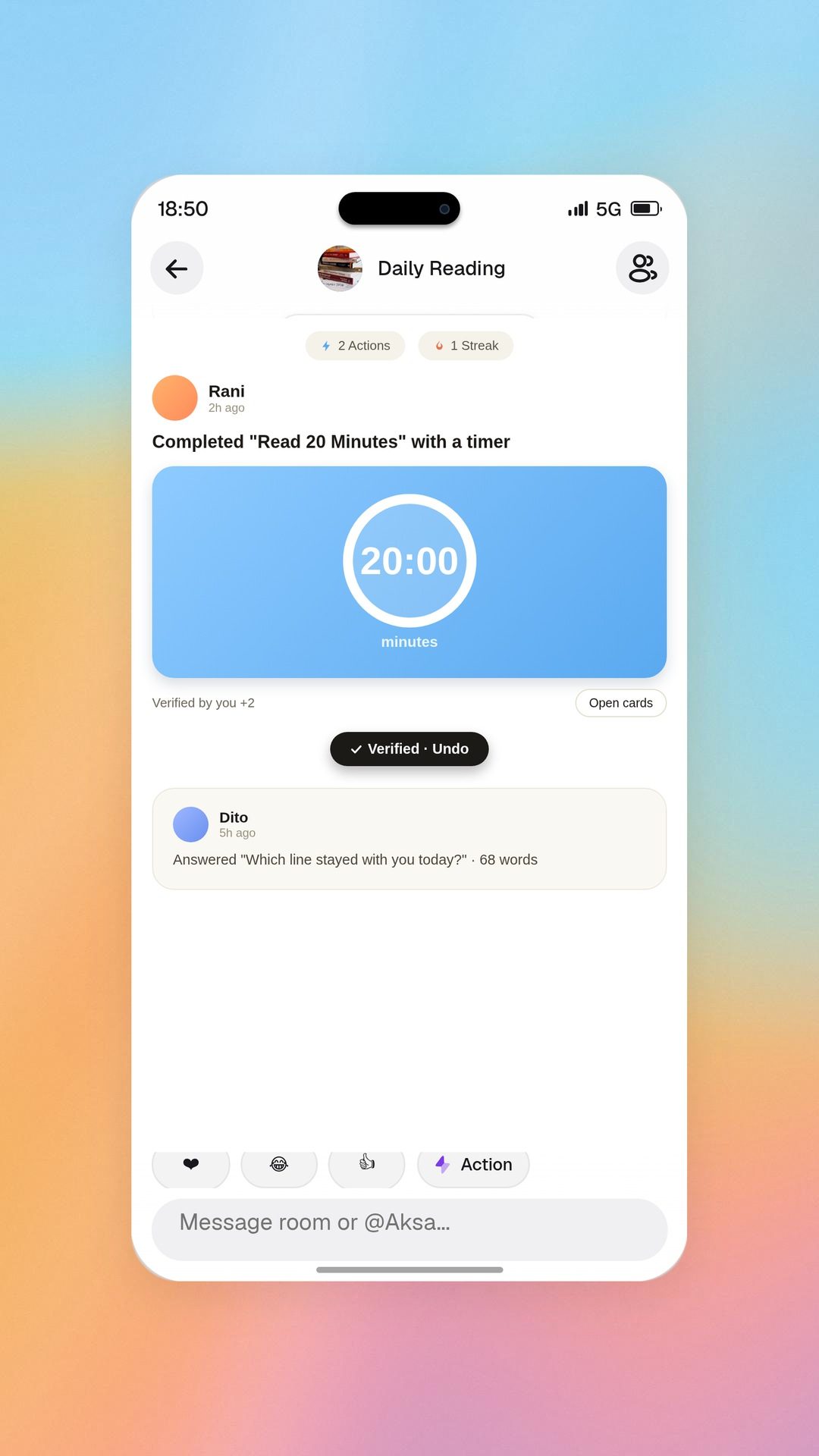
Verified Done, defined
Verified Done is the final state of an action in Aksa. An action reaches it only when two things are true: there is durable proof, and the verification rule for that action has been met.
Two things explicitly do not trigger it: an AI response and a checked item in the interface. Completion is never inferred from what the agent said or what the UI shows as ticked - only from evidence that survives scrutiny.
The definition sounds strict because it is meant to be. A completion state that can be reached without work is a completion state nobody - including you - can use for anything real.
This guide covers the definition, the lifecycle an action travels to get there, who and what verifies, and why the strictness is the feature - because a completion state that can be faked is worse than none at all.
The path to Verified Done: the action lifecycle
Aksa treats an action as a persistent workflow, not a disposable task row. Each action keeps its desired outcome, owner and collaborators, current state, relevant context, blockers, approvals, activity history and proof.
The minimum lifecycle runs: Proposed - the action is suggested and scoped. Accepted - someone owns it. Running - work is underway. Blocked or Approval Needed - something is in the way and the action says so. Proof Submitted - the evidence is in. Verified Done - the proof holds and the verification rule is met.
The lifecycle's value is honesty about the middle states. 'Blocked' and 'Approval Needed' are first-class states, not silent stalls: an action that cannot move says why, which turns vague anxiety about progress into a specific thing to fix.
Why a checkbox is not proof
A checkbox records an interaction: at some point, someone tapped. It says nothing about the world - whether the run happened, whether the page was written, whether the call was made. The tap and the work are different events, and only one of them matters.
Checkbox completion degrades predictably: week one, you tap honestly; week three, you tap to protect the streak; week six, the app says you have a 40-day chain of work you mostly did not do. The record did not lie maliciously - it just never asked for anything real.
Verified Done closes that gap by requiring the durable artifact: the photo, the written answer, the timer session, the witnessed confirmation. The state is a conclusion drawn from evidence, not a button press.
Who verifies - and what the rules look like
Verification is rule-based and per action, not vibes-based and global. Each action's rule matches its proof type: the photo action checks that a real photo arrived; the counter action checks the number against the target; the timer action checks that a session ran and ended properly.
The AI agent plans, operates, verifies and keeps momentum - without replacing human control. It may adapt the next step and coordinate support within granted permissions, but it never infers completion from its own responses. The agent assists the workflow; the evidence decides the state.
The honesty labels apply throughout: hand-entered counts stay unverified, device-read totals are device-reported and never tamper-proof, and weak or missing evidence is never upgraded into verified proof. Verified Done is only as meaningful as the strictness that guards it.
Why durable matters: proof you can audit later
Durable means the proof persists and stays reviewable - attached to the action, in the activity history, visible on the progress surfaces. A completion state you cannot inspect later is a rumor with a timestamp.
Durability is what makes the record useful months on: the portfolio review, the streak audit, the coach or partner asking 'show me March.' Verified Done days come with their evidence; checkbox days come with nothing.
It also protects the record from the most dangerous auditor - future you. Six months from now, the question 'did I really do the work?' deserves an answer with artifacts, not a green checkmark and a shrug.
What this changes in practice
For individuals: the streak becomes believable. Every counted day has evidence behind it, so protecting the number and doing the work are the same action - the corruption path that kills checkbox streaks does not exist.
For groups: comparison becomes fair. A room leaderboard built on Verified Done ranks work, not tapping speed - which is what makes the weekly podium, and the spotlight cards it produces, worth anything.
For the AI agent: trust becomes possible. An agent that can see real completion states - not inferred ones - can give useful nudges: it knows the difference between 'stalled at Running' and 'done,' because the difference is evidence, not guesswork.
The boundary that keeps the whole system honest
Aksa's monetization boundary states it directly: paid cosmetics may decorate identity and share surfaces, but should not buy Rank or verification. The completion state is not for sale - a paid theme can change how your profile looks, never what your record says.
This boundary is what makes Verified Done usable as a social signal. The moment verification could be bought, every verified day becomes suspect and the entire economy of witnessed effort collapses - rooms, streaks, leaderboards, all of it priced in a currency that was just debased.
So the strictness is not a feature checklist item; it is the foundation. Durable proof, per-action rules, no inference from AI replies, no purchase path to the state - remove any one and 'done' quietly stops meaning done.
A worked example: one action through the lifecycle
Proposed: the agent suggests 'draft the project proposal, one page minimum' as tomorrow's action toward the launch goal. Accepted: you take it, and it appears on your list with its proof rule attached - a written answer summarizing the draft.
Running, then Blocked: Tuesday goes sideways; at 9 PM you mark the blocker - 'waiting on the budget figure from finance.' The action does not silently rot; it says why it is stuck, and the agent's next nudge is specific: get the figure, or write the page around the gap.
Proof Submitted, then Verified Done: Wednesday, the figure arrives, the page gets written, the answer is submitted - 'draft done, one page, budget table included pending final numbers.' The rule checks: durable proof present, requirement met. The state flips - and the flip means something, because it could not have happened by tapping.
FAQ
What is Verified Done?
The final state of an action in Aksa, reached only when durable proof exists and the action's verification rule has been met. It is never inferred from an AI response or a checked item in the interface - completion is a conclusion drawn from evidence, not a button press.
Why is a checkbox not proof?
A checkbox records a tap, not the work. Honest tapping degrades into streak-protecting tapping within weeks, producing chains of 'done' days that never happened. Verified Done requires the durable artifact - photo, answer, timer session, witnessed confirmation - so the state always points at evidence.
What is the action lifecycle in Aksa?
Proposed, Accepted, Running, Blocked or Approval Needed, Proof Submitted, Verified Done. An action is a persistent workflow keeping its outcome, owner, state, context, blockers, approvals, history and proof - so middle states like Blocked are named and visible instead of silent stalls.
Can the AI agent mark something as done?
No. The agent plans, operates, verifies and keeps momentum within granted permissions, but completion is never inferred from an AI response. The agent assists the workflow; the evidence decides the state. Human control is not replaced. That separation matters most exactly when you are tired: the agent can remind, adapt and coordinate, but it cannot forgive - only evidence moves the state.
What counts as durable proof?
Evidence that persists and stays reviewable: a photo, a written answer, a recorded count, a timer session, a check-in, a confirmation - attached to the action's history. Labels stay honest throughout: hand counts unverified, device totals device-reported, weak evidence never upgraded to verified.
What is a verification rule?
The per-action requirement matched to its proof type: the photo action checks a real photo arrived, the counter action checks the number against target, the timer action checks the session ran and ended properly. Verified Done requires both durable proof and the rule being met.
Why do Blocked and Approval Needed exist as states?
So stuck work says why it is stuck. A named blocker turns vague progress anxiety into a specific fixable thing, and lets the agent's nudge be concrete ('get the figure or write around it') instead of generic. Silent stalls kill goals; named blockers get resolved.
How does Verified Done affect streaks and leaderboards?
Streaks count proof-backed days, so the number always measures work. Room leaderboards rank verified work rather than tapping speed, which keeps comparison fair - and makes the weekly podium and its winner spotlight cards mean something to the people earning them.
What happens to my proof after Verified Done?
It stays durable: attached to the action, kept in the activity history, and visible on the progress surfaces - the heatmap, completion history and momentum chart. The evidence is reviewable months later, which is what makes audits, portfolio reviews and your own 'did I really do the work?' answerable with artifacts instead of memory.